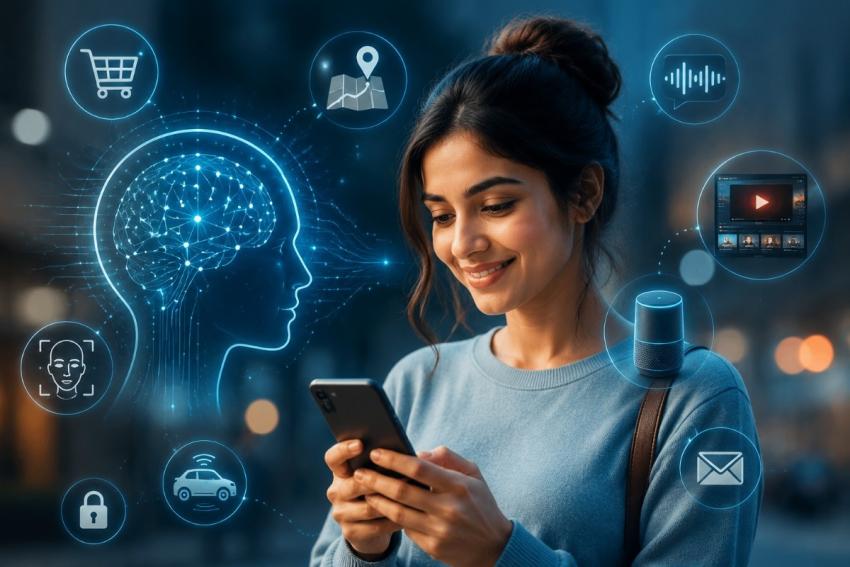
Chances are you've bumped into artificial intelligence a dozen times today already, and you probably didn't notice. Forget the humanoid robots and sci-fi movie tropes for a second; most AI today isn't flashy at all. It's quietly humming away in the background of your phone, your streaming apps, and the websites you scroll through without a second thought.
Once you know where to look, it's honestly a little eye-opening how much of your day is shaped by algorithms working behind the scenes. Below are ten everyday examples worth knowing about.
1. Personalized Streaming Recommendations
Ever feel like Netflix, Spotify, or YouTube knows your taste better than your own friends do? That's not a coincidence. When your video app queues up a new show or your music app builds you a playlist for the week, there's a fair amount of number-crunching happening behind the curtain.
These platforms look at what you've watched, which songs you've skipped, how long you lingered on a particular title, and even what people with similar tastes tend to enjoy. Stack up millions of these little data points, and the models get sharper and sharper at guessing what you'll want next.
2. Navigation Apps and Real-Time Traffic Prediction
Google Maps and Apple Maps aren't just reading off a satellite image when they tell you your arrival time; there's a lot more going on. These apps pull live GPS signals from thousands of drivers on the road at the same moment you're checking your route.
From there, machine learning models weigh that live data against historical traffic patterns, construction updates, and even the weather. The result: the app can often spot a slowdown before it fully forms and reroute you around it.
3. Email Spam and Phishing Filters
Your inbox stays (mostly) clean thanks to classification systems working around the clock. Old-school spam filters were pretty basic; block this sender, flag anything with the word "lottery." Today's filters are a lot smarter.
They dig into the message's structure, where the links actually lead, the header details, even the tone of the language used. And every time you hit "mark as spam," you're feeding the model a little more information, which makes it better at catching junk for everyone else too.
4. E-Commerce Product Recommendations
Amazon and similar platforms lean heavily on recommendation engines to boost sales and make shopping easier. That "Frequently Bought Together" section you see on a product page? That's market basket analysis at work.
The system combs through mountains of past purchases looking for patterns. If enough people who buy a certain phone case also grab a screen protector, the algorithm starts pairing those two automatically for the next shopper browsing that same phone.
5. Smartphone Facial Recognition
From there, machine learning studies the geometry, distances between features, contours, the works, so your phone still recognizes you even with new glasses, a haircut, or dim lighting. If terms like "computer vision" and "neural networks" are new to you, this beginner's guide to AI and machine learning is a good place to get up to speed before reading on.
6. Predictive Text and Auto-Correct
That little word bubble popping up as you type isn't just fixing typos anymore. Modern keyboards read the whole sentence to figure out what you're likely trying to say.
Natural Language Processing (NLP) models predict your next word based on how people generally talk, plus your own habits. The longer you use it, the better it gets at picking up your slang, your go-to phrases, and your particular way of texting.
7. Fraud Detection in Digital Banking
Every time you swipe a card, an AI system is quietly checking that transaction in the blink of an eye. It's comparing the purchase against your usual patterns: where you shop, how much you typically spend, what kind of merchant it is, what time of day it is.
So if your card suddenly gets used for a big electronics purchase overseas while you're sitting at home, the bank's system catches it, blocks it, and pings you almost instantly.
8. Smart Home Voice Assistants
Alexa, Siri, and Google Assistant all rely on speech recognition to turn your words into action, and a surprising amount is happening in that split second after you speak.
First, background noise gets stripped out. Then NLP steps in to parse what you actually meant. Finally, the assistant reaches out to the right app or device to play your song, set your timer, or dim the lights.
9. Rideshare Price Adjustments and Driver Matching
There's a lot more going on behind an Uber or Lyft booking than just "find the nearest driver." The app is constantly predicting arrival times, adjusting prices based on demand in your area, and sometimes grouping riders together for shared trips.
During busy hours, these systems nudge pricing up or down to pull drivers toward the neighborhoods that need them most; a balancing act happening thousands of times a minute.
10. Social Media Content Moderation
With billions of posts going up every single day, there's simply no way human moderators could review it all by hand. That's where automated systems step in, scanning content the instant it's uploaded.
Computer vision checks images for anything unsafe, while text-analysis tools hunt for hate speech, harassment, or misinformation. It's not a perfect system, but it takes a huge amount of pressure off human moderation teams and helps platforms hold the line on their community standards.
How Understanding Everyday AI Shapes Career Paths
Once you start noticing AI in the tools you already use, it stops feeling like some abstract, futuristic concept. Every recommendation engine, every fraud alert, every rerouted drive; someone built that. Software engineers, data professionals, and algorithm specialists are behind all of it.
If you're weighing a move into tech, seeing how these systems actually work in daily life is a great way to figure out which skills are worth your time. Programming, data handling, and algorithmic thinking are a solid foundation no matter which direction you go.
Educational platforms like SkyllX build their courses around real-world projects, so learners aren't just memorizing theory; they're seeing how it plays out in practice. Pairing solid technical fundamentals with hands-on training makes the jump into data analytics, software development, or AI a lot less intimidating.