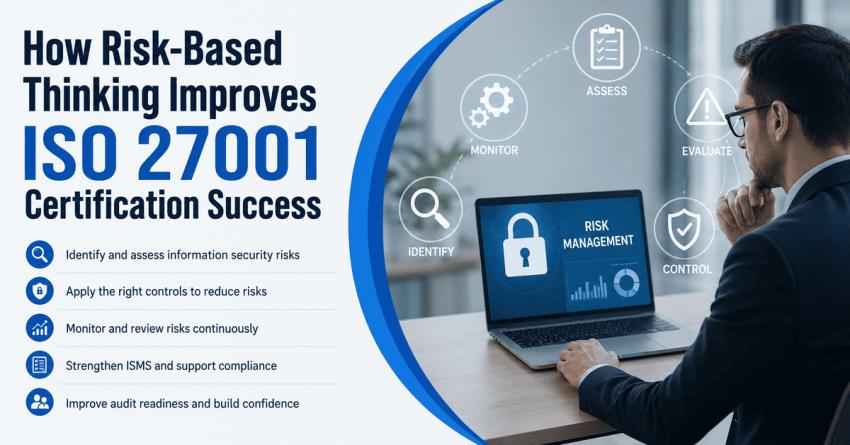
Achieving ISO 27001 certification requires more than implementing security controls and preparing documents. Organizations that successfully achieve and maintain certification integrate risk-based thinking throughout their Information Security Management System (ISMS). This proactive approach helps identify potential threats, assess risks, and implement effective controls before security issues impact business operations, improving compliance and long-term information security performance.
What Is Risk-Based Thinking in ISO 27001?
Risk-based thinking is a proactive approach that focuses on identifying, evaluating, and treating information security risks. ISO 27001 requires organizations to understand internal and external issues, identify risks to information assets, and implement controls that reduce those risks to an acceptable level.
This approach enables organizations to prioritize resources based on the likelihood and impact of security threats rather than applying the same controls to every process. As a result, businesses can improve operational resilience while ensuring compliance with ISO 27001 requirements.
Why Risk-Based Thinking Is Important for ISO 27001 Certification
Risk-based thinking forms the foundation of an effective ISMS. Certification auditors expect organizations to demonstrate that risks have been identified, evaluated, monitored, and reviewed regularly.
Organizations that effectively implement risk-based thinking can:
- Identify vulnerabilities before they become security incidents.
- Allocate resources to the most critical information security risks.
- Improve compliance with ISO 27001 requirements.
- Support continual improvement of the ISMS.
- Increase stakeholder and customer confidence.
- Reduce the likelihood of audit nonconformities.
A structured risk management process strengthens audit readiness and supports successful certification outcomes.
Practical Ways to Apply Risk-Based Thinking
Organizations can integrate risk-based thinking throughout their ISO 27001 implementation by following these best practices:
Identify Information Assets
Prepare an inventory of information assets, including hardware, software, databases, cloud services, business processes, and confidential information. Understanding what needs protection is the first step in effective risk management.
Perform Risk Assessment
Evaluate threats, vulnerabilities, existing controls, and potential business impacts. A systematic risk assessment helps determine which risks require immediate treatment and which can be accepted based on organizational criteria.
Implement Appropriate Controls
Select security controls that effectively reduce identified risks. Controls may include access management, encryption, incident response procedures, employee awareness training, backup processes, supplier security controls, and physical security measures.
Monitor and Review Risks
Regularly reviewing risk assessments and treatment plans helps organizations address changing cybersecurity threats and business requirements.
Maintain Documented Information
Proper documentation provides evidence of effective risk management activities and simplifies internal and external audits.
Organizations looking to reduce implementation time can use professionally developed ISO 27001 documents that include manuals, procedures, policies, templates, forms, and records aligned with ISO 27001 requirements. Comprehensive ISO 27001 documents help organizations establish a structured ISMS while ensuring consistency across all documented processes.
Common Mistakes to Avoid
Many organizations experience delays in certification because they:
- Perform incomplete risk assessments.
- Fail to update risk registers regularly.
- Select controls without proper risk evaluation.
- Maintain outdated ISMS documentation.
- Ignore emerging cybersecurity threats.
- Treat risk assessment as a one-time activity instead of an ongoing process.
Many organizations experience certification delays because of incomplete risk assessments, poor documentation, and weak ISMS implementation. These are some of the common reasons for ISO 27001 certification failure that organizations should address to improve their chances of successful certification.
Avoiding these mistakes improves audit readiness and supports continual compliance.
Conclusion
Risk-based thinking is not only an ISO 27001 requirement but also a practical approach that strengthens information security and improves business resilience. By identifying risks early, implementing effective controls, maintaining accurate ISO 27001 documentation, and continuously improving the ISMS, organizations can increase their chances of successful ISO 27001 certification. A structured risk management approach helps streamline implementation, reduce audit findings, and build confidence among customers, regulators, and business partners.