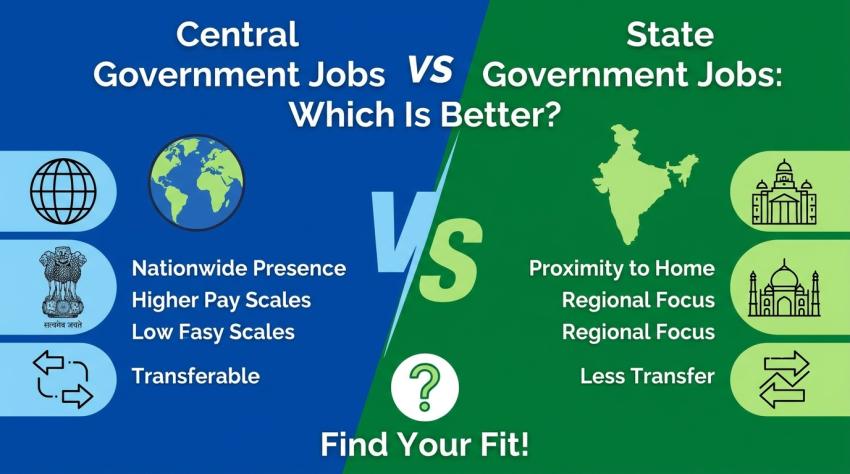
Job security, salary, career growth, and benefits at the time of retirement are among the reasons why government jobs are among the most preferred ones in India. Every year, lakhs of candidates prepare for competitive exams of Central Government organization and various State Governments. But many candidates have one question in their mind that if should they prepare for Central Government Jobs or State Government Jobs?
The factors that determine this are your career goals, language of preference, posting location, salary expectations and promotion opportunities. The difference between these two sectors can help candidates make the right decision and plan the appropriate preparation.
What Are Central Government Jobs?
Jobs in the Central Government are provided by departments, ministries, and institutions which function under the Government of India. Recruitment is done via national level organizations, and thus individuals from all over the country have an opportunity to apply for these positions.
Some of the recruiting organizations are:
Staff Selection Commission (SSC)
Union Public Service Commission (UPSC)
Railway Recruitment Boards (RRBs)
Institute of Banking Personnel Selection (IBPS)
State Bank of India (SBI)
Intelligence Bureau (IB)
Defence organizations
Central Armed Police Forces (CAPFs)
Tax Department
Central Secretariat Services
Such jobs generally provide job opportunities across India.
What Are State Government Jobs?
Jobs in the State Government come from the various departments that work under their respective State Governments. The recruiting process can be done through State Public Service Commission, State Staff Selection Board, State Police Recruitment Board, State Education Department, State Revenue Department, State Health Department, and other state bodies.
These include:
State PSC Civil Services
State Police Recruitment
State Education Department
State Revenue Department
State Municipal Services
State Electricity Boards
State Transport Departments
State Health Services
State Cooperative Departments
Eligibility
Recruitment is done by both Central and State Government with varied educational qualifications for aspirants.
The eligible candidates are:
Class 10 pass
Class 12 pass
ITI certificate holders
Diploma holders
Graduate candidates
Engineering graduates
Postgraduates
Professional degree holders
The age limits generally vary from 18 to 32 years. Upper age relaxation is given for reserved categories as per government guidelines.
Central Government Jobs vs State Government Jobs
Feature
Central Government Jobs
State Government Jobs
Recruitment Level
National
State
Competition
Very High
Moderate to High
Posting
Anywhere in India
Mostly within the state
Salary
Generally Higher
Varies by state
Language Requirement
Hindi/English
State language often required
Promotion
Structured national hierarchy
Depends on state service rules
Transfer
Frequent nationwide transfers
Mostly within the state
Pension & Benefits
Central Government rules
State Government rules
Examination Language
Mostly Hindi & English
Regional language available
Salary Comparison
Central Government employees are usually paid according to the 7th Central Pay Commission along with perks like:
Dearness Allowance (DA)
House Rent Allowance (HRA)
Travel Allowance (TA)
Medical facilities
Pension perks
Leave Travel Concession (LTC)
While state government salaries depend on the individual state’s pay scale. There are some very prosperous states that pay nearly similar salaries as the Central Government employees; whereas, there are some states that pay comparatively low salaries.
Generally speaking, the salaries in the Central Government are more standardized.
Job Security
The Government jobs in both the Central and State Governments offer job security of high order.
The perks usually include:
Permanent employment
Regular salary
Medical benefits
Paid leave
Pension or retirement benefits (as applicable)
Promotion opportunities
Departmental examinations for career growth
Job security is about equal in both the streams.
Promotion Opportunities
Organizations in the Central Government normally have defined promotion policies, regular departmental exams, and career advancements across the country.
Promotions in State Governments rely on:
Department
State policies
Seniority
Vacancy availability
Performance
The process of promotion can vary widely from one state to another.
Work Location
The candidates are advised to think well on the places of their desired work before selecting any of the two.
Central Government Jobs
We accept posts from all over India.
Frequent transfers possible
Applicants who are willing to relocate are welcome to apply
State Government Jobs
Posting within the state
Less frequent transfers
Better for candidates wishing to stay close to home
Language Requirements
One of the main differences is language.
Typically, the Central Government exams employ:
English
Hindi
For many state jobs, a person must be able to read, write and speak the regional language.
All aspirants who are preparing for the State Government posts should verify the language criteria given in the notification.
Competition Level
The competition in Central Government exams is much higher as people from all over India apply for them.
Examples include:
UPSC Civil Services
SSC CGL
SSC CHSL
RRB NTPC
IBPS PO
SBI PO
State Government exams are open only to those who meet the state's requirements for recruitment, but competition is fierce in larger states.
Preparation Strategy
Students aiming for Central Government jobs should use to concentrate on:
Quantitative Aptitude
Reasoning
English
General Awareness
Current Affairs
Computer Knowledge
State Government exams also focus on:
State General Knowledge
Regional History
Geography
State Economy
Local Language
State Government schemes
Which One Should You Choose?
If you like to take Central Government Jobs then:
Desire for better pay deals
Are comfortable with transfers across India
Look for job opportunities across the country
Aim for prestigious national-level services
Is able to perform in very competitive exams
If you are interested in the state government jobs then choose State Government Jobs:
Prefer working within your home state
Know the local language well
Want fewer transfers
Wish to contribute to state administration
Focus on career opportunities in their state
Candidates who are successful in both Central and State Government exams prepare both exams together as the subjects like reasoning, quantitative aptitude, current affairs, general studies have certain overlaps.
Final Thoughts
Central Government and State Government jobs are stable, have decent pay, good benefits and a future. The choice will be determined by the nature of your profession, the desired place of work, language skills, and willingness to move. You don't have to choose between the two, it increases your odds of success if you get ready for both. By following the steps of checking official recruitment notification, making a study plan and practicing previous years question papers timely, you can easily get your desired Government jobs and can build your successful career in the public sector.