Every parent dreams of giving their child a bright future. For families in West Bengal's rural areas, that dream often begins with education—but financial struggles can make school seem out of reach. The good news is that help is available. Whether through government initiatives or the dedicated work of nonprofit organizations, there are clear pathways to free education support for poor children in West Bengal. This guide explains exactly how families can access these opportunities, what programs exist, and how to navigate the application process with confidence.
Understanding Free Education Programs in West Bengal
What Support Is Available for Rural Families?
NGO in Durgapur for education West Bengal offers several ways for children from economically weaker families to receive free or affordable education. These programs cover not just tuition but also essentials like books, uniforms, bicycles, and sometimes even meals.
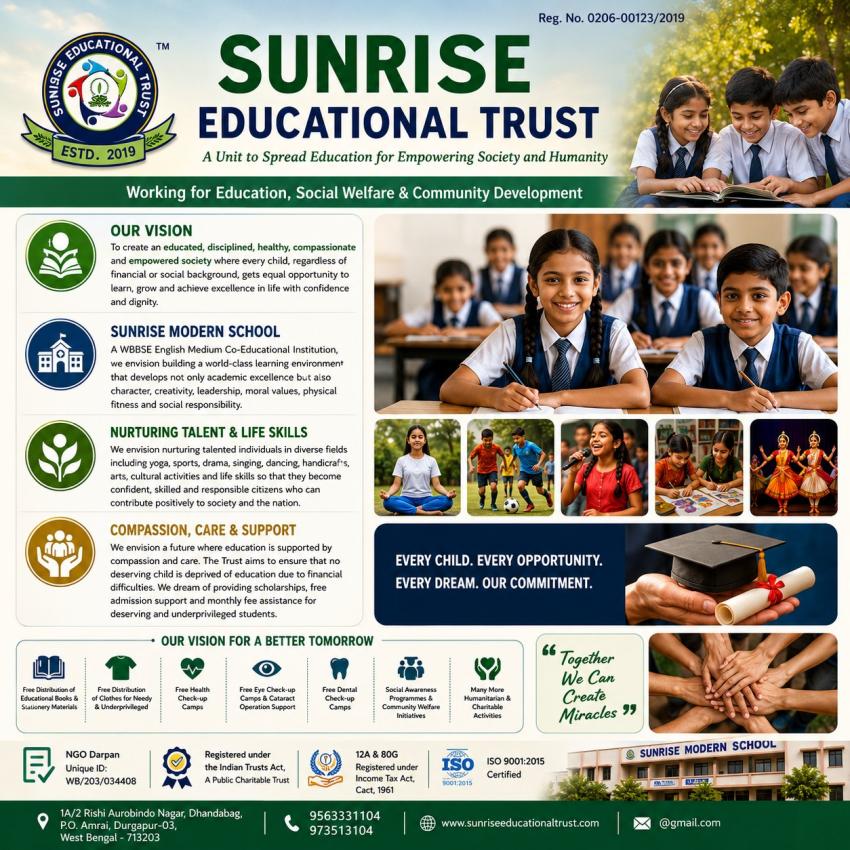
Beyond government schemes, many educational NGOs in West Bengal are making education accessible. Organizations set up learning centers in villages, offer remedial classes for struggling students, and provide scholarships to keep children in school. These NGOs often reach the most remote communities, filling gaps where government programs may not fully penetrate.
Eligibility Criteria: Who Can Apply?
Qualifying for Government Schemes
To access government free education programs, families typically need to meet certain requirements:
Residency: The child must be a permanent resident of West Bengal.
School Enrollment: Students must be enrolled in government-recognized schools, usually government or government-aided institutions.
Economic Status: Many schemes target families below the poverty line. Income certificates are often required.
Category-Based Reservations: Some programs reserve benefits for Scheduled Castes, Scheduled Tribes, and Other Backward Classes.
For parents unsure about eligibility, the easiest step is to visit the child's school and ask the principal or head teacher directly. Schools are the primary channel for distributing government benefits.
Qualifying for NGO Programs
Nonprofit organizations often have simpler and more flexible eligibility criteria:
· Families living below the poverty line receive priority
· First-generation learners are often given special consideration
· Programs may focus on specific districts or communities
· Many NGOs prioritize girl child education
Parents should contact NGOs working in their area to understand specific requirements.
Step-by-Step Guide: How to Get Free Education Support
Applying for Government Schemes
Step 1: Speak with the School
Your child's school is the gateway to most government programs. Approach the principal, head teacher, or the designated coordinator for government schemes. Ask about available programs, application timelines, and required documents.
Step 2: Gather Essential Documents
Prepare the following:
· Income certificate (issued by competent authority)
· Residence proof (ration card, voter ID, or electricity bill)
· Caste certificate (if applicable)
· Previous academic records
· Passport-size photographs
· Aadhaar card of the child and parents
Step 3: Fill Out the Application Form
Schools typically provide application forms. Complete them carefully and attach all supporting documents. Double-check for completeness before submission.
Step 4: Follow Up
After submitting, check back with the school to confirm enrollment in the program. For schemes like Sabooj Sathi, the school coordinates with district authorities for distribution.
Accessing NGO Education Support
For families in remote areas where government programs may not reach effectively, NGOs offer a lifeline. Here is how to access their support:
Step 1: Identify NGOs in Your Area
Search online, ask at the local school, or inquire at the community panchayat office. Many educational trusts have websites or contact numbers.
Step 2: Visit the Organization
Go to the NGO's office or community center. Explain your family's situation and your child's educational needs. Most organizations have staff who speak local languages and understand community challenges.
Step 3: Provide Documentation
NGOs may ask for income proof, residence details, and the child's academic records.
Step 4: Enroll in Programs
Once approved, your child can participate in free learning centers, remedial classes, or scholarship programs.
Types of Free Education Support Available
· Tuition Fee Waivers: Government schools do not charge tuition for most students, but fees can still exist in some institutions. Several programs cover these costs completely.
· Free Learning Materials: Textbooks, notebooks, stationery, and school uniforms are often provided free of cost through government schemes and NGO initiatives.
· Bicycle Support: The Sabooj Sathi scheme addresses transportation barriers, particularly for girl students.
· Mid-Day Meals: Government schools provide free midday meals to all enrolled students.
· Remedial and After-School Support: Many NGOs run learning centers offering extra classes with individual attention.
Common Challenges and How to Overcome Them
Lack of Information: Many parents do not know about available schemes. The solution is to ask at the school, talk to community leaders, and stay informed through local newspapers.
Document Hassles: Government programs require paperwork. Approach local authorities like the panchayat office for help in obtaining income and residence certificates.
Distance to School: Even with free tuition, distance remains a challenge. Bicycle schemes and community learning centers are addressing this problem.
Seasonal Migration: Some families migrate for work, disrupting schooling. NGOs with flexible programs allow children to re-enroll when they return.