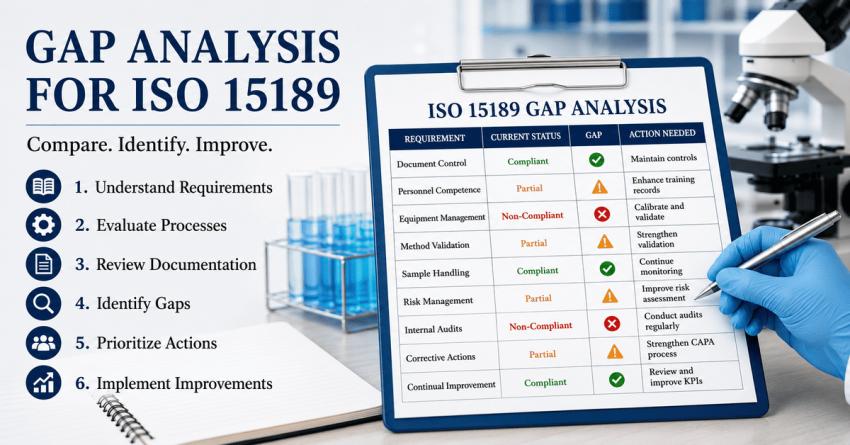
Achieving ISO 15189 accreditation is an important milestone for any medical laboratory committed to delivering accurate, reliable, and high-quality testing services. Before preparing for an accreditation assessment, laboratories should perform an ISO 15189 gap analysis to compare their existing quality management system (QMS) with the standard's requirements. This process helps identify weaknesses in laboratory processes, records, and ISO 15189 documents, allowing corrective actions to be implemented before the accreditation audit.
What Is an ISO 15189 Gap Analysis?
An ISO 15189 gap analysis is a structured evaluation of your laboratory's current practices against the requirements of ISO 15189. Its purpose is to identify missing procedures, incomplete documentation, and operational gaps that could affect compliance.
Conducting a gap analysis before the accreditation assessment saves time, reduces implementation costs, and provides a clear roadmap for improving your laboratory quality management system.
Step 1: Understand ISO 15189 Requirements
Begin by reviewing the requirements of ISO 15189 and understanding how each clause applies to your laboratory. Focus on document control, personnel competence, equipment management, method validation, sample handling, risk management, internal audits, corrective actions, and continual improvement.
Before starting the gap analysis, reviewing a sample ISO 15189 manual can help you understand the typical structure, required documentation, and quality management system elements expected during accreditation.
Using a clause-based checklist makes the review process organized and ensures every requirement is evaluated.
Step 2: Evaluate Current Laboratory Processes
Assess how your laboratory currently operates. Observe routine activities, review workflows, and interview personnel to confirm that daily practices match documented procedures.
Many laboratories find differences between actual operations and written procedures. Identifying these inconsistencies early helps prevent audit findings and improves operational efficiency.
Step 3: Review Documentation
Documentation is one of the most important parts of an ISO 15189 gap analysis. Review your quality manual, SOPs, work instructions, policies, forms, records, calibration logs, maintenance records, quality indicators, and internal audit reports.
Verify that all ISO 15189 documents are approved, current, version controlled, and consistent with laboratory practices. Incomplete or outdated documentation is one of the most common causes of nonconformities during accreditation assessments.
If your laboratory is preparing or updating its documentation, explore the ISO 15189 documents package, which includes editable quality manuals, procedures, SOPs, forms, templates, and audit checklists designed to support ISO 15189 implementation and accreditation readiness.
Step 4: Identify Compliance Gaps
Record every gap identified during the review. Common findings include missing documented procedures, incomplete competency records, inadequate equipment calibration records, weak document control, missing risk assessments, and ineffective corrective action processes.
Each finding should include the current situation, the related ISO 15189 requirement, and the corrective action needed to achieve compliance.
Step 5: Prioritize Corrective Actions
Not every gap has the same level of risk. Prioritize corrective actions based on their impact on patient safety, testing accuracy, regulatory compliance, and accreditation readiness.
Assign responsibilities, set realistic deadlines, and monitor progress to ensure corrective actions are completed effectively.
Step 6: Develop an Implementation Plan
Use the findings from the gap analysis to create an implementation plan covering documentation updates, staff training, internal audits, equipment validation, management reviews, and ongoing performance monitoring.
Maintaining accurate ISO 15189 documents throughout implementation helps ensure consistent compliance and supports continual improvement.
Conclusion
Performing a gap analysis for ISO 15189 is one of the most effective ways to prepare your laboratory for accreditation. By reviewing laboratory processes, evaluating documentation, identifying compliance gaps, and implementing corrective actions, laboratories can strengthen their quality management system and improve operational performance. Keeping ISO 15189 documents accurate, complete, and up to date further supports compliance, simplifies audits, and increases confidence in achieving successful ISO 15189 accreditation.