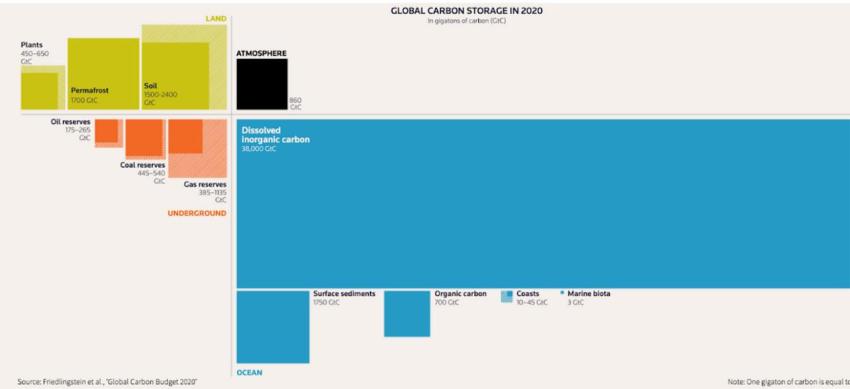
The announcements on climate change keep coming. We get all electric, removing all gasoline vehicles from the road, and put solar panels in. But global average temperatures are still rising. This leaves a bad taste in the mouth: squeezing our output is simply insufficient anymore. The atmosphere contains around 1.5 trillion tonnes of carbon dioxide, most since the start of the Industrial Revolution. It is wrapping itself around the earth like a wool blanket, keeping out heat. To return to that huge, burning question: are we really able to execute a U-turn? Can we remove carbon from the air, or are we still chasing rainbows?
The short answer is yes. The longer answer? It’s a mind-bogglingly complex mix of biology, geochemical engineering, and massive industrial fans.
Let’s break down the science of how we clean up our atmospheric mess.
The Problem: A Sky Flooded with Carbon
Think of our atmosphere as a bathtub that is rapidly overflowing. Turning off the tap stops the water from rising further. But the floor is already soaked. To truly fix the climate crisis, we need a drain. We must develop scalable, permanent means of remove carbon from the air and burying it under thousands of years' worth of material to ensure that it cannot escape.
How do we manage something so big? Scientists divide the solutions into two main buckets: nature-based and technological.
Solution 1: Nature’s Time-Tested Machinery
There are forms of carbon capture we have to rely on; nature does it perfectly, but billions of years ago. Photosynthesis is a process in which trees, plants, and soil absorb carbon dioxide. This is an area where we remove carbon from the air efficiently.
But nature has a storage problem. What happens when a restored forest catches fire or gets cleared for agriculture? All that captured carbon goes right back up in smoke. Nature is a vital part of the puzzle, but it can’t carry the weight of our industrial legacy alone.
Solution 2: Industrial Giants and Enhanced Rocks
That is where the really heavy-duty science comes in. Engineers have designed Direct Air Capture (DAC) systems that remove carbon from the air permanently to fix this issue. A wall of solar-powered fans. These devices suck in ambient air and bubble it through chemical filters. They hold either solid sorbents or liquid solvents that bind with CO2 molecules. The pure carbon dioxide separates from the remaining gas and stores deep underground in basalt rock formations. The gas reacts over time, and it becomes stone.
Quick Questions: The Carbon Removal Reality Check
● Is remove carbon from the air too expensive? Right now, technological DAC costs a pretty penny, over $500 per tonne of carbon. However, scaling up production will drive those costs down dramatically.
● Does it give polluters a free pass? Absolutely not. Removing carbon is an addition to radical emissions cuts, not a substitute.
● Where can I find a roadmap for this? If you want to see exactly how these pathways stack up, dive into the deep-dive resources over at the So What? Global Warming Intro to Carbon Removal guide.
The Road Ahead
Remove carbon from the air isn't science fiction. It already happens naturally, and new technologies continue to expand what's possible. However, carbon removal by itself isn't going to do the trick.
Where the real opportunity is going to be is a new carbon economy blending together low-carbon energy, more enlightened policies, ecosystem restoration, and novel carbon removal. Combined, these methods will provide the greatest success at slowing climate change and safeguarding future generations.
It is not a perfect trick, however, because there really are no shortcuts here. Knowing the science does grant us one gift: perspective. Seeing climate action as a further concatenation of solutions lets us avoid the headlines and get on with real evidence-based work towards making progress.