

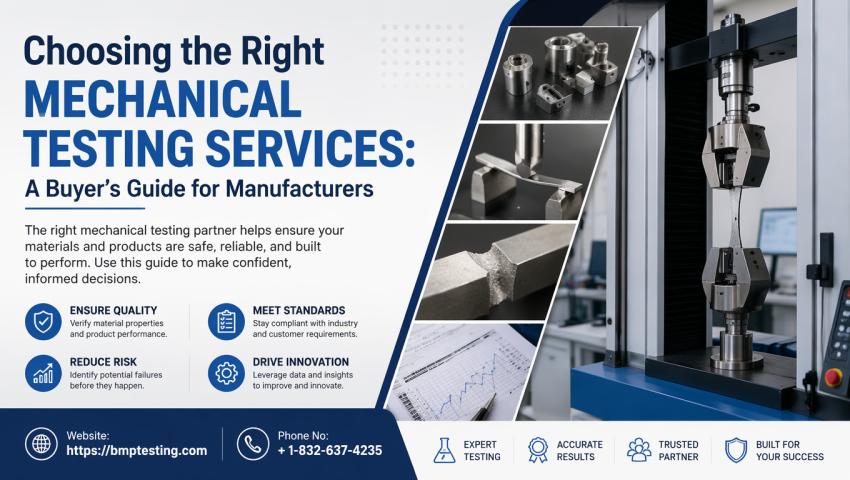
In manufacturing, your product will be as good as the materials you use to create it. Mechanical testing isn't only something you do to comply with regulations! It is a crucial part of product safety, reliability and customer satisfaction. A poor selection of the testing laboratory can result in an error, delay, or even product failure.
This guide will help you select a laboratory to assist you with your quality objectives and business success if you are seeking a mechanical testing partner.
Why Mechanical Testing Matters
Manufacturers rely on mechanical testing to gain insights into the behavior of their materials under various conditions. It is a fundamental characteristic of a material that gives details of its strength, toughness, elasticity and performance.
Testing provides companies with the following benefits:
- Ensure product quality
- Improve product safety
- Meet industry standards
- Minimize product failures.
- Guard their brand image
Choosing the correct testing laboratory can have a huge impact in the successful outcome of your products.
1. Look for Proper Accreditation
The first thing to verify when looking into mechanical testing laboratory is accreditation. Accreditation certifies that the laboratory is in compliance with accrediting standards and provides reliable results.
ISO/IEC 17025 Accreditation
ISO/IEC 17025 is considered the international standard for testing laboratories. It indicates the laboratory:
- Has qualified personnel
- Uses properly calibrated equipment
- Produces accurate and reliable results
- Follows a strong quality management system
Industry-Specific Certifications
Certain industries need further certifications. If your business is in one of these fields, search for labs that are certified by the sector (e.g., aerospace, automotive, medical manufacturing).
2. Evaluate the Laboratory's Technical Expertise
Not all laboratories are equally experienced and specialized. Some laboratories offer a variety of services, but you need to make sure that they have experience in the type of testing you need.
Ask questions such as:
- How Often Is Equipment Calibrated?
Test equipment should be calibrated periodically and be traceable to known national standards. Accurate and repeatable test results are guaranteed with proper calibration.
- Who Performs the Testing?
Find out who will be conducting your tests. Older technicians, engineers, and metallurgists can be helpful and offer a lot of insight to help explain the unexpected.
- Are they able to cope with Specialized Testing?
If your company is using a unique product, custom components or materials, ensure that the lab can meet your needs. Not all laboratories will be appropriate for all applications and may only be able to offer standard tests.
3. Select a Laboratory with Good Communications Skills
Mechanical testing should be a process that does not involve sending out samples and waiting for results. Good communication is an important part of a successful testing partnership.
- Ask About Turnaround Times
Determine testing times and if the lab offers clear timelines. Reliable laboratories should be able to provide realistic completion dates.
- Understand Their Sample Management Process
Inquire about the receipt, tracking, storage and disposal of samples. There should be a procedure for handling all samples in the well-organised laboratory throughout testing.
- Review Sample Reports
Ask for a sample testing report prior to selection. A good report should be:
- Easy to understand
- Clearly organized
- Accurate and detailed
- Helpful for decision-making
The best laboratories will give you useful information, rather than only raw test data.
4. Be aware of Warning Signs
There are a number of warning signals that could mean you have found the wrong laboratory.
- Unclear Accreditation Information
It is advisable to proceed with caution if a laboratory is not readily able to give you information about its scope of certification and accreditation.
- Unusually Low Prices
Low price could signify cutting corners in the testing or reduced quality of the services provided. Never take anything for granted when it comes to testing standards and methods.
- Poor Documentation Practices
Every stage of testing has complete records in professional laboratories, including:
- Sample receipt
- Testing procedures
- Equipment calibration
- Data verification
- Final reporting
Documentation issues can result in audit and/or investigation issues.
Look for a Long-Term Partner
The best mechanical testing laboratory supplies more than just test results. They guide manufacturers in interpreting the results and understanding how it impacts product performance.
A good testing partner should:
- Give precise and valid testing
- Offer technical expertise
- Communicate clearly
- Back any quality objectives
- Help reduce risks
Good partnership with a reputable lab can enhance product quality and contribute to business sustainability.
Final Thoughts
The selection of mechanical testing services is a crucial decision for any manufacturing company. The right laboratory helps ensure product quality, safety, and reliability while reducing risks and preventing costly failures. When choosing a testing provider, keep in mind:
- Accreditation and certifications
- Technical expertise
- Communication and customer service
- Quality reporting
- Experience in your industry
When looking for mechanical testing services in Houston, you need to look for a laboratory that is accurate, transparent, has technical expertise, and provides customer support. A trusted testing partner can help you achieve better product quality, comply with regulations and standards, lower your operational risks, and contribute to the success of your enterprise in the long run.


