The Future of Networking: How AI Business Card Scanners Are Changing Everything
Walk out of any conference, trade show, or client meeting today, and you're likely holding a small stack of paper business cards you have no idea what to do with. Most of them will sit in a drawer, fade in a jacket pocket, or vanish entirely — along with every promising lead they represent. That's a problem a surprisingly large number of professionals still haven't solved. But the emergence of the AI business card scanner is changing that equation fast.
This isn't just about going paperless. It's about rethinking how professionals build, maintain, and act on their networks — automatically, intelligently, and at a scale that was simply impossible five years ago.
Why Traditional Business Cards Are Failing Modern Professionals
The business card has existed in roughly its current form since the 17th century in Europe. For most of that history, it did its job well enough. You met someone, exchanged cards, and — if you were diligent — transcribed the details into a Rolodex or, later, a spreadsheet.
The problem is that today's professionals network at a completely different pace. A single industry conference can produce 50 to 200 new contacts in a weekend. A sales rep attending trade shows quarterly might collect thousands of cards per year. Manually entering that volume of contact data is not just tedious; it's a realistic bottleneck that causes real revenue loss.
Numerous CRM vendors and sales productivity studies have found that a significant portion of business cards acquired at events are never followed up on. The friction of manual data entry delays action long enough for the moment to pass, not because professionals don't want to. By the time someone sits down to enter those contacts, the lead is cold, the timing is off, and the context has disappeared.
Paper cards also create accuracy problems. Handwritten notes on the back get misread. Names with unusual spellings get mangled. Contact details change, and a card from two years ago may now be out of date. The system, as it stands, is brittle.
What an AI Business Card Scanner Actually Does
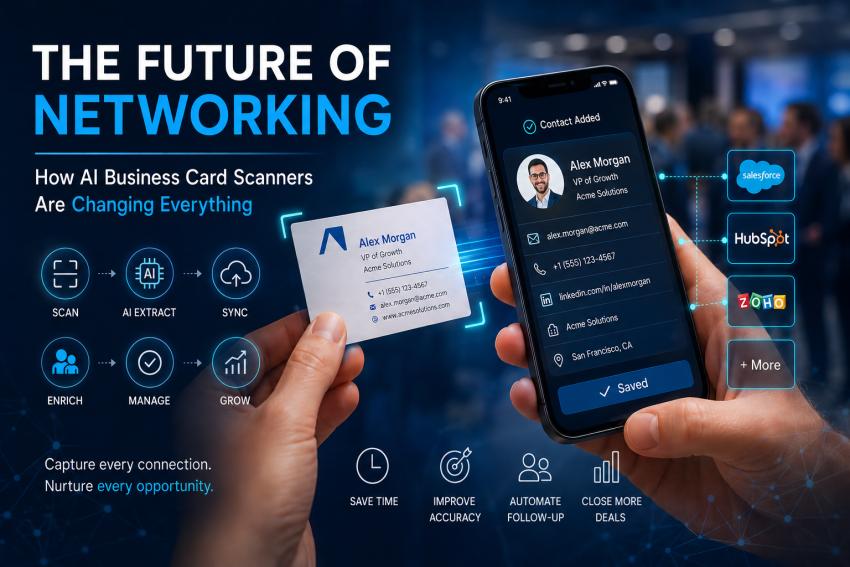
An AI-powered business card scanner uses a combination of optical character recognition (OCR), natural language processing (NLP), and machine learning to extract structured contact information from a photo of a business card — and then do something useful with it.
The basic workflow looks like this: you photograph a card with your phone, and within seconds the app parses the image, identifies fields such as name, title, company, phone number, email address, LinkedIn URL, and physical address, and then populates those fields in a digital contact record. That part — the business card OCR software layer — is no longer particularly novel.
What follows is what sets modern AI-powered solutions apart from older scanning applications. Intelligent reasoning is used on the extracted data by contemporary platforms:
Deduplication: The system checks whether this contact already exists and, if so, prompts you to merge or update rather than create a duplicate.
CRM integration: Contacts flow directly into Salesforce, HubSpot, Zoho, or whichever platform you're using — no copy-paste required.
Enrichment: Some tools cross-reference public data sources to add additional context, such as the contact's LinkedIn profile, company size, recent news, or mutual connections.
Follow-up automation: Certain platforms can trigger a follow-up email or a CRM task immediately after a card is scanned, while the interaction is still fresh.
This is what AI contact management really means in practice — not just storing information, but activating it.
The Technology Behind Modern Business Card Scanning Apps
Understanding why this technology works well now, when it struggled even a decade ago, requires a brief look under the hood.
OCR Has Gotten Dramatically Better
Early business card OCR software was notoriously unreliable. It struggled with unusual fonts, non-standard layouts, cards with dark backgrounds, or anything printed at a slight angle. Modern OCR engines — especially those trained on tens of millions of card images — handle these challenges with accuracy rates that routinely exceed 95% for standard Latin-script cards and are improving rapidly for non-Latin scripts like Arabic, Japanese, and Chinese.
The same deep learning developments that have significantly changed picture recognition are responsible for this improvement. Compared to the rule-based systems of previous generations, neural networks trained on huge labeled datasets learn to recognize and extract named items (a person's name vs. a corporate name vs. a phone number) significantly more accurately.
NLP Handles the Ambiguity
A phone number is relatively easy to parse. A job title like "VP of Growth & Strategic Partnerships – APAC" is harder to parse. Modern smart business card scanners use NLP to correctly classify and store even verbose, non-standard fields. The same NLP layer handles multilingual cards, unconventional layouts, and cards that include taglines or marketing copy alongside contact information.
Mobile Cameras Made It Practical
The hardware side matters too. Today's smartphone cameras — with their high resolution, optical image stabilization, and computational photography — capture card images sharp enough for reliable extraction even in poor lighting conditions. This made the mobile business card-scanning app format viable in a way that earlier mobile cameras couldn't.
How Professional Landscapes Are Changing Due to AI Networking Tools
The implications extend beyond personal productivity. At an organizational level, the shift toward digital contact management and networking automation tools is changing how companies think about lead capture and relationship building.
AI Lead Capture at Events
For sales-heavy organizations, events are high-value but chaotic environments. Teams scatter across a conference floor, each collecting contacts independently, often with no standardized process for quickly getting that data into a shared system. AI lead-capture tools — many of which center on the smart business card scanner as their primary input mechanism — create a consistent, auditable pipeline from physical interaction to a CRM record.
By enabling scanning of event badges in addition to cards, certain enterprise solutions go one step further, enabling real-time connections between digital profiles and in-person interactions. As a result, the record of who spoke to whom and what was said is richer and more trustworthy.
Minimizing the Bottleneck of Data Entry
Here, a more general concept is at play. When contact management is automated, the human involved may concentrate on the connection itself. Salespeople who used to manually enter card information for 20 to 30 minutes after each event day can use that time for more useful and likely-to-convert personalized follow-up.
This is one of the most consistent findings in sales productivity research: reducing administrative friction doesn't just save time; it changes the quality of the work that follows.
Digital Networking Solutions for Remote and Hybrid Contexts
The pandemic era accelerated interest in digital networking solutions more broadly, and while in-person events have largely returned, the habits formed during those years have persisted. Many professionals now use hybrid contact strategies — physical cards for in-person interactions, digital cards, and QR codes for virtual interactions. AI scanning tools increasingly handle both, recognizing QR-code-based digital cards as well as traditional paper formats.
What an AI-Powered Business Card Scanner Should Have
Not all tools in this category are equally capable. Here's how to evaluate them:
Accuracy and language support. If your network is international, verify that the platform supports the languages and scripts used by your contacts. Accuracy on complex or non-standard cards varies significantly across tools.
Level of integration. A CSV-exporting scanner is helpful. It is far more valuable if it feeds structured data directly into your CRM, with field mapping that matches your current schema. Seek out native interfaces with the platforms that members of your team actually utilize.
Data handling and privacy. Contact information is private. Recognize whether the vendor utilizes your data to train models, where card images and extracted data are kept, and how data is managed in accordance with the CCPA, GDPR, and other relevant laws.
Characteristics of a team. Enterprise solutions and individual productivity tools differ greatly in this regard. Make sure the platform meets your needs if you require usage stats, role-based access, or shared contact databases.
Enrichment potential. While some platforms only collect information, others actively provide more context to contacts. Enrichment may be a useful differentiator or a needless expense, depending on your use case.
The Prospects: Where Are We Going?
The AI business card scanner is best viewed as part of a broader trend toward intelligent, automated contact information extraction and relationship management, rather than as a stand-alone product category.
The next generation of these tools will likely move further toward ambient capture — reducing even the friction of photographing a card by scanning passively or automatically extracting contact information from email signatures, LinkedIn profiles, and meeting transcripts. Some platforms are already experimenting with this.
There's also growing interest in relationship intelligence — tools that don't just store contact data but analyze patterns of interaction, surface dormant connections worth re-engaging, and provide context before important meetings. This is where AI networking tools are heading: from passive data storage toward active relationship guidance.
For businesses, the competitive implication is straightforward. Companies that systematize their networking processes — capturing every contact accurately, enriching them consistently, and following up promptly — will out-execute competitors who still rely on manual, paper-based workflows. The technology to do this is mature, accessible, and increasingly affordable.
Conclusion: Time to Rethink Your Networking Stack
The paper business card isn't going to disappear overnight. But the infrastructure supporting what happens after you receive one has fundamentally changed. An AI business card scanner turns a fragile, often-lost piece of paper into a structured, actionable, integrated contact record — automatically and in seconds.
Whether you're a solo consultant, a sales team lead, or an enterprise revenue operations manager, the case for adopting digital contact management tools built on AI is no longer speculative. The friction costs of manual data entry are real. The accuracy problems of paper-based systems are real. And the productivity gains from automation — more time for follow-up, fewer dropped leads, cleaner CRM data — are equally real.
The future of networking is already here. The question is whether your workflows are built to take advantage of it.