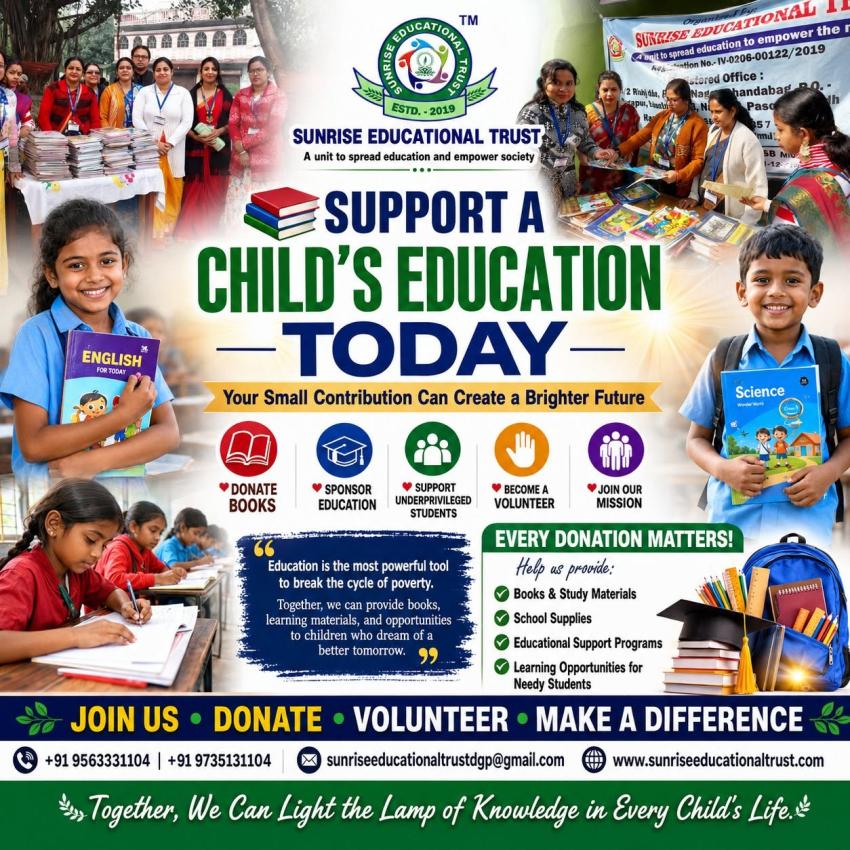
There was a time when joining a social cause meant traveling to an office, filling out paper forms, and waiting weeks for a response. For many people in rural India, that wait was often permanent. Today, an has changed that reality entirely — turning what was once a bureaucratic hurdle into a two-minute process on a mobile phone.
This shift matters more than it might seem. Education support NGOs across the country are now reaching communities they could never access before, simply because the door to participation has been widened and moved online.
How Indian Educational Philanthropy Grew From the Ground Up
To understand why this digital shift is so significant, it helps to look back. After Independence in 1947, India faced a literacy crisis of enormous proportions. Voluntary organizations and community leaders stepped in where government resources fell short. These early pioneers — often working without formal registration or funding — laid the foundation for what would become a vast network of charitable institutions Join NGO Membership Online.
During the 1960s and 1970s, nonprofit education foundations began to take more organized shape. Child education trusts were formally registered, donor networks expanded, and the idea of structured educational charity organizations gained social legitimacy. Over the years, their work helped pull millions of children into classrooms that would otherwise have remained out of reach online NGO membership application.
What These Organizations Actually Do
People sometimes assume that NGOs in education simply distribute textbooks or run tuition centers. The reality is considerably broader.
A well-functioning child education trust typically works across several dimensions at once:
- Identifying children from low-income families who have dropped out of school
- Providing scholarships and fee assistance to keep students enrolled
- Training local teachers and strengthening under-resourced schools
- Running programs specifically designed to bring girls and marginalized groups into education
- Coordinating with local governments to plug gaps in public infrastructure
Meanwhile, an educational charity organization operating at scale might simultaneously manage a community education program in a tribal district of Jharkhand and a student welfare initiative in an urban slum in Chennai. The geographical spread is part of what makes membership-driven models so important — and so dependent on easy, accessible registration.
The Quiet Power of Membership
Here is something that rarely gets discussed: organizational strength in the social sector is built on numbers, not just money. When a nonprofit education foundation can demonstrate that ten thousand people have signed up as members, it carries moral weight in policy conversations, grant applications, and community negotiations.
An online NGO membership application simplifies this dramatically. A teacher in a small town in Rajasthan can express her support for a literacy initiative without taking a day off work. A college student in Pune can affiliate with a student welfare cause between lectures. The barrier to entry drops, and participation rises.
This has real consequences. Communities that feel represented in an organization's membership are more likely to trust it — and more likely to collaborate with its programs on the ground.
From Enrollment to Empowerment
Consider a typical scenario. A first-generation learner from a rural family in Odisha completes Class 10 with help from a nonprofit education foundation. Her family cannot afford Class 11 fees. A scholarship made possible by a community education program covers the cost. Years later, she becomes a member of the same organization — contributing her time as a volunteer mentor.
This cycle, repeated across thousands of families, is how educational philanthropy creates lasting change. It is not charity in the transactional sense. It is investment in human capability, one student at a time.
Academic development is only one part of the outcome. Skill enhancement programs attached to many educational NGOs have helped young people find employment. Social awareness work has reduced dropout rates tied to child marriage and caste-based discrimination. The long-term economic impact — while harder to measure — is visible in communities where second-generation learners are breaking cycles of poverty.
A Call Worth Answering
The work of educational NGOs does not sustain itself. It depends on people choosing to be part of something larger than their own immediate concerns.
If you have considered supporting a cause in education or child welfare, the moment to act is genuinely easier than it has ever been. Many organizations now offer a simple online NGO membership application that takes minutes to complete. You can volunteer, donate, advocate, or simply lend your name to a movement that is quietly doing important work.
Future generations will not know you made that choice. But they will benefit from it.