Transitioning out of military service can be difficult. It is not due to lack of skills and motivation among veterans. The actual problem is to find a civilian job that provides the same sort of responsibility and purpose.
A job in the office might not feel fulfilling if you're accustomed to taking care of important equipment that can affect lives. That's why an NDT Training Program is one of the best career paths for transitioning service members.
What is Non-Destructive Testing (NDT)?
Non-Destructive Testing (NDT) involves the examination of materials and equipment without causing damage. Advanced technology such as industrial X-rays, ultrasound, magnetic fields and special dyes are used by NDT technicians to detect hidden defects. These inspections are used to help ensure the safety of:
- Aircraft and aerospace components.
- Oil and gas pipelines.
- Bridges and highways
- Ships and submarines
- Power plants and industrial equipment
The precision, discipline and attention to detail required in the work are qualities that veterans already have.
NDT is an ideal career option if you're seeking a direct pathway from military service to a lucrative civilian job.
Step 1: Use Your Veteran Benefits to Pay for Training
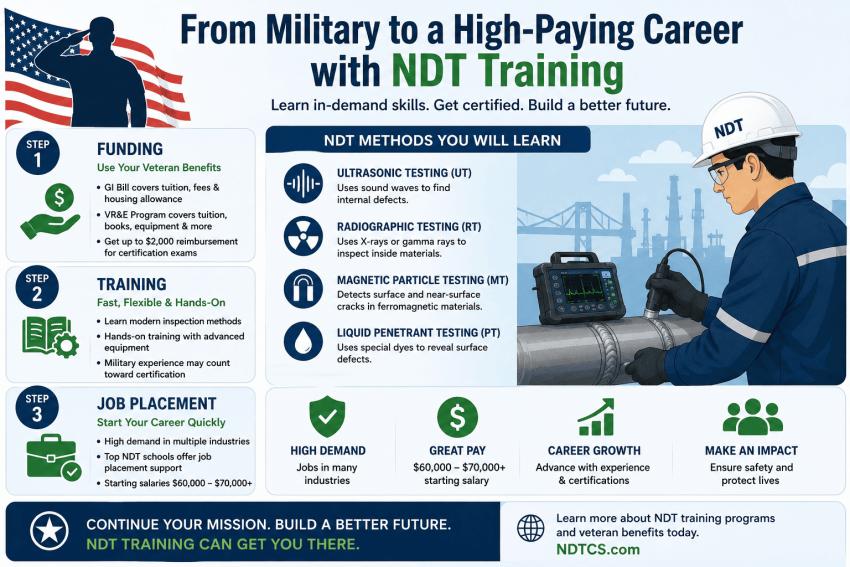
When starting a new career, one of the most important things to consider is the cost of education. Fortunately, many of the veteran training programs for NDT are government- approved, so that most of the veterans can train without paying much or any out-of-pocket cost.
- GI Bill benefits (Chapter 30 and Chapter 33)
There are several GI Bill schools that are accredited. These programs may include:
Tuition and fees
Training materials
Monthly Housing Allowance (MHA)
This financial assistance enables veterans to pursue learning without having to think about education expenses.
- Vocational Readiness and Employment (VR&E) Program
If you served in the military and are now disabled, you can be eligible for the VR&E program, referred to as Chapter 31.
The following can be obtained from this program:
Full tuition coverage
Books and study materials
Certification testing fees
Required equipment
Monthly financial assistance
Certification Exam Reimbursement
If you train using an alternate certification path, the Department of Veterans Affairs may cover the cost of your certification exams, up to $2,000 per exam.
Step 2: Complete Your NDT Training
One of the most interesting aspects of the job of an NDT technician is that a four year college degree is not required for this career. There are several programs available that can train you in a couple of months for a job.
In your NDT Training Program you will study a number of inspection techniques used in industry.
- Ultrasonic Testing (UT): This technique involves applying high frequency sound waves to identify defects within metal and other substances.
- Radiographic Testing (RT): Internal structures and welds are inspected by use of industrial x-rays or gamma rays, without disassembling the equipment.
- Magnetic Particle Testing (MT): This process involves magnetic field and fine particles, which are able to detect surface and near surface cracks.
- Liquid Penetrant Testing (PT): Using special dyes, defects on the surface of the materials are made visible, even when they cannot be perceived by the eye alone.
The techniques are applied regularly in industries where safety and reliability are paramount.
Military Experience Can Give You an Advantage
If you've served in the military, and have experience in aircraft maintenance, engineering, ship maintenance, or equipment inspection, you might already have some of the experience that can be applied to civilian NDT certification.
Veterans should request their VMET (DD Form 2586), since they may be able to count on some military work hours towards the required on-the-job training hours. This can speed up the process of achieving higher certification levels.
Step 3: Get a Job Fast
Hiring certified NDT technicians is always on the rise. The need for skilled inspectors is high due to the aging infrastructure, growing energy projects and rising aerospace production.
There are many quality NDT Schools that have career placement support. They have strong ties with employers and provide links to employers that are actively recruiting.
Trained NDT professionals are in high demand among defense contractors, aerospace manufacturers, energy companies and industrial inspection services.
The American Society for Nondestructive Testing (ASNT), also offers industry resources and networking opportunities.
Why Employers Like Hiring Veterans
Employers appreciate the many qualities that veterans have to offer.
You should already be able to:
- Follow detailed technical procedures
- Work under pressure
- Observe strict safety measures
- Handle responsibility
- Participate in a team effort
- Pass workplace compliance requirements
These skills make veterans excellent candidates for NDT careers.
Many of the NDT programs that are geared toward veterans achieve placement rates of 90 percent or higher. Wages are typically between $60,000 and $70,000 for entry-level technicians, and highly experienced technicians with the most advanced certifications can make well into the six figures.
A Career That Continues Your Mission
Military service is a way to protect people and accomplish important tasks. You can pursue that purpose as a career in NDT.
Each inspection you conduct contributes to the safety of airplanes, the security of pipelines, the reliability of bridges and the proper functioning of industrial facilities. Your work is helping to keep the public safe.
An NDT Training Program might be a suitable career option for those who like technical problems and are looking for a stable job with good prospects for advancement.
Take the First Step
It's easy to get started. Look into a VA-approved school for non-taxpayer education benefits, and call the veterans' advisor to find out about the benefits offered.
Training and support can help make the career switch from military to high-tech inspection a successful one that can provide stability, purpose, and growth.