In today’s healthcare environment, achieving medical laboratory accreditation is essential for ensuring accuracy, reliability, and patient safety. The ISO 15189 standard provides a comprehensive framework for laboratories to maintain high levels of quality and technical competence.
However, one of the biggest challenges laboratories face is understanding ISO 15189 requirements—especially when it comes to documentation. A clause-wise approach helps simplify this process and ensures nothing is missed during implementation.
Understanding ISO 15189 Documentation
Documentation is the backbone of any ISO 15189 medical laboratory system. It ensures that all processes remain standardized, traceable, and consistently followed, while also aligning with accreditation requirements.
Instead of treating documentation as paperwork, laboratories should view ISO 15189 documents as practical tools that support daily operations and improve overall efficiency.
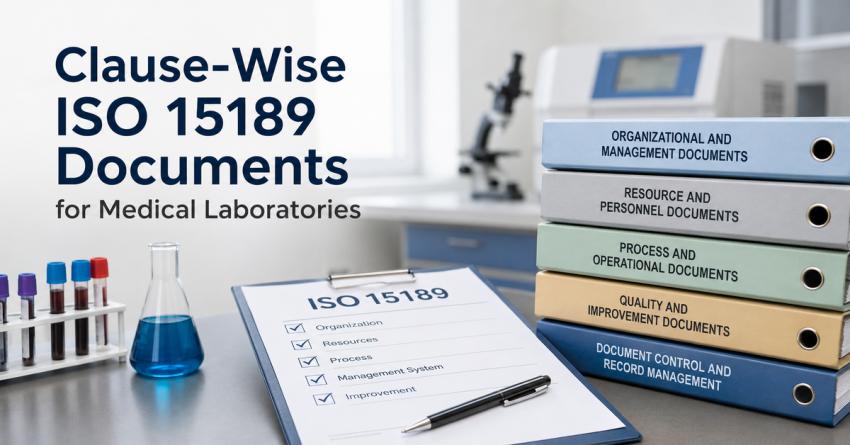
Clause-Wise Approach to ISO 15189 Documents
Breaking down documentation based on clauses helps laboratories clearly identify requirements at each level of the system.
Organizational and Management Documents
These documents define how the laboratory is structured and managed, including quality policy, objectives, organizational structure, and responsibility matrix. They form the foundation for ISO 15189 accreditation by ensuring governance and accountability.
Resource and Personnel Documents
To meet ISO 15189 requirements, laboratories must demonstrate staff competence and proper resource management through training records, competency assessments, and equipment calibration logs.
This ensures personnel and equipment consistently meet required standards and support reliable performance.
Process and Operational Documents
These are the core working documents, including SOPs, sample handling procedures, quality control records, and reporting formats.
They ensure all testing activities are performed in a controlled and standardized manner, maintaining consistency and accuracy.
Quality and Improvement Documents
Continuous improvement is a key aspect of ISO 15189. Laboratories are required to maintain records related to corrective and preventive actions (CAPA), risk assessments, and nonconformities.
These documents help identify gaps, monitor performance, and implement improvements over time, strengthening the overall quality management system.
Document Control and Record Management
An effective system ensures ISO 15189 documents are approved, updated, accessible, and maintained with revision history.
This is especially important for laboratories operating under a flexible scope, where processes may frequently change.
Why Clause-Wise Documentation Improves Accreditation Success
A structured documentation system directly supports ISO 15189 accreditation by:
- Reducing errors and duplication
- Ensuring all requirements are covered
- Simplifying implementation
- Supporting faster compliance
It also helps laboratories adapt when expanding services or introducing new methods.
Practical Approach to Managing ISO 15189 Documents
In real laboratory environments, managing large volumes of documents can become complex. Many laboratories adopt a structured system that includes:
- Pre-defined SOP formats
- Standardized forms and templates
- Organized document hierarchy
- Clause-wise mapping of requirements
Such a system not only reduces confusion but also ensures that all documents are aligned with operational workflows and accreditation needs.
Laboratories aiming to improve their documentation structure often rely on practical examples of ISO 15189 documents for medical laboratories, where procedures, SOPs, and formats are systematically arranged to support compliance and day-to-day laboratory operations.
Role of Documentation in Maintaining Quality
Beyond accreditation, documentation plays a vital role in maintaining consistent quality in laboratory operations. It supports reliable and reproducible test results, ensures clear communication between departments, and enables proper training and competency tracking.
It also helps in monitoring performance and driving continuous improvement, making documentation an essential component of any ISO 15189 medical laboratory.
Conclusion
A clause-wise understanding of ISO 15189 documents makes it easier for laboratories to implement and maintain compliance with ISO 15189 requirements. By organizing documents based on functional areas, laboratories can build a strong foundation for ISO 15189 accreditation and ensure long-term operational excellence.
Ultimately, documentation is not just about compliance—it is about creating a system that supports accuracy, efficiency, and continuous improvement in every ISO 15189 medical laboratory.