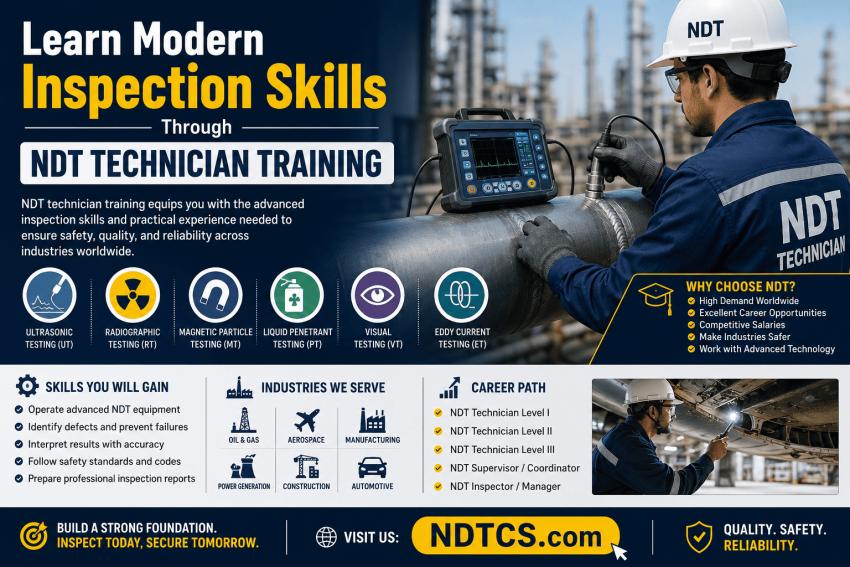
Industrial safety and quality control have now become a more critical matter than ever before in the fast developing world. In industries like power generation, construction, automotive, manufacturing, oil and gas, and aerospace, the importance of reliable inspection techniques cannot be understated. This is where Non-Destructive Testing (NDT) comes into play. The training of an NDT technician teaches the user in-depth inspection techniques which enable the detection of defects and weaknesses in material without causing damage.
With the ongoing modernization of industries and the increasing safety standards, the need for skilled NDT technicians continues to grow. An NDT technician training course can have a tremendous impact on the world, providing a stable, rewarding career with highly demanded skills.
What is NDT?
NDT is a technique that is used to examine the material, parts of structure or the structure without impairing their usability. NDT differs from destructive testing, which harm the material in the process of inspecting it, in that it maintains the integrity of the product while testing.
NDT is used extensively to identify many cracks, corrosion, porosity, weld defects, leaks and other defects that are not visible, and can cause equipment failure. These inspections are aimed at ensuring industries meet quality criteria, enhance safety, and minimize maintenance expenses.
Why NDT Technician Training is Important
NDT requires technical expertise, precision, and practical knowledge. A professional training program for NDT teaches students to operate inspection equipment, analyze the data, adhere to safety guidelines, and meet industry standards.
If not properly trained, inspectors may be liable to accidents, loss of money, and damage to equipment. This is the reason why companies look for the certified and skilled NDT technicians who can confidently conduct accurate inspections.
Training can also lead to industry recognised certificates, which are often needed in industry-based roles.
Modern Inspection Methods taught in NDT Training.
A program of NDT (Non-Destructive Testing) Technician training gives students an introduction to a number of new inspection techniques which are adopted in many industries. These techniques are used to detect defects in a variety of materials and structures.
Ultrasonic Testing (UT)
Ultrasonic Testing is a method used to determine the presence of defects within the materials by using high-frequency sound waves. It is often used to detect corrosion, measure thickness and check weld inspections.
Modern UT equipment offers the most accurate digital readings and imaging, which allows for inspections to be faster and more accurate.
Radiographic Testing (RT)
Radiographic Testing is a non-destructive testing method that is conducted by using X-rays or gamma rays to look at the internal structure of material. It assists in identifying cracks, voids and inclusions which are not visible from the surface.
Because of the benefits of faster image processing and better inspection quality, digital radiography has been gaining in popularity.
Magnetic Particle Testing (MT)
This method is used to detect surface and near-surface defects in ferromagnetic materials. Magnetic fields and fine particles are used to effectively and promptly detect cracks or discontinuities.
Liquid Penetrant Testing (PT)
Liquid Penetrant Testing is an easy and useful technique to identify surface discontinuities. An imperfection or crack will be visible or fluorescent dye is placed on the surface of the material.
Visual Testing (VT)
Visual inspection is still one of the most critical NDT techniques. The most modern testing methodology can include digital cameras, borescopes, drones and advanced imaging equipment for hard-to-reach places.
Eddy Current Testing (ET)
Eddy Current Testing is a method of evaluating cracks, corrosion and thickness variations of materials using electromagnetic fields. It is commonly used in aerospace and manufacturing industries.
Skills You Learn Through NDT Technician Training
NDT technician training focuses on both technical knowledge and practical experience. Students will learn a variety of modern inspection skills such as:
- Being familiar with inspection concepts and practices
- Using cutting-edge testing tools
- Reading and interpreting inspection results
- Recognizing faults and material failure
- Taking safety precautions and industry standards
- Drafting Technical Inspection Report(s)
- Utilizing digital imaging and computer systems.
These skills enable technicians to operate in challenging industrial settings.
Importance of Hands-On Training
The most valuable aspect of an NDT technician training program is the practical training. Theoretical learning takes place in class, while hands-on experience enables students to gain practical knowledge in actual inspection scenarios.
Advanced inspection equipment and simulation environment are employed to train students for field work at modern training centers. Practical training enhances confidence, problem solving and technical accuracy.
Employers generally prefer candidates who have excellent hands-on experience, as they can adjust to job requirements the most quickly.
Industries That Require NDT Technicians
In several sectors, where safety and quality control is vital, NDT technicians are playing important roles.
Oil and Gas Industry
To ensure pipelines, storage tanks, pressure vessels and offshore structures are inspected to avoid leaks and failures.
Aerospace Industry
Strict inspections must be carried out on the aircraft components to ensure safety of passengers and structural reliability.
Manufacturing Industry
NDT is used by manufacturers to ensure product quality and identify flaws in product manufacture.
Construction Industry
Bridges, buildings and infrastructure projects need to be inspected to make sure that they are structurally sound and will last for many years.
Power Generation
NDT inspections are essential for making sure that power plants run correctly and do not have costly failures.
Certification and Career Growth
Many employers prefer to hire certified NDT technicians as they indicate that they have the necessary technical skills and industry expertise. Typically, there are three levels of NDT certifications:
- Level I: Technicians can do inspections under supervision and under written directions.
- Level II: Technicians are able to perform on their own inspections as well as interpret results and prepare reports.
- Level III: This is the highest qualification that can be achieved and enables workers to lead programs, train others, and devise inspection processes.
Technicians can advance to senior technical and managerial positions after acquiring experience and specialized certifications.
Benefits of Choosing an NDT Career
There are lots of benefits to selecting a career in NDT:
High Demand
In today's world, there is a demand for skilled NDT professionals across all industries to ensure safety and quality standards.
Competitive Salaries
Good wages and job growth opportunities are frequently offered to certified techs.
Global Career Opportunities
Technicians can be certified in NDT to work in other countries and industries because of the international recognition of the certifications.
Career Stability
Industrial safety is an ever-growing field that will continue to attract workers for the long-term.
Technical and Practical Work
Those who are more hands-on technical and problem-solving are well suited for a career in NDT.
The Future of Modern Inspection Technology
Technology is still changing the NDT industry. Today's inspection systems feature the following:
- Digital radiography
- Automated ultrasonic testing
- Robotic inspection systems
- Using AI to identify defects.
- Drone-assisted visual inspection
- Real-time digital reporting
NDT technician training programs are evolving to include these advanced technologies, helping students remain competitive in the future workforce.
Technicians who have the new technical skills and digital knowledge will have more career opportunities in the future as industries continue to modernize.
Conclusion
An NDT technician training program is a great way to start a fulfilling technical career. NDT is essential to industrial safety, product quality and operation reliability for various industries.
The knowledge, hands-on experience, and preparation for certification offered in a professional training program offer the key to success in today's competitive industrial environment. Whether it's ultrasonic testing, radiographic inspection or sophisticated digital techniques, NDT technicians play a vital role in the future of industrial safety and quality assurance.
If you're looking to pursue a technical career that has great potential for growth, NDT technician training is the ideal choice for developing valuable skills and ensuring long-term career success. For more details, you can visit https://ndtcs.com