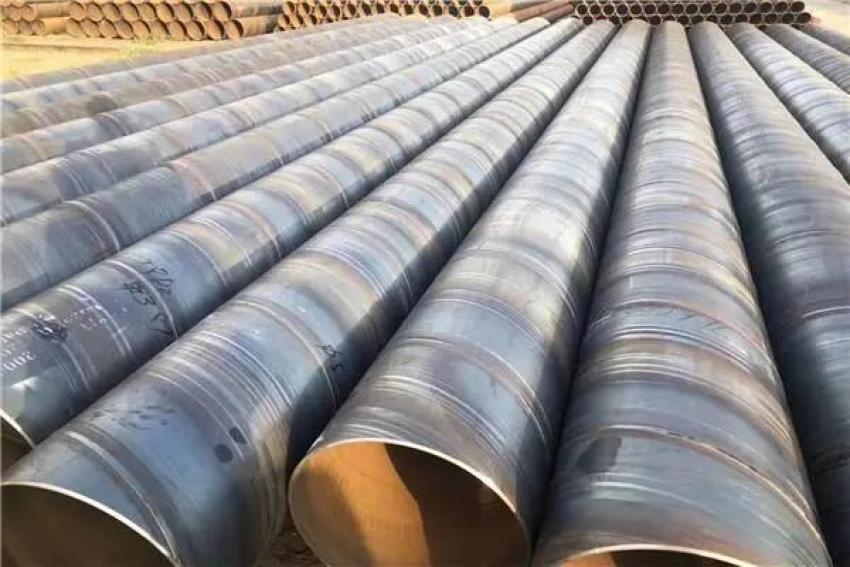
In steel pipe procurement and engineering applications, ERW and SSAW pipes are two of the most common types of pipeline pipes. Whether used for oil and gas transportation, urban water supply networks, or building structural support, a correct understanding of the differences between the two directly affects project costs, construction efficiency, and long-term operational safety. This article will provide a detailed comparison of ERW and SSAW pipes from the perspectives most important to purchasers, including performance characteristics, specification range, cost differences, and application scenarios.
1. Differences in Manufacturing Process and Weld Quality
ERW pipes utilize a high-frequency resistance welding process. After hot-rolled coils are continuously rolled into shape, the skin effect and proximity effect of high-frequency current are used to instantly heat the edges of the steel strip to a molten state, achieving solid-state pressure welding under the action of extrusion rollers. This process does not use any welding wire or flux, therefore the weld composition is very similar to the base material, and the weld heat-affected zone is narrow, resulting in a fast welding speed.
SSAW pipe is manufactured using a spiral submerged arc welding process. The steel strip is continuously rolled into shape at a specific spiral angle, and then welded on both the inner and outer sides using submerged arc welding (welding wire + flux). The weld seam is spirally distributed, and its length is approximately 1.1-1.4 times the pipe length.
Key Performance Comparison:
● Dimensional Accuracy: ERW pipes have stricter tolerance control for outer diameter and wall thickness, exhibiting excellent straightness and ovality; SSAW pipes, due to their spiral forming characteristics, have relatively poorer roundness control.
● Weld Strength: ERW pipes can achieve a weld strength coefficient of 0.85-1.0, but there may be a strength difference between the weld and the base material; SSAW pipes, with double-sided submerged arc welding, achieve weld strength essentially equivalent to the base material, with a weld strength coefficient reaching 1.0.
● Inner Surface Quality: ERW pipes have a smooth inner wall and small weld reinforcement, resulting in lower fluid transport resistance; SSAW pipes have a significant spiral weld reinforcement on the inner wall, which may affect transport efficiency.
● Pressure Resistance: Both can meet medium and high pressure transport requirements, but the weld direction of SSAW pipes forms a certain angle with the principal stress direction, which is beneficial for stress dispersion.
2. Specifications and Manufacturability
ERW Pipe Size Range: Outer diameter typically ranges from Φ21.3mm to Φ610mm (maximum approximately 813mm), with wall thickness generally not exceeding 20mm. Its advantage lies in small to medium diameters of 24 inches (610mm) and below.
SSAW Pipe Size Range: Outer diameter starts from Φ219mm and can reach over Φ3000mm. Wall thickness can reach 25mm or even thicker, offering an irreplaceable advantage in large-diameter applications.
For buyers, if the project pipe diameter is below 24 inches, ERW pipe is usually a more cost-effective choice; however, once the pipe diameter exceeds 24 inches, SSAW pipe is almost the only feasible straight seam or spiral seam welded pipe solution.
3. Procurement Cost and Economic Analysis
Steel pipe cost is one of the core factors in procurement decisions. According to market data from 2024-2025, under the same specifications and steel grade, the ex-factory price of ERW pipe is typically 10%-15% lower than that of SSAW pipe. Taking Φ630×10mm API 5L Gr.B line pipe as an example, ERW pipe costs approximately 5500 RMB/ton, while SSAW pipe costs approximately 6200 RMB/ton.
However, the total life cycle cost (TCO) needs to consider more factors:
a. Transportation costs: ERW pipe is lighter, has higher dimensional accuracy, and is easier to stack and transport.
b. Installation costs: ERW pipe is lightweight and has good straightness, making on-site installation simple and quick; SSAW pipe is heavier, and its ovality may affect the efficiency of circumferential weld alignment.
c. Inspection costs: ERW pipe has only one longitudinal weld, resulting in less non-destructive testing; SSAW pipe has a longer spiral weld, leading to a greater workload for UT/RT testing and a corresponding increase in inspection costs.
d. Maintenance costs: Under normal low- and medium-pressure operating conditions, the difference between the two is not significant; in high-pressure or corrosive media environments, the longer weld of SSAW pipe means more potential monitoring points and maintenance work.
In summary, for small-to-medium diameter, low-to-medium pressure, and cost-sensitive pipeline projects, ERW pipes offer a significant life-cycle cost advantage; for large-diameter water transmission or low-pressure, high-flow projects, SSAW pipes may have a lower overall cost due to their diameter-based economic advantages.
4. Application Scenarios and Selection Recommendations
Based on API 5L, and other standards, as well as engineering practice experience, the following selection directions are recommended:
Scenarios where ERW pipes are preferred:
● Low-pressure urban gas pipelines (pressure ≤ 4MPa, diameter ≤ 610mm)
● Municipal water supply pipelines such as tap water and fire protection systems
● Structural applications such as building structures, scaffolding, and pile pipes
● Internal oilfield gathering and transportation pipelines, refined oil transportation
● Precision pipes for automotive and machinery manufacturing
● Any project with strict requirements for dimensional accuracy, internal surface finish, and straightness
Scenarios where SSAW pipes are preferred:
● Large-scale water transmission projects, hydraulic and electrical pressure steel pipes (diameter ≥ 800mm)
● Long-distance low-pressure, high-flow transmission pipelines
● Structural applications such as large-diameter pile pipes, wind turbine towers, and bridge pile foundations
● Oil and gas transmission pipelines operating in Class 3 and 4 (ordinary areas)
● Large-diameter projects that are cost-sensitive and whose pipe diameter exceeds the manufacturing capacity of ERW pipes
Standard limitations: API 5L clearly stipulates that high-pressure oil and gas pipelines passing through high-altitude and cold regions, the seabed, and densely populated urban areas (Class 1 and 2 areas) must use LSAW (straight seam submerged arc welded pipe), and ERW and SSAW are not applicable in these cases.