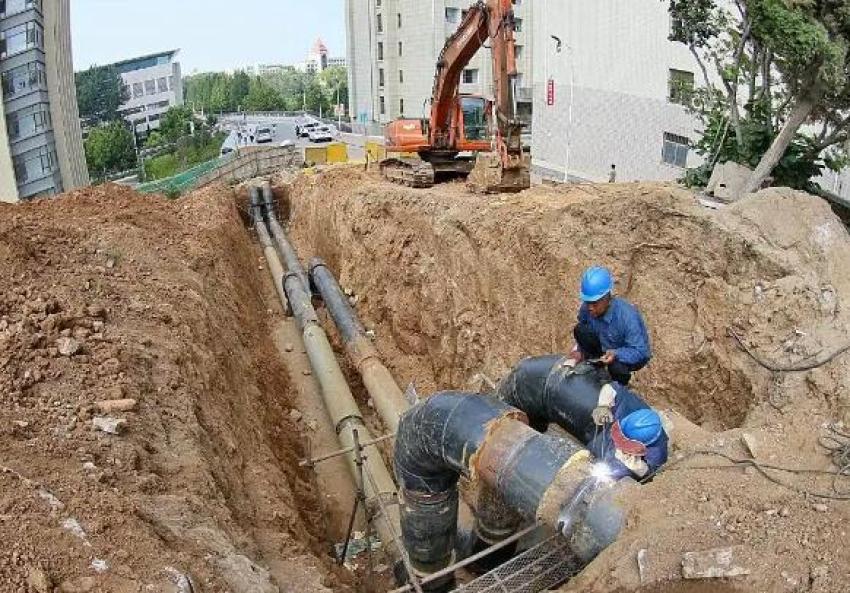
In municipal water supply, gas, and sewage treatment projects, scenarios involving material conversion of pipes are frequent—for example, connecting ductile iron pipes (corrosion-resistant and highly pressure-resistant) with carbon steel pipes (tough and suitable for high-pressure applications). Due to significant differences in material, strength, and joint types, the connection must balance sealing, stress stability, and ease of construction. Today, we'll detail three mainstream connection methods and key construction points to help you avoid pitfalls like leaks and breakage!
First, understand the connection challenges—why can't you just weld?
The difference in physical properties between ductile iron pipes and carbon steel pipes is the core challenge in connection:
Material Differences: Ductile iron has a high carbon content (more brittle), while carbon steel pipes are commonly made of low-carbon steel (good toughness). Direct welding can lead to joint cracking due to the difference in thermal expansion coefficients.
Joint Type Differences: Ductile iron pipes often have flexible joints, while steel pipes mostly have welded or flanged joints. Direct butt welding can cause leakage due to uneven stress.
Deformation Resistance Differences: Steel pipes are prone to slight bending under pressure or foundation settlement, while ductile iron pipes are more rigid. Improper connection can lead to stress concentration at the joint, damaging the seal.
Three Main Connection Solutions:
● Solution 1
Flange Converter Connection (Most common, suitable for medium and low pressure scenarios)
Principle: A "converter" with flanges at both ends connects one end to the flange (or flanged short pipe) of the ductile iron pipe and the other end to the flange of the steel pipe. Bolts are used for fastening, and a rubber gasket is used for sealing.
Applicable Scenarios: DN100-DN1000 pipelines, working pressure ≤1.6MPa, such as urban water supply and low-pressure gas pipelines.
Construction Steps:
Pre-treatment of Pipe Materials: Ductile Iron Pipe Ends: Cut smoothly, clean burrs at the joint. If the original pipe has no flange, weld a "ductile iron flange short pipe" (pay attention to controlling the welding temperature to avoid cracking of the cast iron); Steel Pipe Ends: Weld steel flange plates, ensuring the flange face is perpendicular to the pipe axis, with a deviation ≤1mm/m.
Installation of Transition Joints: Select flange transition joints with matching nominal pressure and diameter at both ends (such as a cast iron flange + steel flange combination, or an all-steel flange joint), and install an oil-resistant rubber gasket in the middle (nitrile rubber for water supply, neoprene rubber for gas); tighten bolts symmetrically, in 2-3 stages (avoid excessive force on one side), and finally ensure that the torque of each bolt is consistent (reference value: approximately 300N・m for M20 bolts).
Advantages: Simple operation, detachable, and convenient maintenance;
Note: The flange surface must be flat, and the gasket must be undamaged, otherwise leakage due to pressure fluctuations is likely.
● Solution 2
Socket-type conversion joint connection (suitable for small diameters, flexible transition)
Principle: Utilizing a specially designed "socket-type conversion joint," one end is a socket (matching the spigot of the ductile iron pipe), and the other end is a spigot (matching the socket or welded end of the steel pipe). Double sealing with a rubber ring and bolts allows for slight axial displacement and angular deviation, accommodating foundation settlement.
Applicable Scenarios: DN50-DN300 pipelines, especially buried installations in areas where slight settlement may occur, such as connections between branch pipes and main pipes in residential areas.
Construction Steps:
Clean the joint: The inner walls of the ductile iron pipe spigot and the conversion joint socket must be ground smooth to remove rust and debris; if the steel pipe end is welded, the pipe end must be beveled (30°-45°) to facilitate welding with the spigot of the conversion joint.
Install the sealing element: Insert a special rubber ring (usually a double-lip structure for enhanced sealing) into the socket of the adapter, and apply lubricant (soapy water or special grease; do not use machine oil, as it may corrode the rubber).
Matching and fixing: Slowly push the ductile iron pipe spigot into the socket of the adapter until it is in place (aligned with the marking lines); weld the steel pipe end to the spigot of the adapter using "symmetrical spot welding + layered welding" to avoid welding deformation that could lead to misalignment; finally, add a stainless steel clamp (optional) to the outside of the joint to enhance pull-out resistance.
Advantages: Flexible connection, strong resistance to settlement, suitable for complex terrain;
Note: Wrap the adapter with a damp cloth during welding to prevent high temperature damage to the rubber ring.
●Solution 3
Welding of the inner lining transition section (suitable for high-pressure, large-diameter scenarios)
Principle: When the pipeline working pressure is ≥2.5MPa (such as high-pressure gas, industrial pipelines), a more rigid connection method is required. A "lined transition short pipe" (such as ductile iron lined with steel pipe or bimetallic composite pipe) is added between two pipe materials, achieving a rigid connection through welding. The lining layer prevents direct contact between the two materials, thus avoiding electrochemical corrosion.
Applicable scenarios: Large-diameter pipelines above DN800, high-pressure transmission projects, or areas with highly corrosive soil.
Construction steps:
Transition short pipe prefabrication: Custom-made transition short pipes (500-1000mm in length) are used (one end is cast iron, the other is steel, joined by centrifugal casting or explosive bonding processes).
Welding connection: The ductile iron pipe end and the cast iron end of the transition short pipe are cold-welded using electric arc welding; the steel pipe end and the steel end of the transition short pipe are conventionally arc-welded. After welding, flaw detection is performed to ensure there are no porosity or cracks.
Corrosion Protection: After welding, apply a corrosion-resistant layer (such as epoxy coal tar pitch paint + fiberglass cloth, or 3PE anti-corrosion) to the joints and transition sections, ensuring a smooth connection with the original pipeline corrosion protection layer to prevent soil corrosion.
Advantages: High rigidity, high pressure resistance, suitable for high-pressure conditions.
Note: Welding requires high technical skill and must be performed by certified welders. A hydrostatic test is required after welding (test pressure is 1.5 times the working pressure).
Construction Key Points:
1. Interface Cleaning: Regardless of the connection method, rust, oil, and dirt at the pipe interface must be thoroughly cleaned; otherwise, the sealing effect or welding quality will be affected.
2. Seal Compatibility: The rubber ring must be compatible with the pipe diameter and the medium (e.g., high-temperature resistant rubber for hot water, fluororubber for acidic or alkaline media).
3. Stress Calculation: The pull-out resistance of the connection point must be calculated (especially for sloped or vertical installations). If necessary, concrete supports should be added for fixation to prevent the pipe from dislodging due to its own weight or the thrust of the medium.
4. Acceptance Testing: After the connection is completed, a water pressure test must be performed to ensure there is no leakage.
The core of connecting ductile iron pipes and carbon steel pipes is solving the sealing and stress problems caused by the material differences. For small-diameter, low-pressure scenarios, flanges or socket conversion joints are selected for simple operation; for large-diameter, high-pressure scenarios, an inner-lined transition section should be welded to balance strength and safety. Strict control over the three key aspects of cleaning, sealing, and welding during construction will ensure connection quality and avoid rework later!