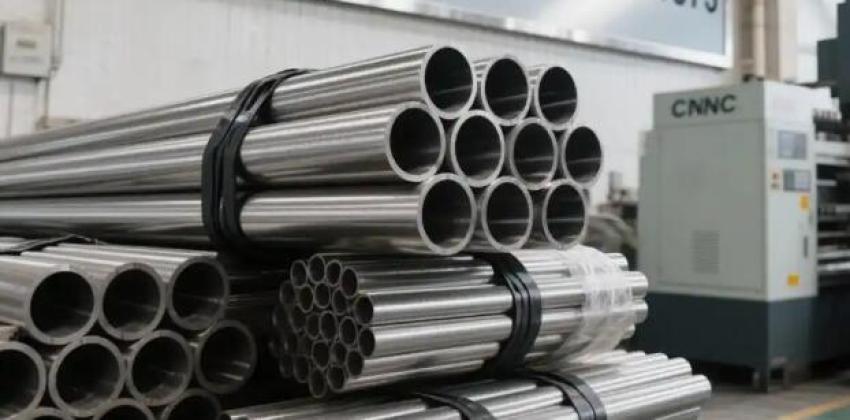
The core value of precision steel tubes lies in their extremely high dimensional accuracy and smooth surface quality, and turning is the key step in determining their surface roughness. Many people wonder why, when turning precision steel tubes, some parts have a mirror-like smooth surface, while others are covered with fine tool marks, even affecting subsequent use. In fact, controlling surface roughness is like controlling the heat and stirring rhythm when cooking. Finding the right method and controlling the details will consistently produce "qualified dishes." Today, we'll use simple language to discuss how to effectively control the surface roughness of parts when turning carbon steel or stainless steel precision tubes, avoiding technical jargon and making the key logic understandable to the average person.
First, it's important to understand that when turning precision steel pipes made of carbon steel or stainless steel, the desired surface roughness is typically between Ra 0.16μm and Ra 1.6μm (Ra 0.04μm is required in special cases). This level of surface smoothness meets the fitting requirements of precision parts and reduces frictional loss. The core of controlling roughness is essentially reducing "microscopic damage" to the part's surface during turning, avoiding noticeable tool marks, burrs, or unevenness. This can be achieved by focusing on four key aspects, each simple and easy to understand, and directly impacting the final result. (Note: Ra 0.04μm falls into the category of ultra-precision mirror finishing, typically requiring ultra-high precision machine tools for stable achievement.)
The first key:
Choosing the right "tool" is like choosing the right spatula for cooking. The tool is the "core tool" of turning; its material and cutting edge precision directly determine the smoothness of the steel pipe's surface. Ordinary tools have rough cutting edges, leaving deep tool marks on the steel pipe surface during turning, much like a dull knife cutting wood, resulting in excessive roughness. Turning precision steel pipes requires high-precision cutting tools—such as diamond tools or carbide-coated tools. These tools have sharp, smooth cutting edges, wear slowly, and can smoothly "cut" the surface of the steel pipe during turning, reducing scratches and damage, thus lowering roughness from the source. At the same time, the tool angles are also crucial. Properly adjusting the inclination angle and rake angle ensures smoother cutting, avoids burrs and tearing marks, and results in a smoother surface.
The second key point:
Adjusting the "cutting parameters" is like controlling the heat when cooking. Cutting parameters (cutting speed, feed rate, and depth of cut) are the core of controlling roughness; if these three are not properly matched, even the best tool will be useless. In simple terms, the smaller the feed rate, the smoother the surface. Feed rate is like the thickness of strokes in handwriting; the finer the strokes, the neater the writing. During turning, a smaller feed rate results in smaller tool marks left on the steel pipe surface, almost invisible to the naked eye. The cutting speed should be moderately high. Too low a speed leads to prolonged friction between the tool and the steel pipe, causing "tool sticking" and leaving adhesion marks on the surface. Too high a speed can generate high temperatures, damaging the steel pipe surface. The depth of cut must be precise. In precision turning, the depth of cut should not be too large, typically controlled between 0.1-0.3mm, to avoid excessive cutting in one go, which can cause surface deformation and tool marks.
The third key point:
Proper workpiece clamping, like securing food before processing. Precision steel pipes are mostly thin-walled and easily deformed. Improper clamping force can cause the steel pipe to bend or shift, resulting in uneven force on the tool during turning, leading to an uneven surface and excessive roughness. The correct clamping method is as follows: Select a suitable chuck, avoid excessive force, and for thin-walled precision steel pipes, add auxiliary supports (such as a center rest or follow rest) to prevent the steel pipe from shaking or deforming during turning. At the same time, clean the impurities and burrs on the surface of the steel pipe before clamping to prevent impurities from getting stuck between the chuck and the steel pipe, causing insecure clamping and affecting turning accuracy and surface quality.
The fourth key point:
Control the "machining environment," details determine the final result. Many people easily overlook the machining environment, but its impact on surface roughness cannot be underestimated. On the one hand, keep the cutting fluid sufficient and clean—cutting fluid acts as a "lubricant," reducing friction between the tool and the steel pipe, carrying away the heat generated during cutting, preventing high-temperature damage to the surface, and also flushing away cutting debris to prevent it from scratching the steel pipe surface. On the other hand, keep the machining environment clean to prevent dust and debris from adhering to the tool or steel pipe surface. These impurities will leave scratches during turning, leading to increased surface roughness. In addition, the precision of the lathe itself is also very important. A high-precision lathe can ensure smooth tool movement and avoid uneven tool marks caused by lathe shaking. In fact, controlling the surface roughness of precision steel tubes during machining doesn't involve complex principles. The core is "choosing the right tools, adjusting parameters, ensuring secure clamping, and paying attention to details." These four aspects are interconnected; by controlling each step, a smooth surface that meets requirements can be consistently achieved. For example, when machining the precision steel tube shaft of an automotive engine, by selecting diamond tools, adjusting appropriate cutting parameters, and ensuring proper clamping and coolant supply, the surface roughness can be controlled within Ra 0.16μm, meeting the part's fit requirements.
Conclusion:
Controlling the surface roughness of precision carbon steel or stainless steel tubes during machining is not achieved through a single factor, but through the coordinated efforts of multiple details. Complex professional knowledge is not required; simply understanding the core principle of "reducing microscopic surface damage" and mastering the four key points of tools, parameters, clamping, and environment is sufficient to effectively control roughness, allowing precision steel tubes to realize their full value and meet the high-end application needs of various industries.