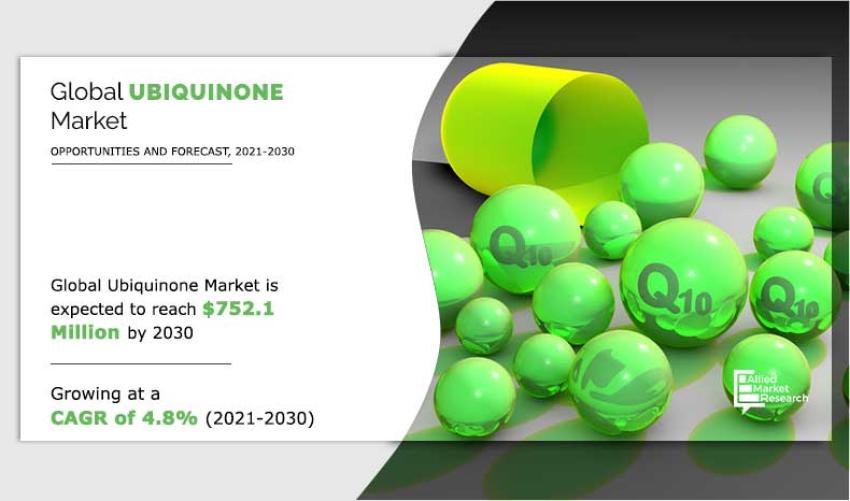
According to a new report published by Allied Market Research, titled, “ubiquinone market by product type, application: global opportunity analysis and industry forecast, 2021–2030,” The global ubiquinone market size was valued at $473.6 million in 2020, and is projected to reach $752.1 million by 2030, registering a CAGR of 4.8% from 2021 to 2030. The rising consumer awareness regarding the health benefits offered by ubiquinone is anticipated to remain a major driving factor for the growth of the ubiquinone market over the forecast period. Inherent benefits of the ubiquinone in pharmaceutical applications to treat cancer, heart health and other chronic and cardiovascular disease has also contributed towards ubiquinone market growth. Moreover, cosmetics is the growing industry in Asia-Pacific countries including India. With the increasing usage of ubiquinone as an ingredient in various cosmetics products such as anti-ageing creams and lotions across the globe is driving the growth of the ubiquinone market in term of value sales.
Moreover, the usage of ubiquinone as an antioxidant has bolstered its adoption in many therapeutic applications which focuses on mitigating the occurrence of various metabolic disorders such as cancer, diabetes, and cardiovascular disorders. In addition to this, consumption of ubiquinone as a dietary supplement have resulted in positive outcomes, particularly in patients who are on statin medications. Thereby, the aforementioned factors are expected to drive the growth of the ubiquinone market during the forecast period in terms of value sales.
Download Sample Report: https://www.alliedmarketresearch.com/request-sample/A13145
The outbreak of coronavirus has positively impacted the ubiquinone industry along with all stages of supply chain and value chain. Owing to the COVID-19 outbreak consumers all around the world became health conscious and in order to boost their immunity power consumers were getting more inclined towards the consumption of dietary supplements made of invasive ingredients including ubiquinone which in turn has boost the demand for ubiquinone from the nutraceuticals industry. This, in turn, has made a positive impact on growth of the ubiquinone market.
The global ubiquinone market is segmented on t are categorized into production method, application, and region. By production method, it is classified into microbial fermentation. By application, it is divided into dietary supplements, pharmaceuticals and cosmetics. Region wise, the market is analyzed across North America (the U.S., Canada and Mexico), Europe (Germany, UK, Italy, France, Spain, Russia and rest of Europe), Asia-Pacific (China, Japan, India, Australia & New Zealand, South Korea, ASEAN and rest of Asia-Pacific), and LAMEA (Brazil, Saudi Arabia, South Africa, Turkey and Rest of LAMEA).
LIMITED-TIME OFFER — Buy Now & Get Exclusive Discount on this Report @ https://www.alliedmarketresearch.com/checkout-final/ebe39ff55c24d2bd75a932b4ff6ea477
Key findings of the study
- By production method, the microbial fermentation segment accounted for the highest share in 2020, growing at a CAGR of 4.5% from 2021 to 2030.
- By application, the dietary supplement segment accounted for the highest ubiquinone market share in 2020, growing at a CAGR of 3.9% from 2021 to 2030.
- By region, North America occupied the maximum share in the market in 2020 and is expected to be the dominating segment during the ubiquinone market forecast period.
Companies can operate their business in highly competitive market by launching new products or updated versions of existing products. Agreement with key stakeholders is expected to be a key strategy to sustain in the market. In the recent past, many leading players opted for partnership strategies to strengthen their foothold in the market. To understand the key ubiquinone market trends, strategies of leading players are analyzed in the report.
For Purchase Enquiry: https://www.alliedmarketresearch.com/purchase-enquiry/A13145
Some of the key players in the ubiquinone market analysis includes Hangzhou Jinlan Pharm-Drugs Technology Co., Ltd., Kaneka Corporation, Kyowa Hakko Bio Co., Ltd., Oriental Yeast Co., Ltd., Shandong Octagon Chemicals Limited, Shenzhou Biology & Technology Co., Ltd., Sinoway Industrial Co., Ltd., Spectrum Chemical Manufacturing Corp., Tokiwa Phytochemical Co., Ltd. and Xiamen Kingdomway Group Company.