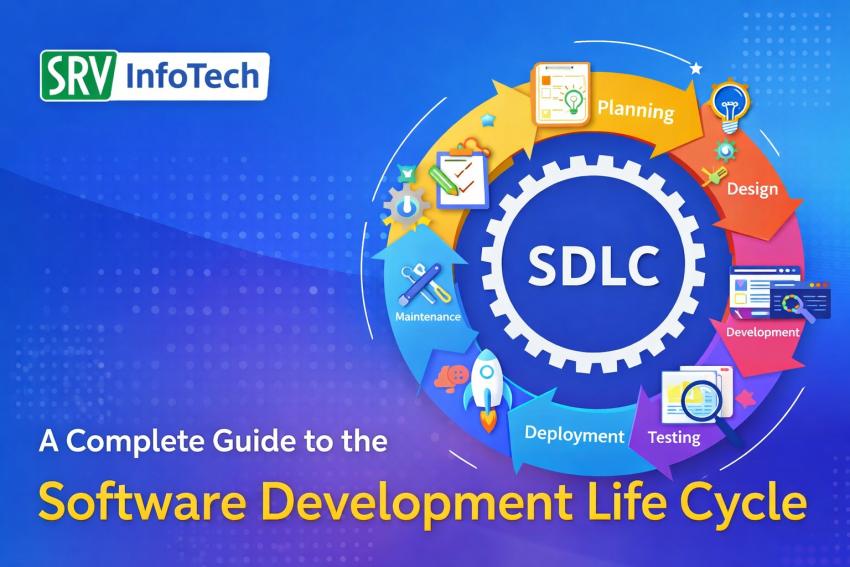
In today's world, where software powers everything from mobile apps to enterprise systems, creating reliable and user-friendly applications is more critical than ever. How does a vision turn into a working software? The answer rests with a proven roadmap: the Software Development Life Cycle. SDLC provides a structured approach to designing, building, testing, deploying, and maintaining software so that it meets real-world needs efficiently and effectively.
What is SDLC?
In essence the Software Development Life Cycle represents an organized approach to follow in designing the entire process of software development. SDLC involves stages to help ensure that all work completed in regards to this process happens in an organized fashion, thus aligning with expectations.
Instead of moving directly to coding, it encourages forward-thinking in each mission-critical activity of planning, designing, and testing to ensure that everything stays on track.
High in quality, meeting user needs
Delivered on time and within budget
Maintainable and adaptable over time
The 7 Key Phases of SDLC
Even while there might be some variations in terms of the number of phases that are clearly defined, it is common for most contemporary software application development programs to revolve around these seven phases that act as guides throughout the process:
1. Planning
This first step provides guidance to an entire project. Business goals, initial requirements, time, and resources, as well as the scope of the project, are determined by teams. Good planning eliminates future surprises.
2. Requirements Analysis
In this context, there are specific requirements gathered. What should be in the software system? What shouldn't be in it? These questions provide a guideline for future processes.
3. System Design
Designers take requirements and use them to create a technical blueprint. In this stage, system architecture design, user interfaces, data models, and system structure are determined.
4. Implementation (Coding)
Programmers implement this design by writing code. This stage can be the longest stage, where different programmers might develop different components simultaneously.
5. Testing
Before a software goes live, it has to pass certain rigorous tests in order to detect any flaws in functionality, performance, or compatibility.
6. Deployment
Once tested and accepted, "the software is released to a production environment and made available to users." Deployment models "differ" depending on an organization and can include pilots or "phase" rollouts.
7. Maintenance
The SDLC does not end when a software application is developed. Teams continue to monitor software in an ongoing effort to repair bugs, deliver new enhancements, and keep it safe and valuable.
Importance of SDLC
SDLC is "not just another checklist," but it makes software development predictable, efficient, and quality-oriented. This is why SDLC is so important:
✔ Structured Process
It removes ambiguity and creates order where teams had to rely on ad-hoc methods of dealing with tasks.
✔ Enhanced Quality Control
By embedding testing and reviews throughout the cycle, SDLC helps ensure robust software that works as expected.
✔ Risk and Cost Management
Planning early allows teams to anticipate challenges, estimate costs, and reduce the risks of expensive rework or delayed delivery.
✔ Improved Collaboration
With defined deliverables and checkpoints, cross-functional teams from developers to stakeholders stay aligned throughout development.
SDLC Models: Impact of Frameworks on the Process
The SDLC process is flexible. Different models are chosen based on project complexity, flexibility, and capabilities. Here are a few of them:
Waterfall Model
Traditional/Sequential - where each stage must complete before beginning the next one. These are simple but inflexible processes.
Agile Model
Strong emphasis on iterative development, feedback, and flexibility. Breaks down work into manageable chunks, grouped in cycles called ‘sprints’, which deliver an increasingly valuable product.
Spiral Model
Combines iterative development with strong risk assessment, ideal for large and complex projects.
Iterative Model
Breaks projects into smaller iterations, allowing teams to refine functionality through repeated cycles.
DevOps
Brings together development and operations, emphasizing automation, continuous integration, and continuous delivery (CI/CD) for faster release cycles.
Integrating Security: An SDLC to DevSecOps Transform
Security has become far from just an afterthought. Today, security practices are fully integrated throughout the SDLC, an approach to security referred to as ‘DevSecOps’. As compared to security testing at or near the completion of the SDLC, security practices, including threat analysis, code reviews, and security testing, throughout all stages help avoid weaknesses, mitigate risks, and create secure systems right from day one.
Real-World Impact of SDLC
Consider SDLC like a home-building process: You don’t drive nails without an agenda, design, or checks for quality, right? SDLC brings all this together – enabling your team to develop trustworthy, functional, and sustainable software on time and within budget. From mobile applications, cloud services, to business-level applications, SDLC brings your vision to life in an organized way.
Final Thoughts
The Software Development Life Cycle (SDLC) is more than just a to-do list; it is a guide in which the development team can create quality software in a planned manner. By knowing the stages of the life cycle and incorporating security as well as collaboration in the project using the corresponding models, the complexity can be managed in order to develop software for the users.
Knowing the Software Development Life Cycle (SDLC) is essential for developing reliable, scalable, and high-quality software solutions. Each phase of SDLC ensures better planning, efficient execution, and long-term performance of applications. At SRV Infotech, we strictly follow a well-structured SDLC approach to deliver robust software solutions, reflecting our expertise as a trusted software development company in Kerala that focuses on quality, innovation, and business success.