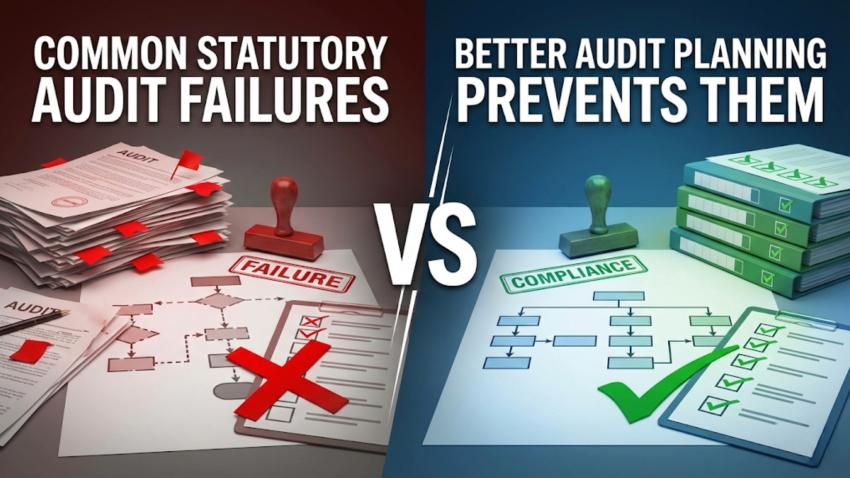
Picture this: You're a CA student who just joined your first audit assignment. Your senior hands you a checklist and says, "Just tick these boxes." Three months later, the client receives a notice from the Registrar of Companies (ROC) for non-compliance that was missed during the audit. The penalty? ₹5 lakhs. The reputation damage? Priceless.
This scenario plays out more often than you'd think in India. According to industry data, over 60% of audit failures don't happen because of intentional fraud—they happen because of poor planning and misunderstanding of what needs to be checked.
Let's understand the most common audit failures and, more importantly, how proper planning can prevent them.
What Makes Statutory Audits Fail in India?
Think of audit planning like preparing for your CA exams. You wouldn't just start studying the night before, right? The same logic applies to audits. Yet many audit failures happen because auditors skip this crucial planning phase.
The Most Common Audit Failures We See
- Revenue Recognition Errors- A software company books the entire annual maintenance contract as revenue in April itself, even though service will be provided throughout the year. This happens because auditors don't spend enough time during planning to understand the client's revenue model. Better planning means understanding exactly how the client earns money before fieldwork begins.
- Expense Misclassification- A manufacturing company spent ₹15 lakhs on repairing old machinery and booked it as capital expenditure (spreading cost over years) when it should have been revenue expense (immediate P&L impact). Good planning identifies significant expense categories upfront and determines what evidence is needed.
- Fixed Asset Register Problems- Many Indian SMEs have chaotic asset registers—assets sold years ago still in books, wrong depreciation rates, improper capitalization. What's missing? A planned approach to physically verify assets and reconcile them with books.
- Inventory Valuation Issues- A garment retailer's unsold winter collection sits in the warehouse. Should it be valued at cost price? No—it needs markdown to net realizable value. Auditors miss this when they don't plan for industry-specific risks.
- The Provision Problem- Companies often under-provide for warranties, restructuring costs, or employee benefits. A mobile phone company selling 10,000 phones should provision for warranty costs based on historical claim patterns (say 5% needing repairs). Catching this requires planning to review provision basis, comparing with industry norms—not just accepting management's numbers.
- Missing Documentation- Try tracing a ₹10 lakh payment with no invoice, approval trail, or contract. During planning, assess the client's record-keeping quality. If weak, plan for extensive testing.
Non-Disclosure of Related Party Transactions
A director's brother's company supplies raw materials at inflated prices—neither transaction nor relationship disclosed. During planning, obtain a complete list of related parties and cross-verify with MCA portal.
How Better Audit Planning Prevents These Failures
Understanding the Client's Business
Before checking any invoices, understand what the client does. Auditing a logistics company? Visit their warehouse. See how they track inventory. Talk to operations teams.
This isn't wasting time—it's planning that helps identify where things can go wrong. When you understand the business model, you spot red flags faster.
Risk Assessment - The Heart of Planning
Not everything carries equal risk. Cash transactions in retail? High risk for manipulation. Prepaid insurance? Lower risk.
Create a risk matrix during planning:
- High-risk areas get senior team members and detailed testing
- Medium-risk areas need moderate attention
- Low-risk areas can have lighter procedures
For example, auditing a pharmaceutical company? Identify regulatory compliance, inventory valuation, and research expenses as high-risk areas needing special focus.
Right People, Right Job
Imagine assigning a first-year article student to verify complex foreign exchange derivatives—disaster waiting to happen.
Good planning matches team skills with task complexity. Complex areas like revenue recognition in long-term contracts go to experienced seniors. Routine verification of office expenses? Junior article students handle this under supervision.
This isn't just efficient—it's about maintaining audit quality and giving juniors appropriate learning opportunities.
Realistic Timelines
Many failures happen due to time pressure. "Finish in two weeks" leads to corner-cutting and missed issues.
Create schedules accounting for:
- Complexity of client operations
- Quality of their record-keeping
- Client team availability
- Your team's workload
Add buffer time for unexpected complications. They always arise.
Document Your Plan
Best plans are worthless if only in the engagement partner's head. Document:
- Identified risks and mitigation approaches
- Team member responsibilities
- Timelines and milestones
- Expected evidence for key account balances
- Materiality thresholds
This documented plan becomes your audit roadmap.
Client Communication
Hold a kick-off meeting during planning. Discuss needed documents, required interviews, site visit schedules, and mutual expectations.
This prevents the classic scenario: "You need last three years' contracts? Why didn't you tell us earlier?" Getting documents at the last minute creates unnecessary pressure and increases error risk.
The Real-World Impact
When audits fail due to poor planning, the consequences are serious:
- Companies face penalties from ₹25,000 to ₹5 lakhs under Companies Act
- Auditors risk disqualification for up to 5 years
- Reputation damage spreads quickly in today's connected world
- Young CAs can see career impacts from early failures
Every hour spent in planning saves three in fieldwork and five in fixing mistakes.
Making Planning a Priority
Many auditors see planning as boring paperwork delaying "real work." But failing to plan is planning to fail.
Start every audit engagement asking:
- What can go wrong in this business?
- Where would fraud most likely occur?
- What don't I understand about operations?
- What resources do I need?
- How much time is realistic?
Answer these during planning, and you've prevented most audit failures.
For students and young auditors who want to move beyond checklist-based audits and actually understand how audit planning, risk assessment, and documentation work in real statutory audit engagements, structured learning through practical, case-based discussions—such as those covered in Masterclass on Statutory Audit can help bridge the gap between textbook theory and on-ground audit execution.
Final Thoughts
Statutory audits ensure stakeholders can trust financial information. When audits fail, everyone loses.
The good news? Most failures are preventable through systematic planning.
Whether you're doing your first audit or you're experienced, remember: audit quality is determined not in fieldwork, but in planning hours before stepping into the client's office.
The next time someone says "just tick the boxes," ask: "What's our audit plan? What are the risks? How are we addressing them?"
That's what separates good auditors from great ones.