API testing holds an importance in modern software development. Applications today rely on fast and reliable connections between services. To deliver quality products, teams must test APIs in a structured way. Tools like Postman and Insomnia caught on because they provide a nice graphical interface. But with the increasing complexity of systems, developers are seeking something more flexible and valuable in the long term. This is where code-powered open source tools are catching on.
The landscape of API testing is changing rapidly. Cost-efficient and automated solutions are now a priority. Karate API testing is becoming one of the leading choices because the Karate framework and tutorials provide both simplicity and power. Many developers are adopting Karate as they look for alternatives to Postman for API testing.
Challenges with GUI-based tools like Postman and Insomnia
Graphical tools such as Postman or Insomnia are widely used for quick checks and creating collections. They help beginners start fast, but challenges appear once a project grows.
● Ease of use vs maintainability: GUI tools are easy to learn, but test scripts can become difficult to manage as they expand.
● Scaling automated tests: Executing large suites demands work and frequently ends in extended runtimes.
● Integration challenges: Attaching tests to CI/CD pipelines can be a hassle.
● Postman collections: These can get gross when shared among big teams, confused and duplicated.
Such issues often limit teams who need a more reliable and scalable approach.
Why GUI-Based Tools Are Limited
The biggest drawback of GUI-based testing lies in long-term maintenance. While initial setup is smooth, keeping collections updated across teams can be painful. Scaling automated tests across multiple environments is another challenge.
Integration with CI/CD pipelines is possible but not always smooth. Postman collections, for example, need workarounds for automation. This slows down development speed. In short, GUI tools provide convenience at first, but they struggle with growth and automation requirements.
The Shift Toward Code-Driven API Testing Tools
Developers are now moving to code-based tools. These frameworks provide automation features that fit naturally into development workflows. They work well with version control and make it easier to scale tests.
Karate Labs stands out in this movement. It is open-source, developer-centric and for both novices and experts. By providing tutorials and a user-friendly syntax, Karate Labs lowers the entry barrier all while remaining powerful.
Code-Based Open Source API Testing Tools
Code-first open-source tools are quietly taking over the world of testing. These tools enable test scripts to be authored in Java, Python or JavaScript. Notable frameworks are REST-Assured, Karate, SuperTest and PyTest.
Benefits of code-based open-source tools:
● Flexibility in building advanced scenarios and handling edge cases.
● Customizable scripts tailored to the unique requirements of APIs.
● Strong integration with development workflows and automation systems.
● Version control supports collaboration and tracking changes.
As software demands increase, these tools have become trusted for reliable, scalable, and cost-friendly testing.
Karate Labs as a Top Alternative to Postman
Karate API testing offers a strong framework for developers who want to improve their testing process. It is one of the most widely adopted alternatives to Postman for API testing.
Key advantages of Karate include:
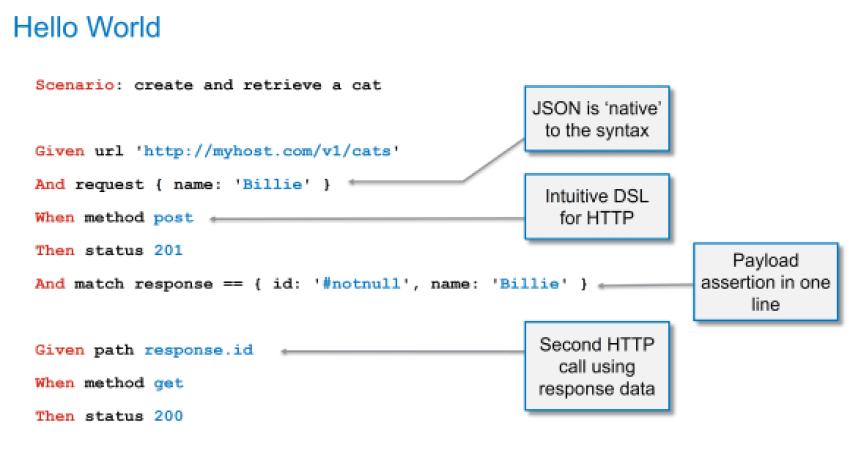
● Simplified Test Scripting: Karate uses a Domain-Specific Language (DSL) with clear syntax. Test scripts are simple to compose and comprehend, even for those with little programming background.
● Default Functions: Karate Lab’s features include data-driven testing, parallel execution, and detailed reports. These are what make test suites so potent and flexible.
● Integration-Friendly: It is an ideal option for CI/CD pipelines as it works effortlessly with jenkins and Git.
● Reusable Code: You can modularize your test scripts, so updating them takes less time.
● Active Community: It has an active user community offering resources, advice and solutions.
Comparing Postman vs Karate Labs
Feature Postman Karate Labs
GUI-based Yes No
Code-driven scripting Limited Full support
CI/CD integration Moderate High
Scalability Medium High
Karate Labs brings together multiple testing needs in a single platform.It combines API automation, performance tests, API mocks and UI automation. Its syntax is language-neutral, accessible to non-programmers. Assertions and HTML reports are built in, and parallel testing accelerates run time.
For teams not comfortable with Java, Karate also provides a cross-platform executable. This removes the need for compilation and enables writing tests directly. The framework supports HTTP, JSON, GraphQL and XML, giving teams flexibility across formats. A Java API is also available for those who prefer direct programmatic integration.
Why Karate Labs Leads the Way
Karate is unique among open-source testing tools. It does not only cover API automation but also brings performance testing and UI testing together. This unified approach saves teams from switching between different tools. It’s minimalistic in design, but remarkably sophisticated in capabilities. In combining ease of use with powerful features, Karate is one of the most pragmatic Postman alternatives for API testing.
In A Nutshell
API testing has evolved from simple GUI clicks to code-driven automation. Teams are moving toward frameworks that support maintainability, automation, and integration with modern development systems. GUI tools like Postman helped popularize API testing, but they fall short when projects demand scale.
Karate Labs offers an open-source, flexible, and future-ready approach.It combines API, UI and performance testing into a unified platform. So for teams seeking trustable, open-source Postman alternatives for API testing, Karate provides a practical, open-hand option, with passionate community support and a developer-focused philosophy. Start adopting Karate Labs today to modernize your testing workflows.