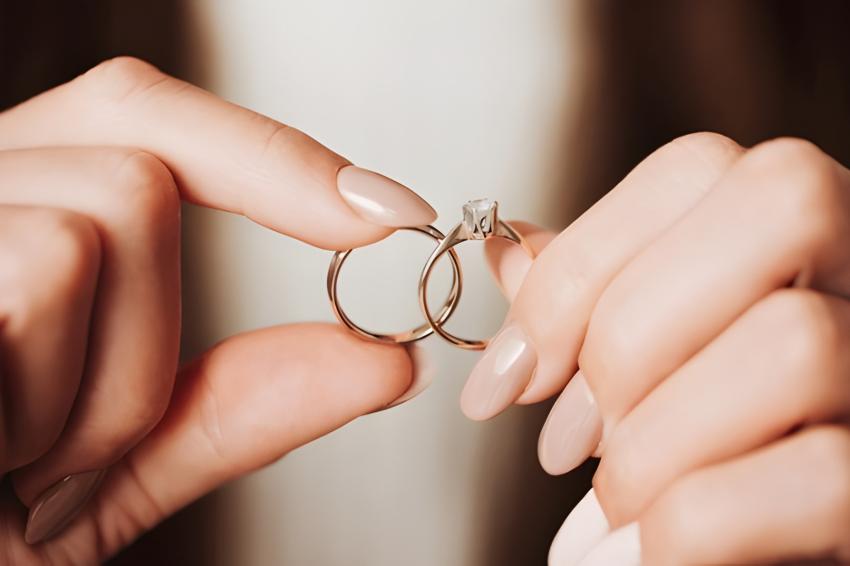
The call to marriage will be heralded with two singular purchases for many couples: the engagement ring and the wedding ring. These rings are usually worn on the same finger but are different from each other in essence, design, and, quite interestingly, price tags. An understanding of these rings in financial terms forms a crucial aspect in the planning of your future. For instance, are you in budget preparation? Obviously, you must have asked the master question: what should I expect to spend? This answer is not a single number but a range influenced by tradition, personal taste, and market trends. Here is a breakdown of average costs as well as factors that create a wide spectrum for both pieces of jewelry, beginning our exploration of the financial differences between an engagement vs. wedding ring.
The Star of the Show: Breaking Down Engagement Ring Costs
Usually, it will be the heavier of the two: an engagement ring is tradition's centerpiece for making itself the most ostentatious display. According to various industry reports, including those of The Knot and Brides, the national average price of an engagement ring in the United States consistently falls between $5,000 and $7,000. However, that average number is really just a starting point—almost everyone ends up spending more than that because very nearly all of the cogs in determining cost revolve around the "Four Cs" of the central diamond: Cut, Color, Clarity, and Carat weight.
The Center Stone: This is the biggest cost driver. A high-quality, one-carat diamond can easily reach the $5,000 mark on its own, while larger carat weights or rare colored diamonds can push the price into the tens or even hundreds of thousands. Many modern couples are also opting for alternative gemstones like sapphires, morganites, or moissanite, which can offer a stunning look for a fraction of the cost of a diamond.
The Setting: The metal and design of the ring band also make a significant contribution. A simple solitaire setting in 14k white gold will be much more affordable than a more complicated halo setting crafted in platinum. Also, the complication of the design along with side stones or detailing as milgrain work will add to the labor cost.
Brand Name vs. Independent: A common practice of visiting those well-known high-street jewelers usually entails a little extra price in the cost for which clients have to pay for the name. Buying from an independent jeweler or through a reputable online retailer generally has much better value for those materials.
The Understated Companion: Understanding Wedding Ring Pricing
Compared to an engagement ring, a wedding band would have a much simpler design, thereby representing the everlasting and unbroken concept of marriage. Hence the reason it is really more inexpensive. The average price of a wedding band would actually differ quite widely—women's wedding bands might average anywhere between $500 and $1,500, while men's bands would range from about $400 to around $1,200. By design, wedding rings are intended for habitual and lifelong use; therefore, they are made up of comfortable and indestructible aspects of design.
Women’s Wedding Bands: The price, as a rule, is determined by the ability of the band to contour or nestle with the engagement ring. The cheapest option is a simple classic metal band. However, if the band has diamonds or gemstones (an "eternity" or "half-eternity" band), it will increase the price accordingly and may rival that of a simpler engagement ring.
Men’s Wedding Bands: The availability of materials for men's rings has greatly expanded. Classic gold bands (yellow, white, or rose) are still popular, but an increasing percentage of grooms are steering away from these metals in favor of alternative materials, such as tungsten carbide, titanium, or ceramic. Such materials resemble metals with their high durability and often hypoallergenic properties while giving a luxurious feel, but they are often much cheaper than precious metals, though one can still find pricey offerings such as platinum.
Key Factors That Influence the Engagement vs. Wedding Ring Price Gap
Why is the difference in average price so enormous? There are three main reasons for that: traditional, material, and design complexity.
Tradition and Marketing: The whole idea of investing a considerable amount in an engagement ring was made popular by one diamond company's advertisements during the 20th century. Thus, cultural expectations developed around how an engagement ring should be an expensive investment. The wedding ring is extremely meaningful but doesn't have quite the same commercial weight as an investment.
Material Volume and Value: Most engagement rings have one large, high-value center stone enveloped in a dominating setting. A wedding band (particularly if plain) uses a fraction of the amount of metal and has typically very few or no stones; hence, the less costly material input.
Design Intricacy: Engagement rings tend more toward intricate works of art needing fine craftsmanship to hold a precious stone firmly. The typical comfort-fit design of wedding bands is much simpler to manufacture, which helps keep down labor costs.
Modern Trends and Practical Budgeting Tips
Redefining such traditions are today's couples, many of whom are choosing not to have diamond engagement rings or custom-made stackable rings or are doing away with rings altogether and settling for just a single piece instead. The best part is that there is absolutely no rule—the budget you set should be personally appropriate and comfortable for you.
In keeping with the rings as a whole, one might choose an elaborate engagement ring and then opt for a simple and cheaper wedding band. Or vice versa, if opting for a minimalist engagement ring, the budget goes toward bringing home a stunning diamond wedding band. Don't forget the insurance part for both rings, just in case there's an investment worth protecting.
The Bottom Line: It’s About Your Story
The so-called "average" price is only that—a guideline. The worth of these rings is not found in the number on their price tags; it is found in the commitment that they symbolize. Whether you spend a few hundred dollars or a small fortune, the rings that are perfect for you are the ones that tell your own personal love story and that are in line with your financial reality. Now that you understand what the average costs are and, more importantly, what the costs are spent on, you will feel free and confident to walk into an engagement vs. wedding ring decision with knowledge in hand.