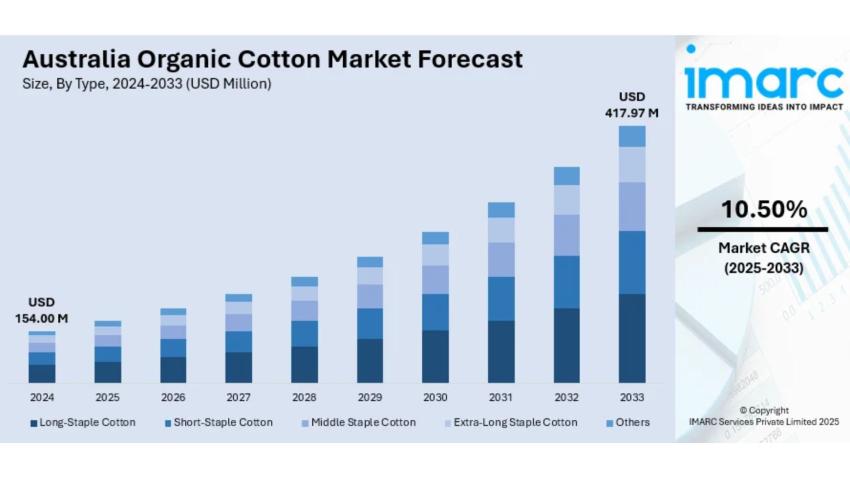
The latest report by IMARC Group, titled “Australia Organic Cotton Market: Industry Trends, Share, Size, Growth, Opportunity, and Forecast 2025–2033,” offers a comprehensive analysis of the Australia organic cotton market growth. The report also includes competitor and regional analysis, along with a breakdown of segments within the industry. The Australia organic cotton market size reached USD 154.00 Million in 2024. Looking forward, IMARC Group expects the market to reach USD 417.97 Million by 2033, exhibiting a growth rate (CAGR) of 10.50% during 2025–2033.
Report Attributes:
Base Year: 2024
Forecast Years: 2025–2033
Historical Years: 2019–2024
Market Size in 2024: USD 154.00 Million
Market Forecast in 2033: USD 417.97 Million
Market Growth Rate 2025–2033: 10.50%
Australia Organic Cotton Market Overview
- People are starting to realize the bad effects of pesticides and chemicals used in regular cotton farming, so they're moving towards organic options.
- Many fashion companies are now using organic cotton in their products and are being open about where their materials come from, making sure they’re sustainably sourced.
- More and more, online stores are expanding their offerings, making it easier to shop with more choices and better info about the products.
- Manufacturers of baby and maternity items are using organic cotton to meet the needs of parents who care about their children's health and want safe, chemical-free fabrics.
- Schools, hospitals, and businesses focused on health and wellness are also using organic cotton for uniforms and everyday use.
- The growing interest in eco-friendly fashion and labels that show a product is environmentally friendly is helping support better supply chains and local farming of organic cotton.
Key Features and Trends of Australia Organic Cotton Market
- Market players are teaming up with certified organic cotton growers to make sure the products are high quality and can be traced back through the certification process.
- New ideas in textile design and manufacturing are becoming more common as more people in Australia start to care about eco-friendly fashion.
- Using social media and influencer promotions is helping more people learn about buying sustainably and choosing organic cotton items.
- More people are shopping online and through mobile devices, which is making organic cotton products easier to find for both city and country customers.
- Brands are using eco-friendly labels and certifications to show they are serious about sustainability and to earn the trust of shoppers who care about the environment.
Growth Drivers of Australia Organic Cotton Market
- More people want fabrics that are made in a sustainable and ethical way.
- People are becoming more aware of how pesticides and chemicals affect health and the environment.
- More products are available online, and e-commerce is growing quickly.
- These fabrics are being used more in baby and maternity items.
- There is support from groups that promote green fashion and eco-labels.
Innovation & Market Demand of Australia Organic Cotton Market
- Companies are working with approved organic producers to improve product quality and track where ingredients come from.
- Designers are using eco-friendly methods in making clothes, which helps create new and better sustainable clothing and packaging.
- Local farms are getting help from people who care about the environment and local laws, which encourages more farmers to grow organic crops.
- Online tools and shopping apps are being used to reach customers better and make them more involved with the brand.
- Manufacturers are making special organic cotton items to meet the needs of people who care about health and safety, like those who need products for babies or wellness.
Australia Organic Cotton Market Opportunities
- Brands are adding maternity and baby care products to their lines because more people are asking for soft, non-toxic fabrics.
- E-commerce and mobile shopping are helping reach people in rural and remote areas, making it easier to connect with more customers.
- The wellness industry is growing, and more brands are using eco-labels, which helps them stand out and build trust with customers.
- Companies are finding new ways to grow their businesses by focusing on sustainable materials and ethical production practices.
- Using certified supply chains is making it easier for Australian organic cotton to be traded both locally and around the world.
Australia Organic Cotton Market Challenges
Ensuring consistent supply of certified organic raw cotton remains a key challenge for manufacturers.
Managing cost competitiveness with conventional cotton products requires optimization and innovation.
Addressing consumer price sensitivity in mass-market segments is necessary for broader adoption.
Maintaining transparency and traceability throughout the supply chain requires ongoing investment.
Adapting to fluctuating regulatory standards and certification processes poses operational hurdles.
Australia Organic Cotton Market Analysis
The industry is experiencing a transition towards fully traceable and certified production chains.
Regional diversity in adoption rates is reflecting differentiated consumer awareness and policy support across Australia.
The market is diversifying with multi-segment applications in apparel, packaging, and institutional uses.
Brands are intensifying marketing efforts through digital channels and influencer partnerships.
Players are assessing supply chain resilience amidst environmental and market fluctuations.
Australia Organic Cotton Market Segmentation:
By Type:
Long-Staple Cotton
Short-Staple Cotton
Middle Staple Cotton
Extra-Long Staple Cotton
Others
By Quality Type:
Supima/Pima
Upland
Giza
Others
By Application:
Apparel
Packaging
Others
By Region:
Australia Capital Territory & New South Wales
Victoria & Tasmania
Queensland
Northern Territory & Southern Australia
Western Australia
Australia Organic Cotton Market News & Recent Developments:
In January 2024, leading brands announced new sustainable collections featuring certified Australian organic cotton for the domestic and export markets.
In February 2024, partnerships between local growers and fashion companies were formed to strengthen traceable organic supply chains.
Australia Organic Cotton Market Key Players:
Leading Australian organic cotton producers
Major fashion brands adopting organic textiles
Certified supply chain partners
Eco-label and certification agencies
Key Highlights of the Report:
Market Performance (2019–2024)
Market Outlook (2025–2033)
COVID-19 Impact on the Market
Porter’s Five Forces Analysis
Strategic Recommendations
Historical, Current and Future Market Trends
Market Drivers and Success Factors
SWOT Analysis
Structure of the Market
Value Chain Analysis
Comprehensive Mapping of the Competitive Landscape
Note: If you need specific information that is not currently within the scope of the report, we can provide it to you as a part of the customization.
🔍 FAQs: Australia Organic Cotton Market
Q1: What is the projected value of the Australia organic cotton market by 2033?
A: The market is expected to reach USD 417.97 Million by 2033.
Q2: What are the main drivers for the organic cotton market’s growth in Australia?
A: Key drivers include rising demand for sustainable fabrics, increased awareness of chemical impacts, and expanding online sales channels.
Q3: Which application segments are witnessing rising usage of organic cotton?
A: The most growing segments are apparel, packaging, and baby/maternity products.
Q4: How are brands increasing consumer confidence in organic cotton products?
A: Through transparency in sourcing, certifications, and eco-labeling efforts.
Q5: Which regions are covered in the market assessment?
A: The report covers Australia Capital Territory & New South Wales, Victoria & Tasmania, Queensland, Northern Territory & Southern Australia, and Western Australia.
About Us:
IMARC Group is a leading market research company that provides management strategy and market research worldwide. We partner with clients in all sectors and regions to identify their highest-value opportunities, address their most critical challenges, and transform their businesses. Our solutions include comprehensive market intelligence, custom consulting, and actionable insights to help organizations make informed decisions and achieve sustainable growth.
Contact Us:
134 N 4th St. Brooklyn, NY 11249, USA
Email: sales@imarcgroup.com
Tel No: (D) +91 120 433 0800
United States: +1-631-791-1145