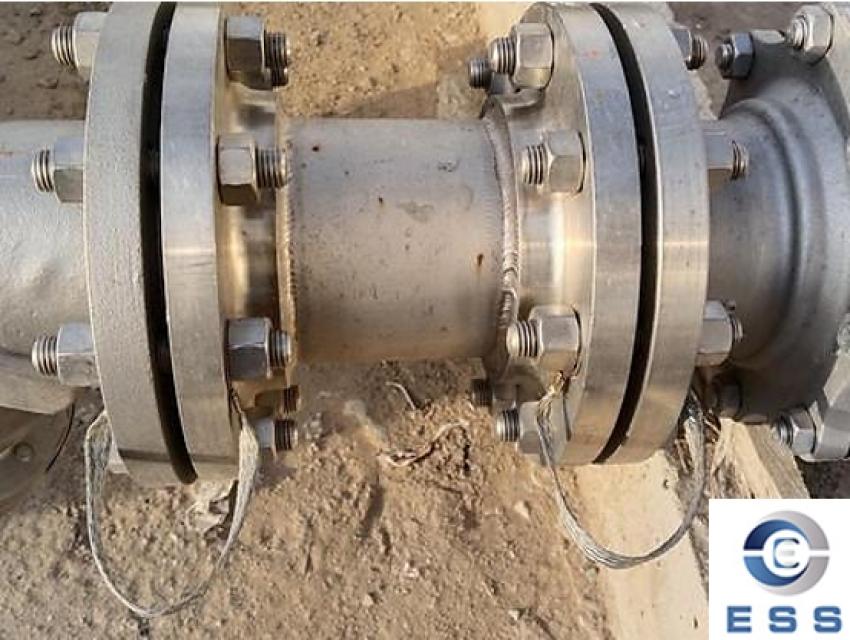
In industrial production, pipe flanges are a common connection component and are widely used in the connection of pipelines, containers, equipment, etc. However, in certain cases, pipe flanges need to be jumped to ensure the safety, stability and efficient operation of the system. So, why do pipe flanges need to be jumped? This article will discuss this issue in detail.
Electrical connection and grounding
First of all, pipe flange jumper plays an important role in electrical connection. In many industrial systems, pipe flange connections may need to be electrically conductive due to material, environmental or process requirements. As an effective means of electrical connection, jumper connection can ensure that the potential on both sides of the pipe flange is equal, thereby avoiding electric sparks or arc discharges caused by potential differences. This discharge phenomenon may not only damage the equipment, but also cause serious consequences such as fire or explosion. Therefore, by bridging the pipe flange, the continuity and stability of the electrical system can be ensured, and production safety can be guaranteed.
Pipe flange jumper connection also helps to achieve equipment grounding. In electrical systems, grounding is one of the key measures to ensure the safe operation of equipment. Connecting the equipment to the grounding system through the pipe flange jumper can effectively conduct the static charge or leakage current on the equipment to the earth, thereby avoiding safety hazards caused by static electricity accumulation or leakage.
Preventing electrostatic hazards
In addition to electrical connections, pipe flange jumpers are also important in preventing electrostatic hazards. In flammable and explosive environments such as petroleum, chemical industry, and natural gas, static electricity is one of the main causes of fire and explosion accidents. When liquid or gas flows in a pipeline, a large amount of static electricity will be generated due to friction, impact, and other reasons. If these static electricity charges are not discharged in time, they may accumulate at the pipe flange connection and cause discharge.
Through the pipe flange jumper, the static electricity on both sides of the pipe flange can be connected to form a continuous static electricity discharge channel. In this way, when static electricity accumulates in the pipeline, it can be quickly discharged to the earth or other safe areas through the jumper device, thereby avoiding safety hazards caused by static electricity accumulation. At the same time, pipe flange jumpers can also reduce the risk of equipment damage and casualties caused by static electricity discharge.
Ensure safe operation of equipment
Pipe flange jumpers are also crucial to ensure the safe operation of equipment. In industrial production, the safe operation of equipment is the basis for ensuring production efficiency and product quality. As a key component of equipment connection, the stability and reliability of pipe flanges directly affect the operation of the entire system.
Through pipe flange bridging, the strength and stability of the pipe flange connection can be enhanced to avoid leakage, breakage and other faults caused by loose or loose connections. At the same time, the jumper device can also monitor and warn the pipe flange connection in real time, and promptly discover and deal with potential safety hazards. In this way, not only can the reliability and service life of the equipment be improved, but also the maintenance cost and the risk of shutdown can be reduced.
Summary
In summary, pipe flange bridging plays a very important role in industrial production. It can not only realize electrical connection and grounding, prevent electrostatic hazards, but also ensure the safe operation of equipment. Therefore, when designing and installing pipe flange connections, the necessity and rationality of the jumper should be fully considered to ensure the safe, stable and efficient operation of the system. At the same time, for pipe flange connections that have been put into use, regular inspections and maintenance should also be carried out to ensure the integrity and effectiveness of the jumper device.