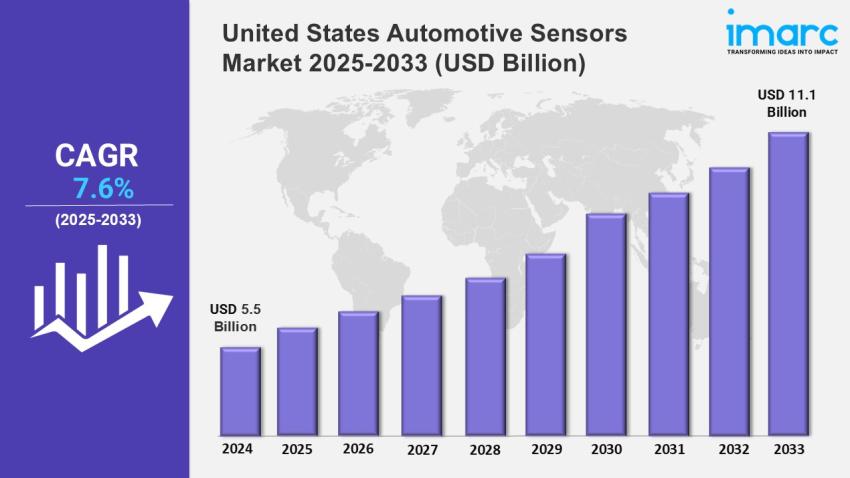
The united states automotive sensors market expands rapidly because of technological advancements which support both vehicle safety as well as efficiency along with consumer preferences for connected vehicles. Modern electric vehicles operating with autonomous systems require advanced sensors to monitor vehicle performance in real time. Vehicle sensors are essential components that boost the operation of advanced driver-assistance systems (ADAS) and EV battery control as well as managing exhaust emissions in conventional combustion engines. Automakers currently add sensors to their vehicles because the technology helps reach government regulations while improving fuel efficiency and decreasing emissions. The automotive industry is undergoing a transformation because of rising smart vehicle popularity which utilizes IoT-enabled sensors that enable predictive servicing and seamless interconnectivity. Advanced vehicle technology development creates an increasing market need for precise and dependable sensors which drives manufacturing companies to innovate their products and compete actively.
The united states automotive sensors market sees a major development where manufacturers focus on producing small-scale inexpensive sensors which provide equivalent performance standards. Manufacturers concentrate their efforts toward creating small-size durable sensors used for modern vehicles. These sensors require both light weight and exact precision characteristics to integrate into vehicle manufacturing processes. Real-time decision-making which depends on sensors that process large data volumes has become more important because of growing adoption of artificial intelligence (AI) and machine learning in automotive systems. Modern car owners are increasing their interest in automotive sensor upgrades for their older vehicles which drives expansion in the aftermarket sector. Research and development activities focus on sorting out cybersecurity threats alongside the integration challenges of multiple sensor systems despite existing difficulties. Sensors establish their position as central innovation elements because the automotive industry continues its movement toward automated and sustainable operations thus defining the mobility path of the United States.
The increasing focus on connectivity and data-driven automotive ecosystems is another significant trend. Sensors that facilitate vehicle-to-everything (V2X) communication are becoming more and more common in modern automobiles, enabling them to communicate with cloud-based platforms, other automobiles, and infrastructure. The user experience and overall driving efficiency are improved by this connectivity, which also improves over-the-air (OTA) software updates, predictive maintenance, and real-time traffic management. Additionally, the need for better in-flight experiences is driving the use of environmental and biometric sensors that track passenger comfort, air quality, and driver fatigue. Sensor fusion, which combines data from multiple sensors to make more accurate decisions, is becoming an increasingly important part of automotive design as automakers concentrate on personalization and smart mobility solutions. These trends' convergence demonstrates the industry's move toward more intelligent, secure, and environmentally friendly transportation options.