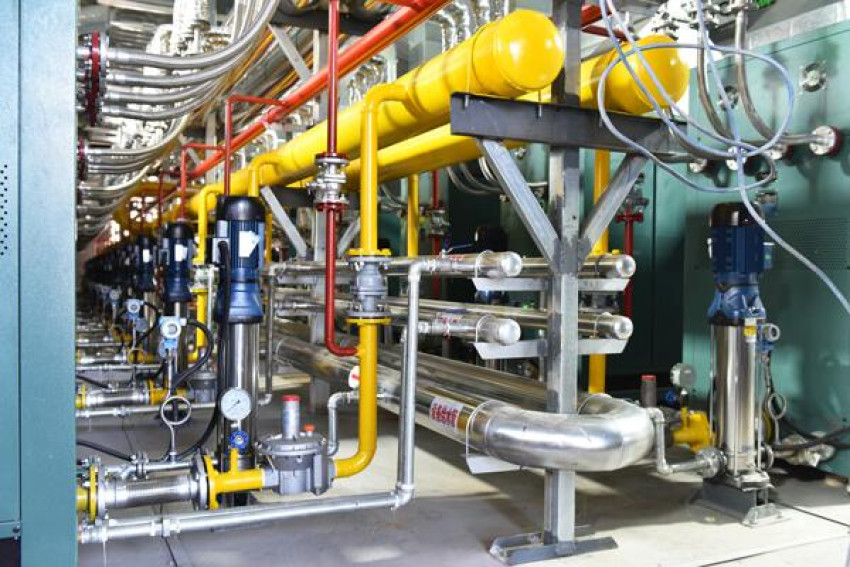
The boiler heating surface tubes include: water-cooled wall tubes and convection tube bundles. Common defects of boiler body heating surface tubes include: corrosion, wear, overheating, scaling, etc. Although the boiler structure is different, the defects that occur during use are generally inseparable from these forms of damage. Therefore, boiler tubes must be paid special attention to in use, maintenance, inspection and repair.
Impact of boiler heating surface damage:
Damage to the boiler heating surface refers to leakage and explosion of water-cooled walls, economizers, superheaters, and reheaters. Among all kinds of accidents of power plant boiler equipment, heating surface damage accidents are the most common, accounting for about 30% of the total number of accidents. Once the boiler heating surface leaks or explodes, most of them need to be shut down for post-processing, and the economic losses caused by this will be huge. When the heating surface explodes, due to the large amount of steam and water spraying out, it will cause a large disturbance to the boiler operation condition, the smoke temperature on the explosion side will be significantly reduced, and the smoke temperature deviation on both sides of the boiler will increase, which will bring difficulties to the control and adjustment of parameters. When a pipe bursts on the water-cooled wall, it will also affect the stability of boiler combustion, and even cause the boiler to extinguish in severe cases. When the heating surface leaks or bursts, if it is not shut down in time for treatment, it is also very easy to cause damage to the adjacent heating surface pipe wall, and bring adverse effects to equipment such as air preheaters, electrostatic precipitators, and suction fans. Therefore, after the heating surface damage accident occurs, the cause should be carefully found, and preventive countermeasures and measures should be formulated to try to avoid and reduce the occurrence of leakage or pipe burst accidents.
Analysis of the main causes of boiler heating surface pipe damage:
1. Boiler heating surface corrosion
The corrosion and thinning damage of the boiler heating surface, due to the large scope involved, often leads to repeated explosions and shutdowns once exposed, and the repair workload is large. Therefore, preventing and protecting equipment from corrosion is one of the basic tasks that must be solved to improve the availability of the unit. Steam and water side corrosion is divided into caustic corrosion, hydrogen damage, oxygen corrosion, under-scale corrosion and stress corrosion according to its mechanism. Flue gas side corrosion includes water-cooled wall corrosion to the fire side, high-temperature coal ash (oil ash) corrosion and low-temperature corrosion. Many domestic power plants have had large-scale tube replacements due to under-scaling corrosion, hydrogen damage to water-cooled walls, and corrosion toward the fire side. A boiler once had a major personal accident with one death and six injuries due to corrosion and explosion of the outer wall of the downcomer in the inclined ceiling. Some foreign supercritical units have had solid hard particle erosion of nozzles and blades caused by the fall of oxide scale on the inner wall of the superheater tube being brought into the steam turbine by steam.
2. Boiler heating surface wear
The flue gas scouring and fly ash wear of the heating surface of the power generation boiler not only cause frequent replacement of the heating surface, increase the cost of power generation, but also cause leakage or tube explosion accidents on the heating surface, directly leading to unplanned shutdowns. Flue gas scouring and fly ash wear of the heating surface are generally localized, and are usually more severely worn in the flue gas corridor area with high flue gas velocity and areas with high ash concentration. To reduce flue gas scouring and fly ash wear, on the one hand, the layout of the heating surface should be improved to avoid the formation of "flue gas corridors" as much as possible, and anti-wear tiles should be installed at the places where the tubes are prone to wear; on the other hand, it should also start from the operation adjustment, control the air leakage in various parts of the boiler to reduce the flue gas flow rate, pay attention to the combustion adjustment work; the third is to avoid the occurrence of incomplete combustion.
3. Overheating of the boiler heating surface
The influence of overheating operation on the leakage of boiler heating surface tubes is obvious. It is well known that overheating operation can usually be divided into long-term overheating and short-term overheating. The more common long-term overheating operation mainly refers to the tube wall temperature being above the design temperature but below the lower critical temperature of the material. In this process, the overheating amplitude is not large but the time is long, and the boiler tubes undergo carbide spheroidization and creep accelerates at the same time, so it is easy to cause brittle cracks and bursts at the weak parts of the tubes. In addition, short-term super-stable operation, which is opposite to long-term super-stable operation, mainly refers to the tube wall temperature exceeding the lower critical temperature of the material, which leads to a decrease in material strength and expansion and bursting of the tube under the action of internal pressure. Therefore, it is very necessary to prevent boiler heating surface tube leakage under this premise.
4. Scaling of boiler heating surface
Scaling is one of the common causes of damage to boiler heating surface. Because one side of the heating surface contacts flame or flue gas, and the other side contacts water or heat transfer oil, in the process of heat exchange between the heating surface and boiler water, it will be affected by water quality and produce scale. If the boiler feed water contains bicarbonate impurities, it will be decomposed by heat at high temperatures to form insoluble precipitates. In the process of boiler feed water circulation, as the temperature rises and falls, some salts will also form crystals and adhere to the tube wall of the heating surface. These precipitates are hard and dense and are called scale. Since the thermal conductivity of scale is poor, once more scale is formed on the heating surface, it will affect the thermal conductivity of the heating surface and cause the local temperature of the metal tube wall to rise. When the temperature exceeds the limit allowed by the metal tube wall, the metal tube wall overheats and creeps, and the strength decreases. Under high pressure, it will cause bulging, perforation, and rupture of the heating surface. When the heating surface is damaged, it directly affects the safety of boiler operation.
5. Installation quality of boiler heating surface
Poor installation quality is one of the important reasons for leakage problems and unplanned shutdown of generator sets. Poor installation quality of boilers will cause huge economic benefits to power companies to a large extent. In addition, poor installation quality will increase the number of boiler surface tube leakages and reduce the health level of boiler heating surfaces, resulting in the inability to effectively implement the safe production of many thermal power generation companies.
Main prevention and control measures for damage to boiler heating surface tubes:
1. In order to prevent the rapid formation of oxide scale, the main prevention and control measures should control the over-temperature operation of the local or overall temperature of the entire unit. Whether it is the main steam temperature or the reheat steam temperature, its temperature control should serve the temperature of the pipe wall in the entire boiler. If the temperature exceeds the pipe wall temperature, combustion adjustment should be carried out in time. If the combustion adjustment is ineffective, the intermediate point temperature can be appropriately reduced to suit the temperature operation of the entire unit. Under realistic conditions, strengthening the adjustment and monitoring of the difference between the boiler air temperature and the flue gas temperature and the main temperature deviation can effectively prevent the occurrence of local over-temperature operation of the heating surface.
2. The main reason for the scale on the heating surface of the boiler is that the boiler feed water contains impurities and the water quality does not meet the standard. Therefore, controlling and managing the water quality of the boiler feed water is an important way to reduce scale. Therefore, according to the operating conditions of the boiler, a reasonable water quality standard should be designed for the boiler water, and the quality should be strictly controlled. On the basis of ensuring the quality of the boiler feed water, the boiler should be regularly maintained to prevent the formation of scale. In addition, a reasonable water supply should be designed according to the operating conditions of the boiler to minimize the amount of make-up water.
3. For welding defects in the installation of pipes on the heating surface of the power station boiler, corresponding measures must be taken to prevent and reduce the occurrence and development of these defects. Problems that occur during welding, such as rough weld ripples, uneven and irregular welds, unsmooth transition between welds and parent materials, poor weld joints, and uneven weld heights, are mostly caused by unclean cleaning of weld ports, poor control of welding current and speed, etc. The welds formed by the welds can be polished and repaired. Before operation, the engineering drawings should be carefully studied and the relevant standards should be strictly followed. Different welding methods and welding skills should be used for different welding positions, and the welding current and speed should be reasonably controlled, while improving one's own professional level; for welding defects with depressions or grooves on the parent material near the edge of the weld, it is mainly because the welding current is too large and the wire feeding speed is too slow, which will cause the arc to become longer. This situation will reduce the effective cross-sectional area of the parent material. The preventive measures are mainly based on the specification requirements of the welding project, select appropriate current parameters and coordinated wire feeding speed, and try to use short arc welding.
4. We must adhere to the principle of prevention first, fully analyze the causes of leakage, grasp the current status and laws of leakage, and take necessary measures to prevent the expansion and recurrence of accidents. In order to prevent leakage of the "four pipes", it is necessary to adhere to the whole process quality management and strictly control the quality of each link of the manufacturing, installation, maintenance and operation of the heating surface. After the furnace is shut down, a comprehensive and detailed anti-wear inspection should be carried out when conditions permit, and problems should be dealt with in a timely manner.