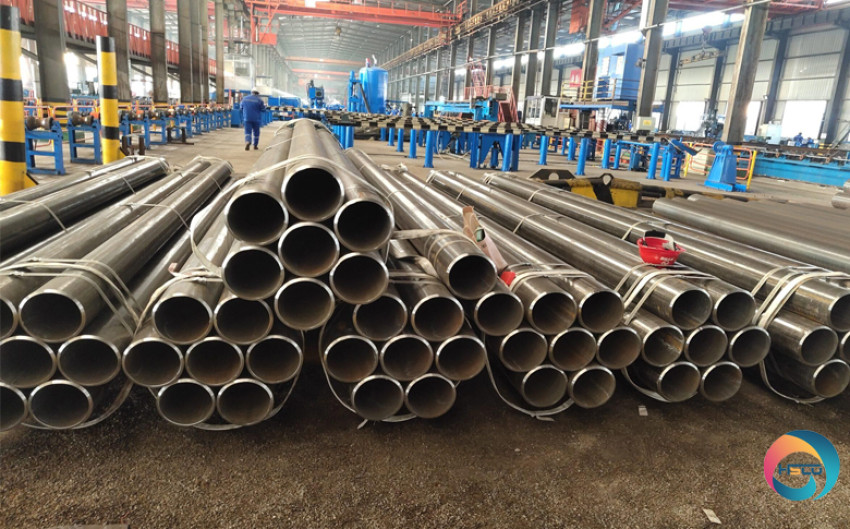
Welded pipe, also known as welded steel pipe, is a pipe made by curling steel plate or strip steel through welding process. Welded pipe has been widely used in many fields due to its diverse characteristics and wide applicability. This article mainly discusses the classification, advantages and disadvantages and application fields of welded pipes.
Classification of welded pipes:
1. ERW pipe: electric resistance welded pipe, also known as long welded pipe. The production process of this welded pipe is to use heated steel strip for hot forming, and then use high-frequency current to heat the weld for welding. This welded pipe has good welding performance and toughness.
2. SSAW pipe: spiral welded pipe, also known as spiral welded steel pipe. The production process of this welded pipe is to use continuous spiral welding process for welding. This welded pipe has good toughness and strength, and is suitable for various high-pressure transmission pipelines.
3. LSAW pipe: straight seam submerged arc welded pipe, the production process of this welded pipe is to use arc electrodes to weld steel plates into tubular shapes, and then perform submerged arc welding. This welded pipe is suitable for various transmission pipelines, including oil and natural gas transmission.
Advantages of welded pipes:
1. Strong corrosion resistance: welded pipes are mainly made of metal materials such as stainless steel and nickel, with excellent corrosion resistance, and are not easy to rust and corrode even in extreme environments.
2. High strength: The strength of welded pipes is higher than that of ordinary steel pipes, and their load-bearing capacity is stronger.
3. Quick construction: Compared with traditional iron pipes, welded pipes have the characteristics of fast installation speed and convenient construction, which reduces the time and labor costs required for construction.
4. High safety: The welded pipe joints after welding are firm and strong, and are not prone to leakage, water seepage, etc., which can effectively ensure safe production.
5. High production efficiency: The production process of welded pipes is relatively simple, and continuous and automated production can be achieved, greatly improving production efficiency.
6. Low cost: Due to the simple production process and high material utilization rate, the cost of welded pipes is relatively low, which is suitable for large-scale, low-cost application scenarios.
7. Diverse specifications: Welded pipes can produce pipes of different diameters, wall thicknesses and lengths according to demand to meet various engineering needs.
Disadvantages of welded pipes:
1. Weak welding: During the welding manufacturing process, if the welding technology is not up to standard, the joints may have problems such as incomplete penetration and unsealed welds, which may lead to water leakage and air leakage after the welded pipe is constructed.
2. Easy to rust: Because the surface of the welded pipe has not been specially treated with anti-corrosion, if it encounters high humidity, high oxide and other environments during use, it is easy to cause rust and wear on the surface of the welded pipe.
Application areas of welded pipes:
1. Construction field
In the construction field, welded pipes are widely used in supporting structures, corridors, overpasses, roof supports and other aspects of buildings. Its advantages include high strength of welded joints, which can ensure the load-bearing and seismic performance of buildings; high corrosion resistance, stable performance in different climatic environments; regular shape, easy processing and installation, and can quickly complete the structural support of buildings.
2. Manufacturing field
In the manufacturing field, welded pipes are widely used in automobiles, machinery manufacturing and electrical equipment. The welded pipe has a smooth appearance and stable quality, ensuring the consistency and stability of the products produced; after special treatment, its wear resistance and pressure resistance can be improved, and its service life can be extended.
3. Transportation field
In the transportation field, welded pipes are widely used in road guardrails, bridge structures and airport support structures. Its advantages include high seismic resistance and load-bearing capacity, which can meet the use requirements of different places; high surface flatness, easy installation, and quick completion of construction tasks; high safety and stability, which can ensure road driving and personnel safety.
4. Petroleum and chemical industry
In the petroleum and chemical industry, welded pipes are used for equipment such as oil pipelines, drilling pipes, downhole pipes, reactors, heat exchangers and storage tanks. These applications require welded pipes to have excellent corrosion resistance, high strength and high wear resistance.
5. Power industry
In the power industry, welded pipes are used to manufacture boilers, chimneys and cooling equipment. These applications require welded pipes to have high precision and consistency, suitable for high-precision engineering needs.
6. Agriculture and Animal Husbandry
Welded pipes are also widely used in agriculture and animal husbandry, such as in the manufacture of agricultural machinery, sheds, etc. These applications require welded pipes to have certain strength and durability.
7. Other applications
In addition, welded pipes are also used to manufacture furniture, wire threading pipes, high-rise shelves, containers, etc. These applications require welded pipes to have different properties, such as corrosion resistance, insulation performance and wear resistance.