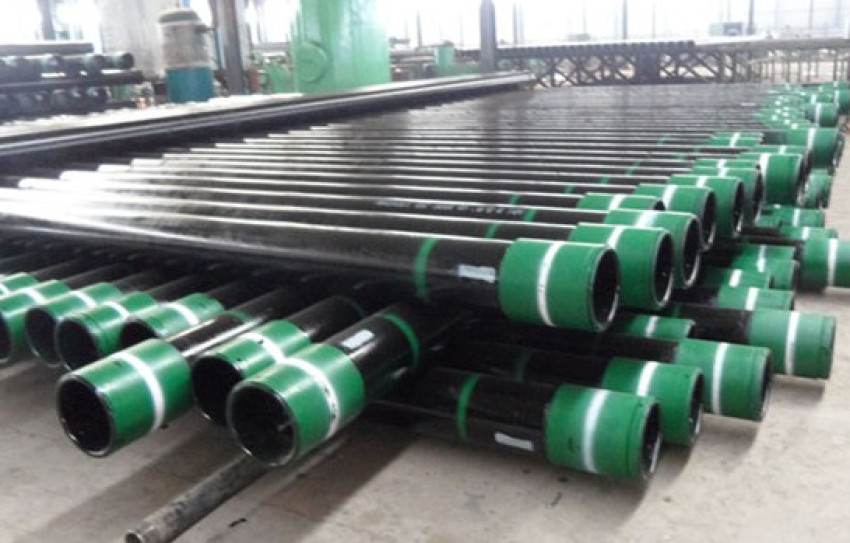
OCTG casing pipe is an important equipment in oil wells, used to ensure the stability of the well wall and protect the oil pipe. Therefore, it is very necessary to conduct regular inspections of oil casing. So, what are the commonly used oil casing pipe inspection technologies and methods?
The production and installation process of OCTG casing pipe involves a lot of inspections, mainly the following:
1. Ultrasonic inspection
When ultrasonic waves are transmitted in the material being inspected, the acoustic characteristics of the material and the changes in the internal structure have a certain impact on the transmission of ultrasonic waves. By investigating the degree and condition of the impact of ultrasonic waves, we can understand the changes in material performance and structure.
2. Radiographic inspection
Radiographic inspection uses the different amount of radiation transmitted through the normal part and the defect to form different blackness on the film.
3. Penetration inspection
Penetration inspection uses the capillary effect of liquid to allow the penetrant to enter the open defect on the surface of the solid material, and then absorbs the penetrant through the developer to the surface to show the existence of the defect.
Penetration testing is suitable for various metal and ceramic workpieces, and the time from penetration operation to defect manifestation is relatively short. Generally, it takes about half an hour to detect surface fatigue, stress corrosion and welding cracks, and the size of the crack can be directly measured.
4. Magnetic particle testing
Magnetic particle testing uses magnetic leakage at the defect to adsorb magnetic powder, forming magnetic traces to provide defect manifestation. It can detect surface and sub-surface defects. The nature of the defect is easy to identify. Paint and electroplating surfaces do not affect the detection sensitivity.
5. Eddy current testing
Eddy current testing mainly uses eddy currents induced in the workpiece by ferromagnetic coils to analyze the quality status inside the workpiece. It can detect surface and near-surface defects of various conductive materials. Usually, the parameters are difficult to control and the test results are difficult to interpret. In addition, it is required that the test target must be a conductive crack and the defect length can be indirectly measured.
6. Leakage magnetic detection
The leakage magnetic detection of oil casing is based on the characteristics of high magnetic permeability of ferromagnetic materials. The quality of in-service oil casing is detected by measuring the change in magnetic permeability caused by defects in ferromagnetic materials.
7. Magnetic memory detection
Magnetic memory detection is derived from the connection between the physical nature of the magnetic phenomenon of metals and the dislocation process. It has many advantages such as high efficiency, low cost, and no need for grinding, and has important and broad application prospects in industry.
Among the several detection methods, there is no special standard for product magnetic memory detection, and the other 6 methods have their own mature detection standards.
In general, there are various detection technologies and methods for oil casing, each of which has its own characteristics and scope of application. Appropriate technology can be selected for detection and evaluation according to specific circumstances. Through regular detection and maintenance, the stability and reliability of oil casing can be ensured, and the smooth progress of oil production can be guaranteed.