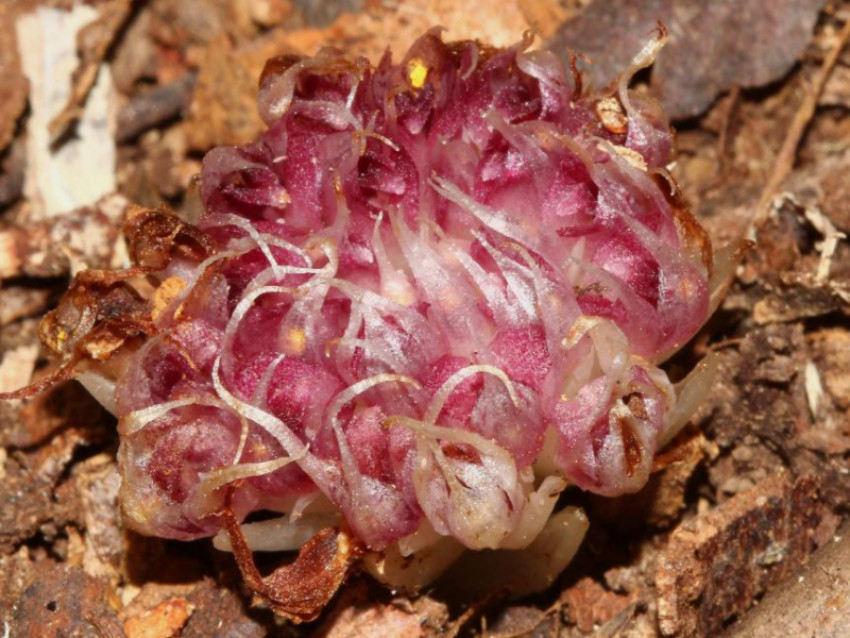
Cây Rhizanthella Gardneri
Rhizanthella Gardneri tree is a species of orchid family discovered by Jack Trott in 1928. They live and bloom in the ground in Western Australia. The flowers of this plant are milky white to red, have a strong fragrance and usually bloom in May and June. Size is from 2.5-3 cm. Because it lives underground without sunlight, the plant associates with a fungus called Thanatephorus Gardneri to grow. There are only about 50 individuals left in the world. This particular type of orchid usually spends its entire life underground. It even blooms in the ground. In late May to early June, each plant blooms with more than 100 flowers that range from cream to red and give off a strong fragrance.
It is only parasitic on bushes. Due to the lack of chlorophyll, plants cannot synthesize energy from sunlight like most plants. Instead, it draws nutrients from the shrub's roots by binding to parasitic fungi. Rhizanthella gardneri reproduces vegetatively by which it can produce three seedlings. Three of the known populations of Rhizanthella gardneri are protected in nature reserves and a concerted initiative has been launched to protect this species for future generations.
Cây Mammillaria herrerae
Mammillaria herrerae is a species of cactus living in the mountains, discovered in 1931 by Wedermann. They have pink flowers, white stems and a golf ball-like shape, so they are also known as "golf ball" cactus. Currently, only 5% of the trees have survived in the past 20 years. This species is classified as endangered, almost and is about to become extinct, caused by the severe destruction of the natural environment, the good news is that many nurseries around the world have also bred and preserved the species. This.
Mammillaria herrerae is native to the Tehuacan valley, west of Oaxaco, Mexico, where there are more than 30 species of endemic species such as (Ferocactus ingens, Ferocactus recurvus, F. robustus, Coryphantha pallida ,M. pectinifera and M. napina etc.) is being preserved. Tehuacan valley belongs to the lowland tropical desert, bushy tree, on alkaline soil, high water-bearing trunk. Belongs to a hot dry climate, high temperature difference, light rain in summer. These are slow-growing bones and are easy to propagate when transplanted on their own roots, but for fast growth, transplant into another type of cactus. Mammillaria pectinifera has a very large root system and holds water, so it should be deep into the pot and drain well to avoid waterlogging. Watering is recommended in spring and summer, as this is the best growing period for the plant. However, you also need to be careful with water, to avoid over-watering causing root rot.
Cây Tahina spectabilis
Tahina spectabilis tree, also known as the suicide palm tree, was discovered by Xavier Metz and his family in 2007, and officially announced in 2008, the number of individuals still alive is less than 100. This tree has a source. Native to northwestern Madagascar, the trunk can grow up to 18 m (59 ft) tall and the leaves spread to 5 m (16 ft). They have a life cycle of 30 to 50 years, blooming only once and then dying. The suicide palm or Tahina spectabilis is a giant palm species that lives only in an area of 4 square kilometers in Analalava, Madagascar. Through DNA analysis, botanists found this suicide palm species to be closely related to Asia when it has similarities with some species of Afghan, Thai or Chinese palm. Another danger facing this tree species is that its habitat is significantly shrinking due to forest fires and people clearing forests for agriculture. Currently, seeds of the suicide palm species are sent to more than 10 different research institutes on 5 continents in the hope of increasing the number of individuals of this particular species.
Dr. John Dransfield said the most special feature of this palm species is that after 30-50 years of life, the new tree blooms for the first time with the number of hundreds of flowers per branch, millions of flowers for the whole tree. Ironically, that is also the only time this palm species blooms because only a few months later, the palm weakens and dies. The reason is that the plant suddenly has to provide nutrients for too many flowers, making the plant exhausted and unable to live.