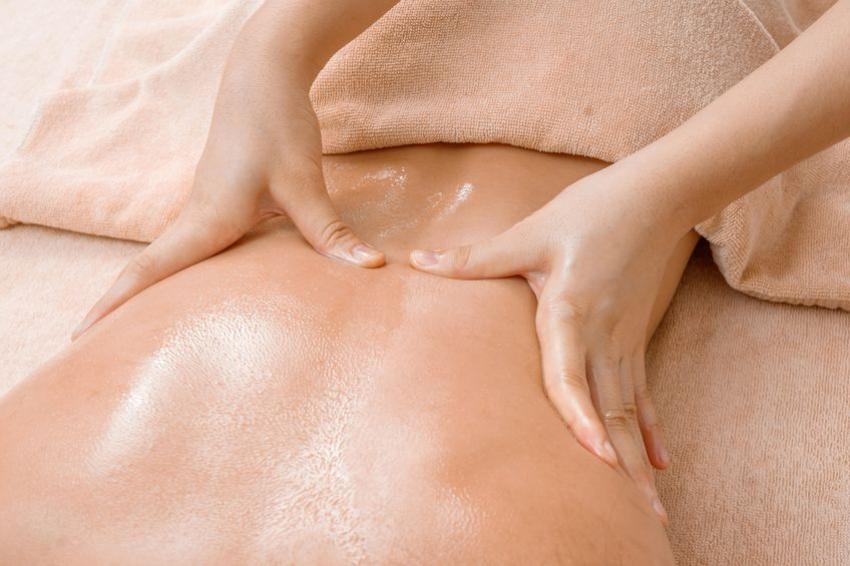
The truth is, the best massage for back pain depends entirely on what is causing your discomfort. Here is a breakdown of the most effective massage styles for back pain and how to pick the exact one your body needs.
1. Deep Tissue Massage
Best for: Chronic stiffness, postural strain, and long-standing muscle tension.
Deep tissue massage uses slow, deliberate strokes and sustained, firm pressure to reach the deeper layers of muscle and connective tissue. Unlike relaxation massages, the therapist works slowly to let your outer muscles yield before targeting the dense fibers underneath.
Choose this if: Your back feels persistently tight or "locked up" from desk work, physical labor, or old muscular strain, and you tolerate firm pressure well.
Skip this if: Your pain is brand new (acute), sharp, or you tend to flinch and hold your breath under heavy pressure.
2. Swedish Massage
Best for: Stress-related back pain, mild soreness, and sensitive or spasming muscles.
Swedish massage is the classic relaxation style, featuring long, gliding strokes, gentle kneading, and rhythmic tapping. While it’s often dismissed as "just pampering," it is surprisingly effective for back pain driven by stress and nervous system overload.
When you’re stressed or anxious, your brain sends signals that keep your back muscles in a low-grade state of contraction. Calm, soothing touch lowers cortisol and convinces your nervous system that it is safe to let go.
Choose this if: Your back flares up during stressful weeks, you’re dealing with sudden muscle spasms that react badly to heavy pressure, or it’s your first massage.
3. Trigger Point Therapy (Neuromuscular Therapy)
Best for: Stubborn "knots" and pain that radiates to another spot.
Have you ever pressed on a tight spot near your shoulder blade and felt an ache shoot up into your neck? That’s a trigger point—a hyper-irritable, contracted bundle of muscle fibers. Trigger point therapy uses focused, static pressure (often with a thumb or elbow) directly on these spots until the muscle releases, alongside slow breathing.
Choose this if: You can point to one or two specific, pea-sized or marble-sized spots that cause localized or radiating aches.
4. Myofascial Release
Best for: Widespread tightness, limited mobility, and feeling "stuck."
Your muscles are wrapped in a web of tough connective tissue called fascia. When fascia becomes tight or restricted from injury, inflammation, or lack of movement, it pulls on your skeleton and creates broad, nagging back pain. Myofascial release uses slow, sustained stretching and dragging pressure—usually with very little oil or lotion—to gently unwind these restrictions.
Choose this if: Stretching never quite reaches your tightness, or your lower or mid-back feels stiff across a large area rather than in one single knot.
5. Sports Massage
Best for: Workout-related soreness, athletic recovery, and repetitive strain.
Despite the name, you don't have to be a pro athlete to benefit from a sports massage. It blends brisk warming strokes, targeted deep work, and assisted stretching to restore range of motion and speed up recovery in overworked tissues.
Choose this if: Your back aches after weightlifting, running, golf, cycling, or weekend yard work.
6. Hot Stone Massage (Bonus Option)
Best for: Muscles that won't relax under normal hand pressure.
Smooth, heated basalt stones radiate warmth deep into rigid back muscles, increasing blood flow and softening tissue before the therapist even applies pressure. Heat naturally quiets pain receptors, making it easier to work out tightness without bruising or discomfort.
Quick Cheat Sheet: Match Your Pain to the Massage
"My back hurts after sitting at a desk all week." → Deep Tissue or Myofascial Release
"I have one sharp knot under my shoulder blade." → Trigger Point Therapy
"My back feels tight whenever I'm overwhelmed or exhausted." → Swedish or Hot Stone
"My lower back gets sore after the gym or running." → Sports Massage
"My back suddenly seized up yesterday." → Wait 48–72 hours, or ask a physical therapist before booking.
Two Secrets to Getting a Better Back Massage
1. Harder Is Not Always Better
Many people think a massage only "works" if it hurts. In reality, if the pressure makes you clench your teeth, curl your toes, or hold your breath, your muscles are fighting back—which creates more tension. On a 1-to-10 discomfort scale, aim for a 6 or 7 ("hurts so good"), never an 8 or above. Speak up immediately if it’s too intense.
2. Ask Them to Work Beyond Your Back
Lower back pain rarely lives only in the lower back. Tight glutes, hip flexors, and hamstrings pull on your pelvis and force your lower back muscles to work overtime. Asking your therapist to spend 15 minutes releasing your hips and glutes often provides twice the relief of rubbing your lower back alone.
When Massage Isn't the Right First Step
Massage excels at treating muscular pain, stiffness, and stress. However, if your back pain involves numbness, tingling, burning, weakness in your legs, or pain shooting below the knee, you may be dealing with a compressed nerve or disc issue. In those cases, skip the spa and get evaluated by a doctor or licensed physical therapist first—they can tell you whether massage is safe to include in your recovery plan.