Rooted in India’s 5,000-year-old system of natural medicine, Ayurveda views the human body not as a mechanical assembly of parts, but as a living landscape of energy, elements, and consciousness. In Sanskrit, the word for oil is Sneha, which carries a second, deeply beautiful meaning: love and tenderness.
To receive an Ayurvedic massage is literally to saturate your body with care.
If you have ever wondered what actually happens during this ancient ritual, here is a step-by-step look into the process, from the first drop of warm oil to the quiet peace that follows.
1. The Inquiry: Tuning the Instrument
Unlike standard spa treatments where the same lotion is used for every guest, an Ayurvedic massage begins with understanding who you are in that particular moment.
Your therapist will typically take a few minutes to evaluate your current constitution—your Dosha (Vata, Pitta, or Kapha):
Are you feeling scattered, cold, or anxious? (Excess Vata)
Are you overheated, irritable, or dealing with skin inflammation? (Excess Pitta)
Are you sluggish, heavy, or emotionally congested? (Excess Kapha)
Based on this brief assessment, the therapist selects a bespoke oil infused with specific medicinal herbs. For a restless mind, they may choose heavy, warm, unrefined sesame oil steeped with calming roots like Ashwagandha. For an inflamed or stressed body, they might use cooling coconut or sunflower oil infused with sandalwood and Brahmi.
2. The Generosity of Warm Oil
The first physical sensation that surprises most newcomers is the amount and temperature of the oil.
In Western massage, oil or cream is used sparingly, primarily to reduce friction on the skin. In Ayurveda, the oil is the medicine. It is warmed gently and applied generously from head to toe.
The skin is our largest sensory organ, closely tied to the nervous system. As the warm, herbalized oil sinks into the pores, it begins to lubricate the tissues, quiet the nervous system, and soften deep-seated physical and mental exhaustion.
3. The Rhythm: Flow Over Force
If you are looking for an elbow driven deeply into your shoulder blades, Abhyanga will surprise you. The strokes are intentional, rhythmic, and continuous:
Long, sweeping strokes (Anuloma) travel down your long bones (arms and legs), mimicking the flow of natural energy (Prana) and stimulating lymphatic drainage.
Circular motions are gently applied around your joints, your abdomen, and your chest, areas where energy often becomes stagnant.
The goal is not to force muscles to surrender, but to coax the entire system into a state of deep safety. When the body feels safe, tension dissolves naturally.
4. Awakening the Marma Points
During the session, the practitioner will gently focus on specific intersections across your body known as Marma points—vital energy junctions where consciousness and matter meet.
Similar to acupressure points, these include areas at the crown of the head, the center of the forehead (the third eye), the solar plexus, the palms, and the soles of the feet. Pausing at these points helps clear energetic blockages and restore emotional balance.
5. Head and Soles: The Anchors of Calm
An authentic Ayurvedic massage rarely neglects the extremities.
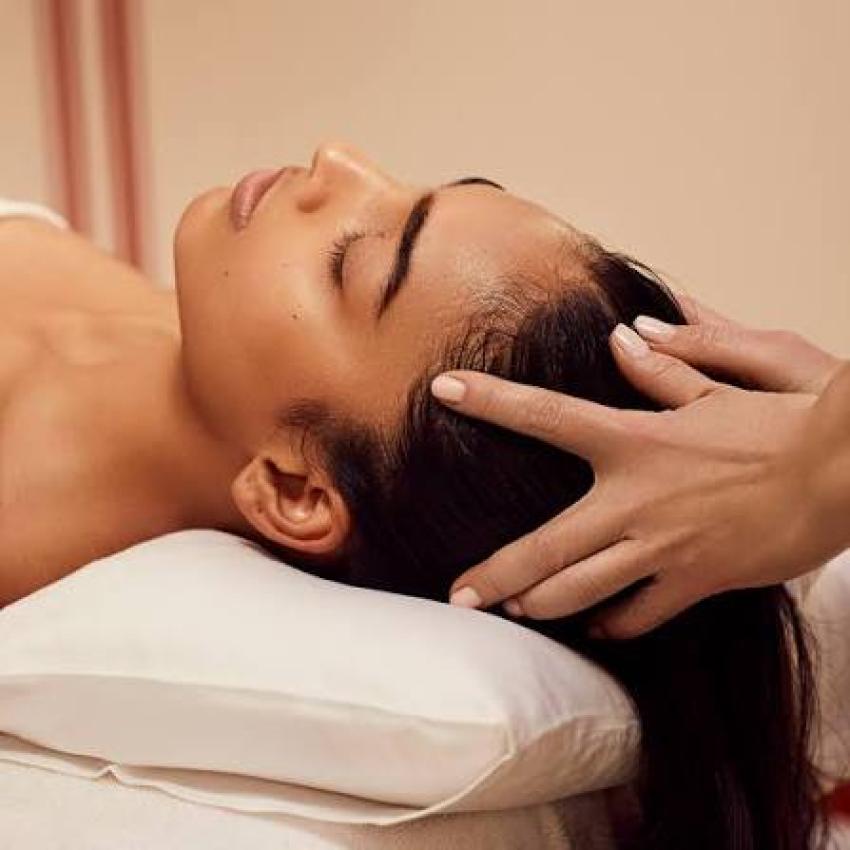
A substantial portion of the treatment is often devoted to Shiroabhyanga (head massage) and Padabhyanga (foot massage). Ayurveda teaches that the nerve endings of the scalp and feet directly reflect the health of the entire organism. Massaging the scalp with warm oil quiets mental chatter, while working the soles of the feet anchors grounding energy, inviting deep, restorative sleep.
6. The Gift of Heat (Swedana)
After the massage is complete, you are typically invited to sit in gentle, humid steam—a practice known as Swedana.
The gentle heat opens the pores, allowing the therapeutic properties of the herbal oils to penetrate deeper into the underlying tissues while encouraging the body to release metabolic waste and emotional stagnation (Ama).
The Return: What Happens on the Inside?
When you finally wash away the excess oil—often using warm water and a gentle herbal paste rather than harsh soap—you do not simply feel like your muscles are relaxed.
You feel anchored.
In modern life, we spend much of our time "living in our heads," constantly thinking, reacting, and processing screens. An Ayurvedic massage draws your awareness out of the chaotic mind and brings it gently back down into the sanctuary of the physical body.