

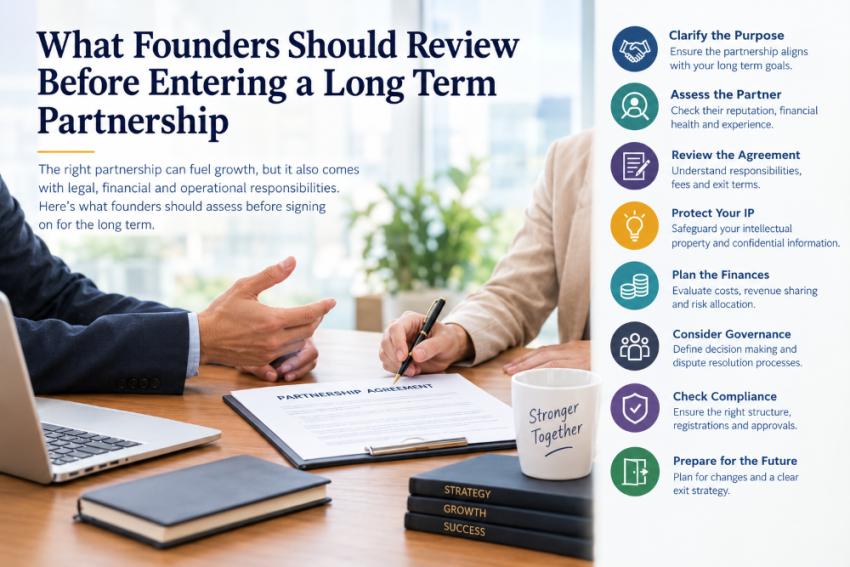
Long term partnerships can play an important role in a startup’s growth. They may provide access to new markets, experienced professionals, technology, distribution networks and additional investment opportunities. For founders, the right partnership can accelerate business development and create opportunities which would otherwise take considerable time and resources to achieve. However, entering a long term partnership also involves significant responsibility. Decisions made during the early stages of a business relationship can affect financial stability, ownership rights, operational control and future expansion. An arrangement which appears beneficial at the beginning may become difficult to manage if the parties have different expectations or fail to define their responsibilities clearly. Founders should therefore look beyond immediate commercial benefits before signing an agreement. A careful review of the proposed terms, the partner’s background and the legal implications can help prevent avoidable disputes. It also ensures the partnership remains suitable as the business evolves.
Understanding the Purpose of the Partnership
The first step is to establish why the partnership is necessary. Founders should identify the specific business objective they expect to achieve and assess whether the proposed arrangement supports their long term strategy. For example, a technology startup may partner with an established company to distribute its products. Another business may collaborate with a specialist to develop a new service. Although both arrangements offer potential benefits, their commercial requirements and legal risks will differ.
Founders should agree on the expected outcomes, the resources each party will contribute and the responsibilities each will undertake. They should also consider whether the partnership requires exclusivity or whether the same objectives can be achieved through a less restrictive arrangement. Clear objectives make it easier to measure performance and determine whether the relationship continues to serve the business. Without them, disagreements may arise over priorities, spending decisions and the level of commitment expected from each party.
Assessing the Partner’s Background and Reliability
A promising business proposal does not always indicate a reliable partner. Before entering a long term arrangement, founders should examine the other party’s financial position, business reputation, management practices and previous commercial relationships. Financial stability is particularly important when the partnership depends on regular payments, shared investment or ongoing operational support. A partner experiencing financial difficulties may struggle to meet its commitments, leaving the startup responsible for unexpected costs or service disruptions.
Founders should also consider whether the partner has the necessary experience, resources and authority to fulfil its obligations. References from previous business associates may provide useful insight into its working practices. Where appropriate, the review should include company records, ownership details, existing disputes and relevant regulatory compliance. The extent of due diligence will depend on the size, duration and complexity of the proposed arrangement. These checks help founders identify warning signs before the partnership becomes difficult or expensive to unwind.
Reviewing Contractual Terms and Responsibilities
A written agreement provides the foundation for a sustainable business relationship. It should clearly define each party’s responsibilities, expected contributions, performance standards and decision making authority. Vague language can create problems later. For instance, a promise to provide adequate marketing support may mean different things to each party. One side may expect a dedicated team and a fixed budget, while the other may consider occasional promotional activity sufficient. The agreement should establish measurable obligations wherever possible. It should also specify payment schedules, reporting requirements, approval procedures and the consequences of failing to meet agreed commitments.
Founders must pay close attention to the duration of the contract and the circumstances in which it can be renewed, amended or terminated. A long term commitment without a practical exit mechanism can restrict business decisions even when the relationship no longer produces meaningful benefits. Seeking advice from startup lawyers for founder agreements can help founders assess contractual responsibilities, clarify ownership arrangements and identify provisions which may create difficulties as the company grows.
Protecting Ownership and Intellectual Property
Intellectual property can be one of a startup’s most valuable assets. Its value may lie in software, product designs, trademarks, technical processes, proprietary information or original business methods. A long term partnership may require the parties to share or jointly develop some of these assets. Without clear provisions, disputes can arise over ownership, licensing and the right to use the resulting work. Founders should distinguish between intellectual property owned before the partnership and material created during the collaboration. The agreement should explain whether new developments belong to one party, are jointly owned or are licensed for a specific purpose.
The scope of each licence should also be defined. Restrictions on geographical use, sublicensing, modification and commercial exploitation may affect the startup’s ability to expand into new markets. Confidentiality deserves equal attention. Both parties should understand how sensitive information may be accessed, stored and disclosed. The agreement should also address the handling of confidential material after the relationship ends. These protections reduce uncertainty and help preserve the startup’s ability to commercialise its assets independently.
Evaluating Financial Commitments and Risk Allocation
Financial obligations deserve careful examination before a founder signs a long term contract. Some partnerships require an initial investment, recurring payments, minimum purchase volumes or shared operating expenses. Others involve commissions, revenue sharing or guarantees linked to future performance. Founders should calculate the total cost of the arrangement rather than focusing only on the initial price. They should consider whether the startup can meet its obligations if sales decline, customer demand changes or additional funding takes longer than expected.
The agreement should also explain how revenue will be calculated and distributed. Clear definitions of gross revenue, net revenue, refunds, taxes and payment deadlines can reduce the likelihood of financial disagreements. Liability provisions require similar scrutiny. An indemnity may require one party to compensate the other for specified losses or third party claims. If the wording is broad, the financial exposure may exceed the benefit of the partnership. Founders should assess which risks they can reasonably control and negotiate appropriate liability limits where legally permissible. Insurance requirements and procedures for resolving claims should also reflect the nature of the business relationship.
Considering Decision Making and Dispute Resolution
Long term partnerships often become more complicated as the businesses involved expand. New products, changing market conditions and additional investment may require decisions which were not anticipated when the agreement was signed. Founders should establish how important decisions will be made. The agreement may need to specify approval rights, voting arrangements, budget authority and procedures for resolving disagreements between management teams.
Deadlock provisions are particularly important when both parties have equal decision making power. Without a clear mechanism, a disagreement over pricing, investment or business direction may prevent the partnership from moving forward. The agreement should also establish how disputes will be handled. Negotiation and mediation may help resolve disagreements before they become costly. Arbitration or court proceedings may be appropriate in other circumstances, depending on the parties’ needs and applicable law. Founders should review the governing law, dispute resolution forum and allocation of legal costs before committing to the arrangement. These details can influence the time and expense involved in enforcing contractual rights.
Checking Business Structure and Compliance Requirements
The legal structure of a startup can affect its ability to enter contracts, raise investment and manage long term commercial relationships. Founders should ensure the business is properly established and its internal records reflect the proposed arrangement. They should also verify whether the partnership requires licences, regulatory approvals, tax registrations or specific contractual safeguards. Businesses handling personal data, financial services or regulated products may face additional obligations.
Startup registration services for founders may be relevant when establishing the appropriate business structure, completing registration formalities or preparing the company for commercial expansion. However, registration is only one part of the process. Ongoing compliance, accurate corporate records and properly authorised agreements remain essential Founders should also check whether the partnership could affect existing contracts, investor rights or obligations to other stakeholders. A new commercial relationship should not inadvertently place the startup in breach of an earlier commitment.
Planning for Changes and an Eventual Exit
Even successful partnerships may eventually reach a point where the parties need to change their arrangements. Business priorities can shift, ownership may change or one party may decide to pursue a different strategy. Founders should therefore discuss exit arrangements before the relationship begins. The contract should explain how either party can terminate the agreement, what notice is required and which obligations continue afterwards.
It should also address outstanding payments, customer responsibilities, the return of confidential information and the continued use of intellectual property. Where relevant, the parties should consider how ongoing projects and shared assets will be handled. Change of ownership provisions deserve particular attention. An acquisition or investment may trigger consent requirements or give the other party a right to terminate the agreement. Identifying these conditions early can prevent complications during future transactions. A practical exit mechanism does not indicate a lack of confidence in the partnership. Instead, it gives both parties a clear process for dealing with changing circumstances.
Conclusion
A long term partnership should be evaluated as a significant business commitment rather than a simple commercial opportunity. Its success depends on more than shared ambitions. Financial stability, clear contractual obligations, intellectual property protection, effective decision making and realistic exit arrangements all influence whether the relationship remains beneficial. Founders who conduct proper due diligence and review the legal terms before signing are better placed to identify risks and protect their business interests. They should also revisit important agreements as the company grows, particularly when its ownership, operations or commercial priorities change. The aim is to create a partnership which supports sustainable growth while preserving the startup’s ability to make independent decisions. Careful preparation at the outset can reduce uncertainty, strengthen trust and provide a more stable foundation for long term business success.