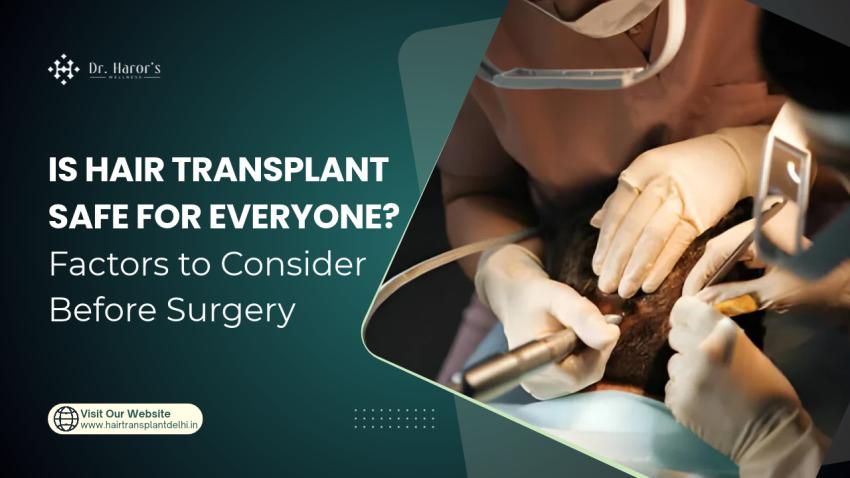
If your hairline has been creeping back for years, you’ve probably thought about a hair transplant at least once. You’ve probably also talked yourself out of it. A lot of people worry about long recovery, visible scarring, and ending up with results that look worse than what they started with.
Those fears made sense a decade ago, when the only option was cutting out a strip of scalp and stitching it shut. Today, modern hair treatment in Delhi offers techniques that are far less invasive, with minimal downtime and no long linear scar in most cases. Still, safety depends on a few things you should understand before you commit. Let’s go through them.
What Is a Hair Transplant?
A hair transplant is a surgical procedure that moves healthy hair follicles from one part of your scalp to the areas where hair has thinned or disappeared. The donor follicles usually come from the back and sides of the head, because that hair is naturally resistant to balding. The surgeon then places each graft at a specific angle, depth, and direction so it blends in with the hair around it.
Common Types of Hair Transplant Procedures
FUE (Follicular Unit Extraction): The surgeon extracts follicles one at a time using a tiny punch tool, then implants them in the thinning area. There’s no strip removal and no stitching, which is why FUE is so popular.
FUT (Follicular Unit Transplantation): This is the traditional method. A thin strip of scalp is removed from the donor area and divided into small grafts of one to three follicles each. It can yield a large number of grafts in one session, but it leaves a linear scar and usually takes longer to heal.
DHT (Direct Hair Transplantation): Follicles are extracted and placed straight into the recipient area using a pen-shaped implanter. This gives the surgeon close control over the depth, angle, and direction of every graft, which helps create a natural-looking hairline.
URHT (Ultra Receptive Hair Transplant): A refined version of FUE built around graft survival. Follicles are extracted with micro-punches and implanted quickly, with careful attention to graft hydration, handling, and placement.
Bio-FUE: Standard FUE combined with biological add-ons such as PRP (Platelet-Rich Plasma) or GFC (Growth Factor Concentrate). These are made from your own blood and are meant to support healing and hair growth after the procedure.
So, Is a Hair Transplant Safe?
For most healthy candidates, yes. A hair transplant is considered a low-risk procedure when it’s done properly. The key phrase is “done properly.” The outcome depends heavily on who is holding the instruments, and that’s why so many patients start their search for the best hair transplant surgeon in Delhi before they look at anything else. Hairline design, graft placement, and graft handling all take years of practice, and they decide whether your result looks natural or obviously done.
What Affects the Safety of a Hair Transplant?
Three things matter most.
The surgeon’s experience. An inexperienced surgeon can place grafts badly, design an unnatural hairline, or damage follicles during handling. The result is hair that looks pluggy or patchy, and fixing it later is difficult and expensive.
Whether you’re the right candidate. Not everyone should have a transplant. Without a proper review of your health history, scalp condition, and the cause of your hair loss, you risk poor healing, wasted grafts, or complications that could have been avoided.
Hygiene and clinic standards. A scalp infection can hurt your results and your health. Clinics that cut corners on sterilisation put you at real risk.
How to Have a Safe Hair Transplant
Here’s what to look for.
Choose the right surgeon. Look for the best hair transplant surgeon in Delhi, meaning a qualified dermatologist with years of experience treating the same kind of hair loss you have. Ask to see before-and-after photos of real patients.
Check the clinic environment. Whether you’re getting hair treatment in Delhi or somewhere else, the operating room should be clean and sanitised. Disposable items like gloves, razors, and needles should be single-use.
Expect a proper consultation. A good clinic will examine your scalp, ask about your medical history, explain what the procedure involves, and give you a realistic idea of the results. If someone promises perfect density without asking a single question, walk away.
Take aftercare seriously. Your post-procedure instructions matter as much as the surgery. Follow the guidance on washing, sleeping position, sun exposure, and medication.
Final Thoughts
Is a hair transplant safe? Yes, when you choose a certified clinic with strict hygiene standards, a surgeon who knows what they’re doing, and a plan that fits your hair loss. With the right preparation and aftercare, you can expect natural-looking results and a much smoother recovery than people used to endure.
If you’re ready to explore hair treatment in Delhi, you can book a consultation at Dr. Haror’s Wellness. Their team of experienced dermatologists will assess your hair loss and recommend an approach that suits you.
#HairTransplantSurgeon #BestHairTransplantClinicInDelhi #BestHairTransplantResult #BestHairTransplantSurgeonInDelhi #BestHairTreatmentInDelhi #BestHairRestorationTreatmentInDelhi #HairTransplantInDelhi #HairTransplantQuestionsAndAnswers #HairTransplantClinicInIndia #BestHairTransplantDoctorInDelhi #BestTrichologistInDelhi #BestHairSpecialistDoctorInDelhiNCR #HairDoctorInDelhi #HairCareInDelhi #FUEHairTransplant #FUTHairTransplant #DirectHairTransplant #DrNavnitHaror #DrHarorsWellness