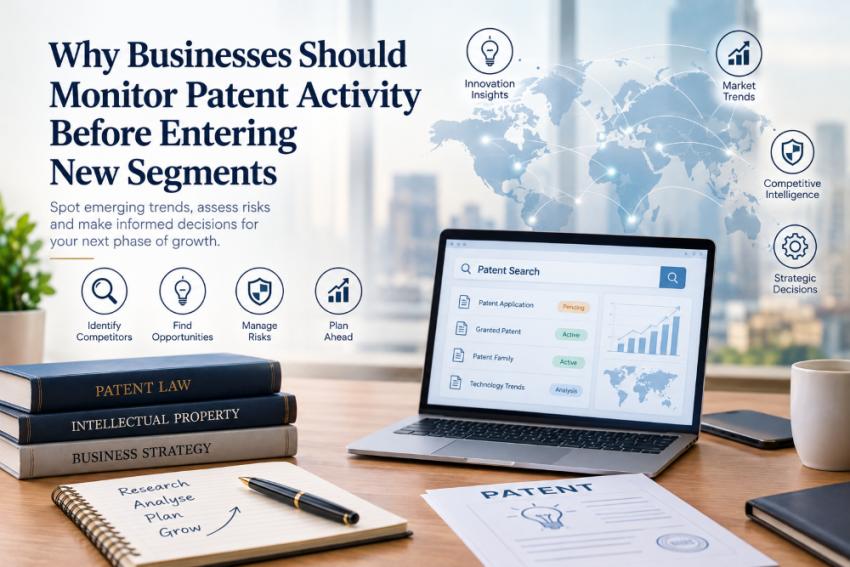
Entering a new business segment can create opportunities for growth, diversification and stronger market positioning. However, moving into an unfamiliar sector also brings risks. Businesses may face established competitors, complex technical requirements and intellectual property restrictions which are not immediately apparent through conventional market research.
Patent activity offers a useful source of information when assessing these challenges. Patent applications and granted patents can reveal where competitors are investing in research, which technologies they are developing and how they are protecting their innovations. Analysing these developments can help businesses evaluate opportunities before committing substantial resources. For Indian companies planning to expand into new product categories or technology driven markets, patent monitoring should form part of the initial assessment. It supports better commercial decisions while helping businesses identify potential intellectual property conflicts before they affect product development or market entry.
Understanding What Patent Activity Reveals
Patents protect qualifying inventions and grant their owners specific exclusive rights, subject to applicable law. Patent applications also contain technical information about the inventions being claimed. This makes patent records a valuable source of intelligence for businesses exploring unfamiliar markets. A company considering entry into electric mobility, for example, may review patent activity relating to battery management, charging systems and vehicle components. An increase in filings within these areas could indicate growing research interest or stronger competition around particular technologies.
Patent records may also reveal how competitors are approaching technical problems. Some companies focus on improving existing products, while others seek protection for alternative designs or entirely new methods. However, a rise in patent applications does not automatically indicate commercial demand or market success. Some inventions never reach commercial production. Businesses should therefore compare patent findings with customer needs, investment trends and other reliable market information.
Identify Competitors Before Investing in a New Segment
A new market may contain competitors which are not visible through ordinary industry research. Technology developers, research institutions, manufacturers and overseas businesses may all hold relevant patent rights. Patent searches can help identify these players and reveal the technical areas in which they are active. Companies can examine published applications, granted patents and patent families to understand how competitors are developing their portfolios.
For instance, a manufacturer planning to introduce smart industrial equipment may discover several businesses holding patents relating to sensors, remote monitoring and automated maintenance. This information can help the manufacturer understand the existing technological landscape before finalising its product design. Businesses should also consider the geographical scope of competitor portfolios. A patent granted in one country does not automatically provide protection in another. However, related filings across several jurisdictions may indicate where a competitor has sought protection for an invention. This information can support decisions about manufacturing locations, distribution plans and potential markets for expansion.
Assess Intellectual Property Risks Before Product Development
One of the most important reasons to monitor patent activity is to identify potential infringement risks early. A product may appear commercially attractive but still involve technical features covered by enforceable third party patent rights. Discovering a possible conflict during the design stage gives a business more time to evaluate its options. Depending on the circumstances, it may be possible to modify the product, develop an alternative technical solution, negotiate a licence or reconsider the proposed market. A patent application alone does not establish an enforceable patent right. Its status, claims and eventual grant must be assessed carefully. Similarly, a granted patent does not necessarily cover every product within a particular industry.
Businesses should distinguish patent monitoring from a freedom to operate assessment. Monitoring tracks relevant patent developments over time. A freedom to operate assessment examines whether a proposed product or process may infringe applicable patent rights in a specific jurisdiction. A patent law firm for businesses can assist with reviewing relevant patent claims, assessing potential conflicts and identifying legal issues before commercial launch. Early review can help companies avoid expensive redesigns, disputes and delays.
Discover Opportunities for Innovation
Patent monitoring is not limited to identifying risks. It can also help businesses discover opportunities to develop distinctive products and services. Patent documents often describe technical problems, existing solutions and proposed improvements. Studying these disclosures may help research teams understand where further innovation could be possible. For example, a company entering agricultural technology may find extensive patent activity relating to automated irrigation. Further analysis could reveal opportunities to explore water efficiency, monitoring systems or alternative technical approaches.
However, businesses must assess patent claims and legal restrictions before using disclosed technology in commercial products. Public availability of a patent document does not mean the invention is free to use. Patent information can also help companies identify potential licensing partners, acquisition targets and research collaborators. A business may find a technical solution which is commercially valuable but outside its current development capabilities. A licensing arrangement or collaboration could offer a practical route into the segment, subject to appropriate legal and commercial review.
Evaluate the Strength of a Competitor's Patent Portfolio
Not all patents provide the same commercial advantage. A large portfolio may contain inventions with limited practical value, while a smaller portfolio may protect technology central to a product's performance. Businesses should therefore look beyond application counts. Relevant factors include the scope of patent claims, legal status, remaining term, geographical coverage and relationship to commercially important products. A patent's enforceability and practical value may also depend on the jurisdiction, the available evidence and the circumstances of a dispute. Applications which have been refused, withdrawn or allowed to lapse should not be treated in the same way as patents currently in force.
Examining these details helps businesses form a more realistic view of competitive barriers. It may also reveal whether a proposed segment depends heavily on a small number of patent holders or offers room for alternative technical approaches. Such findings can influence investment decisions, product positioning and negotiations with technology owners.
Integrate Patent Monitoring Into Business Planning
Patent monitoring is most useful when it begins before a company commits to a new segment. Businesses should define the technologies, competitors and jurisdictions relevant to their expansion plans. They can then review patent publications at regular intervals and track significant changes in competitor portfolios. Patent databases maintained by national intellectual property offices and international organisations provide useful starting points for this research. The findings should be shared with product development, research, legal and commercial teams. Engineers can use technical disclosures to inform design decisions, while management can assess competitive pressure and potential investment requirements.
Companies should also review their own intellectual property position. Before launching a new product, they should consider whether their innovations are suitable for patent protection and whether their existing rights cover the planned commercial activities. Where products include software, technical documentation, graphics or other original creative material, businesses may also need to consider copyright. Copyright lawyers for companies can help assess the protection available for qualifying original works and clarify how copyright differs from patent protection. Copyright does not ordinarily protect an underlying idea, method or technical function merely because it appears in a document or software product.
Recognise the Limitations of Patent Intelligence
Patent data should inform business decisions rather than determine them alone. Filing activity can reflect defensive strategies, research priorities or plans for future licensing. It does not necessarily demonstrate immediate commercial demand. Publication delays can also leave gaps in the available information. Many patent applications remain confidential for a period before publication, subject to applicable rules and exceptions. Businesses may therefore be unable to identify every relevant development at a particular point in time. In addition, some companies protect valuable technical knowledge through trade secrets instead of patents. A patent search may not reveal these confidential innovations. For a reliable assessment, businesses should combine patent monitoring with market research, technical evaluation, financial analysis and legal advice.
Conclusion
Monitoring patent activity before entering a new business segment helps companies understand their competitors, identify emerging technologies and assess potential intellectual property risks. It can also reveal opportunities for innovation, licensing and strategic collaboration. For Indian businesses seeking growth in unfamiliar markets, early patent intelligence can support better investment decisions and reduce the likelihood of costly legal complications. By combining regular monitoring with appropriate legal assessments and commercial research, companies can enter new segments with a clearer understanding of both the opportunities and the challenges ahead.