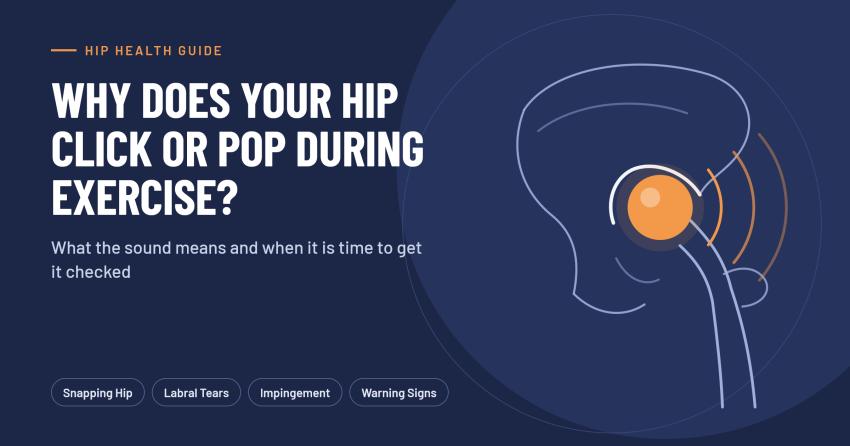
You lower into a squat, swing your leg during a warm-up or lift your knee on a stair climber, and there it is again: a click, a clunk or a pop from somewhere in your hip. Sometimes you can hear it. Sometimes you just feel it. Most people’s first question is simple. Is this something to worry about?
The honest answer is that it depends. A lot of hip clicking is harmless and comes from tendons or muscles moving over bone. Other times, the sound is a clue that something inside the joint needs attention. The difference usually comes down to where you feel it, what triggers it and whether pain comes along for the ride.
“A pop that doesn’t hurt is usually your body moving. A pop that hurts is your body asking you to listen.”
Dr. Mufaddal Gombera, MD
How the Hip Is Built
Your hip is a ball-and-socket joint. The rounded top of the thigh bone (the femoral head) sits inside a cup in the pelvis called the acetabulum. A ring of cartilage called the labrum lines the edge of that cup and helps keep the joint stable.
Around the joint, several strong tendons and muscles cross over bony bumps as you move. When one of those tendons catches and then slides over a bone, you get a snap. When something inside the joint itself is damaged, you can get a click or catch from within. Doctors usually sort hip clicking into three groups based on where it starts.
1. Outer Hip Snapping (External Snapping Hip)
This is the most common type. It happens when the iliotibial band (IT band) or the gluteus maximus tendon slides over the greater trochanter, the bony point you can feel on the side of your hip.
What it feels like:
- A snap on the outside of the hip
- Often visible or easy to feel with your hand
- Common when walking, running, climbing stairs or rotating your hip
- Some people can make it happen on purpose
Runners, cyclists and dancers see this one often, especially when the IT band and outer hip muscles are tight.
2. Front of the Hip Snapping (Internal Snapping Hip)
Here, the iliopsoas tendon, which helps lift your thigh, snaps over a bony ridge on the pelvis or over the front of the hip joint.
What it feels like:
- A deep snap or clunk in the front of the hip or groin
- Often audible, sometimes loud enough for others to hear
- Typically happens when the hip moves from bent to straight, such as lowering your leg from a leg raise, standing up from a squat or kicking
- Harder to see or touch because the tendon sits deep
This type is often linked to repetitive hip flexion. Soccer players, dancers, gymnasts and people who do a lot of leg raises or high-volume core work are common examples.
3. Clicking From Inside the Joint (Intra-Articular)
This is the type that deserves more attention. Clicking that starts inside the joint may be a sign of:
- A hip labral tear. A torn piece of the labrum can catch between the ball and socket.
- Femoroacetabular impingement (FAI). Extra bone on the ball, the socket or both causes them to pinch during movement, which can damage the labrum over time.
- Loose bodies. Small fragments of cartilage or bone can float in the joint and get caught.
- Cartilage wear. Early arthritis can create a grinding or clicking sensation.
What it feels like:
- A sharp click, catch or locking sensation deep in the groin or front of the hip
- Pain that often comes with the click rather than being silent
- Stiffness or reduced range of motion
- Discomfort with sitting for long periods, pivoting or deep squats
- A feeling that the hip “gives way” now and then
If you notice yourself cupping your hand around the side of your hip to show where it hurts, that “C” shaped grip is something hip specialists see often in patients with joint problems.
What About Painless Popping?
Many active adults get occasional pops or cracks from their hips that never cause pain, swelling or weakness. These can come from small gas bubbles releasing inside the joint fluid, the same process behind cracking knuckles, or from tendons gliding over bone.
Painless snapping that does not change how you move is usually not dangerous. It may still be worth paying attention to if it starts happening more often, gets louder or begins to feel irritated after workouts.
Exercises That Commonly Trigger Hip Clicking
Certain movements tend to bring it out:
- Deep squats and lunges
- Leg raises and other lying core exercises
- Running, especially on hills or with a long stride
- Cycling with a saddle set too low
- Dance, yoga and martial arts movements that take the hip through big ranges
- Lateral moves like side lunges or skater jumps
If one exercise consistently produces a painful click, that pattern is useful information to share with a doctor or physical therapist.
Common Contributing Factors
- Tight hip flexors or IT band from long hours of sitting or repetitive training
- Weak glutes and core, which leaves the hip less stable under load
- Sudden jumps in training volume without enough recovery
- Poor movement mechanics, such as knees caving inward during squats
- Hip shape differences like FAI, which some people are simply born with
What You Can Do at Home
For painless or mildly irritated snapping, these steps often help:
- Take a short break from the exercise that triggers it and swap in something gentler.
- Stretch the hip flexors and outer hip a few times a day, especially if you sit for work.
- Strengthen your glutes and core with exercises like bridges, side planks, clamshells and side-lying leg lifts.
- Check your form. Slow down your squats and lunges, and keep your knees tracking over your toes.
- Ease back in gradually once things calm down.
Ice after activity can help with soreness. Over-the-counter pain relievers may help in the short term, but they should not be used as a way to keep training through pain.
Expert Perspective
Dr. Mufaddal Gombera, MD, is a dual board-certified orthopedic surgeon in Orthopedic Surgery and Sports Medicine at Fondren Orthopedic Group in Houston, Texas. He is the Director of the Hip Preservation Center at Texas Orthopedic Hospital, completed his sports medicine fellowship at Northwestern University and has served as an assistant team physician for Northwestern Football, the Chicago Cubs and the Chicago Blackhawks.
His approach to hip care starts with conservative options first, including activity changes, physical therapy and other non-surgical treatments. When those are not enough, minimally invasive arthroscopic surgery may be used to repair problems like labral tears or impingement. Active adults dealing with painful hip clicking can learn more about evaluation and treatment options through Mufaddal Gombera, MD.
When Hip Clicking Needs a Doctor’s Visit
Book an evaluation if your hip clicking comes with any of these:
- Pain during or after the click
- Locking, catching or a feeling that the hip gives way
- Swelling or a limp
- Groin pain that lasts more than a few weeks
- Reduced range of motion or stiffness that keeps getting worse
- Clicking that started after a fall, twist or other injury
A hip specialist will usually check how you move, test specific positions that reproduce the click and may order X-rays or an MRI to look at the bones, labrum and cartilage. Getting the right diagnosis early often means simpler treatment and a faster return to training.
The Bottom Line
A clicking or popping hip is common in people who exercise, and many cases are nothing more than a tendon sliding over bone. Pain is the key difference. Silent, painless snapping can usually be managed with stretching, strengthening and smarter training. Clicking that hurts, catches or limits your movement is worth having checked, because problems inside the joint tend to do better when they are caught early.