Consider a complete smile overhaul? Well, guess what - you are not the only one here! A number of Australians take years to expose a tooth chip or a discoloured stain in pictures, as they dread looking like they have got rows of very fake "piano keys" for teeth. The issue can also be money. Yet, when you first investigate the topic of veneers in Melbourne, it's very likely that you will soon come to understand that veneers, small pieces of porcelain which are individually made and bonded to your natural teeth, are among the most effective methods for correcting tooth gaps, imperfections, and discolouration.
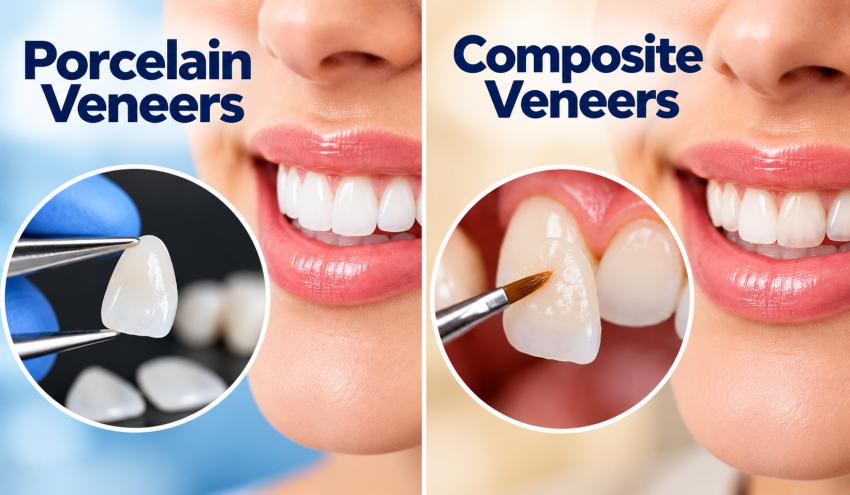
Now, before you book anything, you've got a major fork in the road: choosing between handcrafted porcelain and chairside composite resin. It's not just a matter of looks. It impacts your hip pocket, how many trips you take to the dental chair, and how much natural tooth you actually get to keep.
Porcelain vs. Composite: Procedure, Material, and Timeline
Let's break down how these two are actually made.
Composite resin is sculpted right onto your teeth in a single session lasting an hour or two. The dentist layers and shapes the material directly, which means very little, if any, of your natural enamel needs to be filed away. Quick, simple, and done in one go.
Porcelain crowns, on the other hand, are in an entirely different league altogether. They are custom made in a laboratory, and that typically entails two to four visits over a few weeks. In order to avoid any bulkiness of the crown or any protrusion, the dentist will carefully remove a minute layer of the enamel from 0.3mm to 0.7mm, about the width of a nail.
Lifespan, Reversibility, and Patient Satisfaction
Because enamel doesn't grow back once it's gone, getting porcelain veneers is an irreversible commitment. If they ever need replacing down the line, your teeth will always require coverage.
Composite bonding, on the other hand, is mostly additive and often reversible if your natural teeth weren't heavily shaped.
Here's the catch, though. Porcelain works like a glass barrier and can last from 10 to 20 years with stain-resistant properties in regard to early morning flat white and red wine. The composite resin is somewhat permeable and is capable of absorbing any pigment contained in food; it will last from 5 to 7 years until a re-treatment is required. Indeed, clinical research done during a two-year period showed that people with porcelain fillings were significantly more satisfied than those with composite resins.
If you want a budget-friendly option to get your foot in the door, asking a clinic about composite veneers in Melbourne is a great starting point, but porcelain is hard to beat if you want a "set-and-forget" solution.
Costs and Health Insurance in Victoria
Let's talk dollars and cents.
Single composite veneers in Melbourne may cost between $400 and $1,200 per tooth; that is, the total price for an eight-tooth transformation will be around $3,200-$9,600. Porcelain is more economical eventually, though, with an initial investment of $1,400 to $3,000 per tooth, so an eight set would cost between $11,200 and $24,000.
Will private health insurance help out?
Usually, no. Standard extras policies treat cosmetic veneers as elective and won't cover them. But if you're repairing severe erosion or dental trauma, Major Dental cover might offer a partial rebate. To soften the blow, most Melbourne clinics offer interest-free payment plans over 6 to 24 months.
Aftercare, Tooth Preservation, and Choosing Your Dentist
Actually, your new smile is not that complicated. Use a soft brush, avoid toothpastes with abrasives, and skip the alcohol-based mouthwashes, which may damage the bonding cement later. In addition, a custom night guard is your last defence against tooth chips which occur because of teeth-grinding during sleep.
While searching for a practitioner, you may also evaluate their general treatment philosophy. For instance, what does a biological dentist do when dealing with cosmetic work? A biological or holistic dentist would attempt to conserve as much of the healthy natural tooth structure as possible and would employ materials that are healthy for your body- biocompatible ones.
AHPRA Regulations
A quick heads-up on Australian rules: under AHPRA advertising regulations, local dental clinics aren't allowed to use influencer sponsorships, clinical outcome reviews, or edited transformation photos. That's a good thing for you; it means you can focus on real practitioner credentials and honest educational advice.
Conclusion:
In the final analysis, there is no easy solution here. For a highly durable and highly stain-resistant tooth filling, porcelain is the way to go, but for a more economical option and the need to get over it without having anything permanent done to the tooth enamel, the composite filling should be considered. Book an appointment with a registered AHPRA dentist.