Finding the right medical device supplier in the Netherlands requires more than comparing product prices. Professional healthcare buyers need to consider product suitability, specifications, quality, documentation, availability, logistics and ongoing supply support.
For hospitals, distributors, wholesalers and international procurement teams, supplier selection is part of a wider supply chain decision. The supplier must be able to provide products which match purchasing requirements while supporting clear communication and dependable ordering processes.
Romed Holland is a Netherlands based medical products company associated with Van Oostveen Medical BV in Wilnis, the Netherlands. Its public product documentation identifies the company as the manufacturer for specific ROMED branded products and references applicable European medical device requirements for those products.
This article explains what professional buyers should consider when evaluating a medical device supplier in the Netherlands and where Romed Holland fits into that procurement landscape.
What Is a Medical Device Supplier?
A medical device supplier provides medical devices and related healthcare products to professional customers. Depending on the business model, a supplier may manufacture products, distribute products from other manufacturers, import products or combine several roles.
The exact role matters because responsibilities can differ across the supply chain. Buyers should establish whether they are purchasing directly from a manufacturer or through a distributor or importer.
A professional supplier should also provide clear product information. This may include product specifications, packaging details, identification information and relevant documentation.
For healthcare procurement teams, understanding the supplier's role helps determine who to contact for technical information, product changes and other purchasing requirements.
Why Consider a Medical Device Supplier in the Netherlands?
The Netherlands is part of the European Union single market. Products sold in the EU must meet applicable EU rules, and manufacturers meeting relevant EU requirements can market compliant products across EU member states.
The Dutch market also has established oversight arrangements for medical devices. The Dutch Health and Youth Care Inspectorate, known as IGJ, monitors medical devices and medicines in the Netherlands.
For international healthcare buyers, a Netherlands based supplier can therefore be one option within a broader European sourcing strategy.
However, location alone should not determine supplier selection. Buyers still need to assess the actual product, documentation, availability, delivery capability and commercial terms.
Romed Holland as a Medical Device Supplier
Romed Holland is associated with Van Oostveen Medical BV, based in Wilnis, Netherlands. Public documentation published by Romed identifies Van Oostveen Medical BV as the manufacturer for specific ROMED products.
For example, a publicly available Declaration of Conformity for ROMED medical examination gloves identifies the product as a Class I medical device and references Regulation (EU) 2017/745. The same document lists applicable standards and product identification information.
This type of documentation is useful to professional buyers because it demonstrates why product level verification matters. Buyers should always assess the documentation applicable to the specific product they intend to purchase rather than assuming one document covers an entire catalogue.
When researching a Medical Device Supplier in Netherlands, procurement teams can use this same principle across potential suppliers: identify the product, check the relevant documentation and confirm the information against the actual purchasing requirement.
What Types of Products Should Buyers Look For?
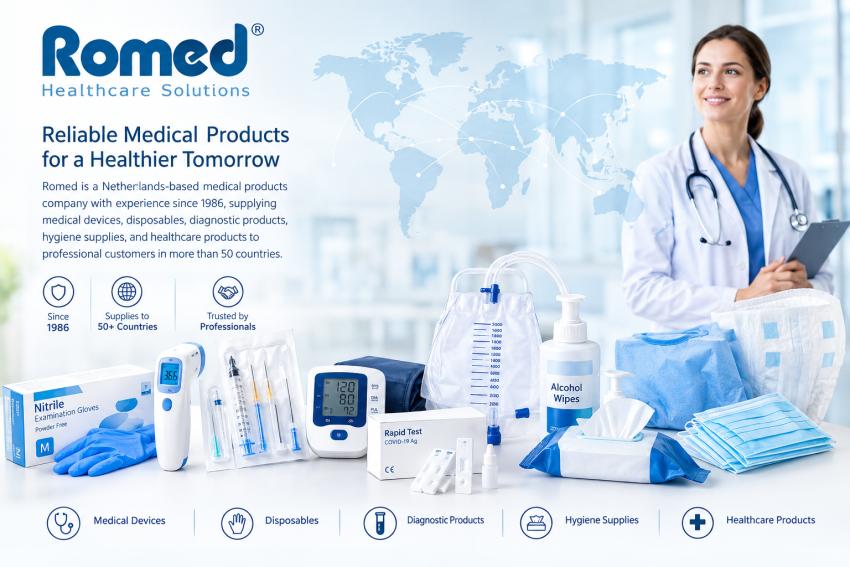
Medical device suppliers can cover a wide range of healthcare categories. The exact range depends on the supplier.
Professional buyers may be sourcing products such as:
- Medical examination gloves
- Medical disposables
- Diagnostic products
- Patient care products
- Healthcare hygiene products
- Protective equipment
- Everyday medical devices
The important factor is not simply how many products a supplier lists. Buyers should determine whether the supplier has suitable products for their intended professional requirements.
A broad product range can simplify procurement, but product suitability and supply consistency should remain the primary considerations.
Start With Product Specifications
Before contacting a supplier, procurement teams should define their requirements as clearly as possible.
Depending on the product, this may include:
- Product type
- Intended use
- Material
- Size
- Dimensions
- Packaging
- Technical characteristics
- Required quantity
- Delivery destination
Clear specifications make supplier comparisons more accurate. They also reduce the possibility of comparing products which appear similar but have different characteristics.
For distributors and wholesalers, accurate specifications are particularly important because product information may need to be passed to downstream customers.
Verify Medical Device Documentation
Documentation should be an important part of medical device procurement.
The specific documentation required depends on the product, classification, market and applicable legislation. Buyers should therefore avoid using a generic checklist for every product.
Where CE marking is applicable, the relevant manufacturer or economic operator must meet the requirements associated with the applicable EU legislation. Government guidance states that manufacturers determine whether their products are subject to CE marking requirements, while importers have responsibilities for applicable products made outside the EEA.
For medical devices, buyers should review product specific information and request relevant documentation where appropriate.
Romed's publicly available product documentation provides an example of this approach. Its Declaration of Conformity for a specific ROMED glove product identifies the manufacturer, product references, classification and applicable European legislation and standards.
Do Not Treat CE Marking as the Entire Supplier Evaluation
CE marking can be an important regulatory consideration for products where it is required, but it should not be treated as the only factor in supplier selection.
Procurement teams should also evaluate:
- Product specifications
- Quality consistency
- Documentation
- Stock availability
- Lead times
- Packaging
- Delivery capability
- Communication
- Repeat order support
A compliant product still needs to fit the buyer's practical purchasing requirements.
This distinction is particularly useful for distributors and wholesalers. Their customers may have specific specifications, quantities and delivery expectations which must be considered alongside regulatory requirements.
Evaluate Product Quality and Consistency
Quality should be assessed at product level and across the supplier relationship.
Buyers should compare the actual product against the stated specifications. Where appropriate, samples can be reviewed before larger purchasing commitments are made.
For recurring procurement, consistency becomes equally important. A buyer may expect the same product specification and packaging from one order to the next.
If a supplier changes a product, packaging or specification, the buyer should have a clear process for receiving and reviewing the update.
A supplier relationship should therefore be assessed over time rather than based solely on one successful transaction.
Check Stock Availability
Stock availability can have a direct effect on purchasing plans.
Before placing an order, ask whether the product is currently available and whether it is normally held in stock or supplied after ordering.
For regularly purchased products, buyers should understand typical replenishment arrangements. Distributors may also need to consider whether the supplier can support their own inventory requirements.
A supplier with a suitable product range may still be unsuitable if availability does not match the buyer's purchasing cycle.
Review Lead Times and Delivery
Lead times should be considered before establishing a recurring supply relationship.
Ask how orders are processed and what delivery arrangements are available. International buyers should also consider the destination country, shipping method and any import requirements relevant to their market.
For European buyers, the Netherlands can form part of a wider EU distribution network. However, actual delivery performance depends on the specific supplier, product, order and destination.
Procurement teams should therefore work with confirmed lead time information rather than assumptions based only on supplier location.
Assess International Distribution Capability
International buyers may need more than a product catalogue.
They may require clear export processes, product documentation, packaging information, shipping coordination and communication across different time zones or markets.
When evaluating a Netherlands based supplier, ask whether the supplier regularly handles international orders and whether its distribution process fits your destination market.
Wholesalers should also consider whether product information and packaging are suitable for onward distribution.
International sourcing works best when product requirements and logistics expectations are established before an order is placed.
Compare Minimum Order Quantities
Minimum order quantities can influence the suitability of a supplier for different types of buyers.
A large distributor may prefer carton or pallet quantities, while a smaller healthcare organisation may need lower purchasing volumes.
Before ordering, confirm the minimum quantity for the products you need. Also consider warehouse capacity, product demand and inventory turnover.
The most suitable order quantity is the one which aligns with the buyer's purchasing model rather than simply the supplier's preferred volume.
Look Beyond Unit Price
A low product price does not necessarily mean a lower procurement cost.
Buyers should consider the complete purchasing arrangement, including:
- Product price
- Minimum order quantity
- Freight
- Packaging
- Delivery
- Storage
- Inventory requirements
- Administrative effort
For example, a lower unit price may require a significantly larger order. This can increase inventory requirements and warehouse pressure.
A broader total cost assessment gives procurement teams a more realistic basis for supplier comparison.
Evaluate Communication and Technical Support
Good communication is essential in B2B medical procurement.
Buyers may need information about product specifications, stock, documentation, quotations, delivery schedules and repeat orders.
The quality of communication can also indicate how easily future purchasing issues may be handled.
Ask clear questions before placing an initial order. Pay attention to whether the supplier provides specific answers and relevant documentation rather than general statements.
For distributors and wholesalers, responsive communication can also make it easier to manage product information for their own customers.
Consider Packaging and Storage
Packaging is an important but often overlooked part of medical device procurement.
Buyers should understand how products are packaged, transported and supplied. Packaging can affect warehouse space, handling and distribution costs.
For example, when purchasing medical devices or related healthcare products in larger quantities, procurement teams should consider carton dimensions, pack quantities and storage requirements alongside the product specification.
This is especially relevant for wholesalers managing several product categories.
How to Evaluate Romed Holland for Procurement
When considering ROMED HOLLAND as a potential supplier, buyers should use the same objective procurement process they would apply to any medical device supplier.
Start with the products required. Then review specifications, product documentation, availability, order quantities, delivery arrangements and communication.
Public Romed documentation provides product specific information for selected ROMED products, including manufacturer details and regulatory references.
This is useful for procurement research, but buyers should still verify the documentation applicable to each individual product they intend to purchase.
The purpose of supplier evaluation is to establish whether the supplier matches the buyer's actual requirements.
What Makes a Medical Device Supplier Suitable for Distributors?
Distributors often have different priorities from individual healthcare facilities.
A distributor may need:
- Consistent product specifications
- Suitable wholesale quantities
- Reliable availability
- Clear product information
- Relevant documentation
- Practical packaging
- Predictable delivery
- Repeat order support
- International distribution capability
The supplier must fit the distributor's own supply chain. A product which works for one customer may not suit another because order volumes, destinations and specifications can differ. For this reason, distributors should assess both product suitability and the supplier's ability to support recurring commercial orders.
What Should International Buyers Check Before Ordering From the Netherlands?
International buyers should confirm the complete purchasing process before committing to an order.
Important areas include product specifications, applicable documentation, order quantities, stock, lead times, shipping arrangements and destination requirements.
Buyers should also establish which party is responsible for different parts of the import and distribution process.
This is particularly important when purchasing medical devices for markets outside the EU. EU market compliance does not automatically mean a product meets every requirement in another destination market.
The buyer should therefore check the rules applicable to the intended destination before importing or distributing products there.
Common Mistakes When Choosing a Medical Device Supplier
One common mistake is choosing a supplier based only on product price. This can overlook freight, minimum quantities, storage and delivery requirements.
Another is assuming a large catalogue means strong supply capability. A supplier may list many products but have limited availability for specific items.
Buyers should also avoid treating generic compliance statements as a substitute for product specific documentation.
Finally, procurement teams should not ignore communication. A supplier's ability to provide clear information can become increasingly important as purchasing volumes and product categories grow.
Practical Medical Device Supplier Evaluation Checklist
Before establishing a long term supplier relationship, procurement teams can review:
- Product specifications
- Product classification where relevant
- Applicable documentation
- Quality and consistency
- Stock availability
- Lead times
- Minimum order quantities
- Packaging
- Delivery arrangements
- International distribution capability
- Communication
- Repeat order support
- Total procurement cost
This checklist can be adapted according to the organisation's purchasing needs.
A hospital may focus heavily on product specifications and documentation. A distributor may place greater emphasis on stock, packaging, order quantities and recurring supply. An international buyer may need additional focus on export and destination requirements.
Conclusion
Selecting a medical device supplier in the Netherlands is a procurement decision which should combine product, regulatory, commercial and supply chain considerations.
Romed Holland provides one example of a Netherlands based medical products company with publicly available product documentation for specific ROMED products. That documentation illustrates the importance of checking manufacturer information, product identification and applicable European requirements at product level.
For healthcare buyers, distributors, wholesalers and international procurement teams, the most useful approach is to define product requirements first and then evaluate suppliers against consistent criteria. Product suitability, documentation, quality, stock, logistics, communication and total procurement cost should all form part of the assessment.
A reliable supplier relationship is built on verified information and clear expectations. Whether sourcing from Romed Holland or another Netherlands based supplier, professional buyers should make the final procurement decision based on the specific products and supply requirements of their organisation.
Frequently Asked Questions
Is Romed Holland a medical device supplier in the Netherlands?
Romed Holland is associated with Van Oostveen Medical BV, a Netherlands based company in Wilnis. Public product documentation identifies Van Oostveen Medical BV as the manufacturer of specific ROMED branded products.
What should I check before buying from a Netherlands medical device supplier?
Check the product specification, applicable documentation, availability, lead time, minimum order quantity, packaging, delivery arrangements and total procurement cost. International buyers should also check requirements applicable to their destination market.
Are medical devices in the Netherlands subject to EU requirements?
Medical devices marketed in the EU are subject to applicable European regulatory requirements. The exact requirements depend on the device and its classification. The Dutch government identifies the Health and Youth Care Inspectorate as the authority monitoring medical devices and medicines in the Netherlands.
What is important when buying medical devices wholesale?
Wholesale buyers should consider product suitability, product documentation, order quantities, stock availability, packaging, delivery and repeat order support. These factors can influence warehouse planning and downstream distribution.
Can international buyers purchase medical devices from a Netherlands supplier?
International buyers can source from Netherlands based suppliers, but they should confirm the supplier's distribution arrangements and check the regulatory and import requirements of the destination market before ordering.
Should buyers compare more than one medical device supplier?
A structured comparison can help buyers identify differences in product suitability, documentation, availability, delivery and commercial terms. The comparison should focus on the buyer's specific requirements rather than simply ranking suppliers by price.