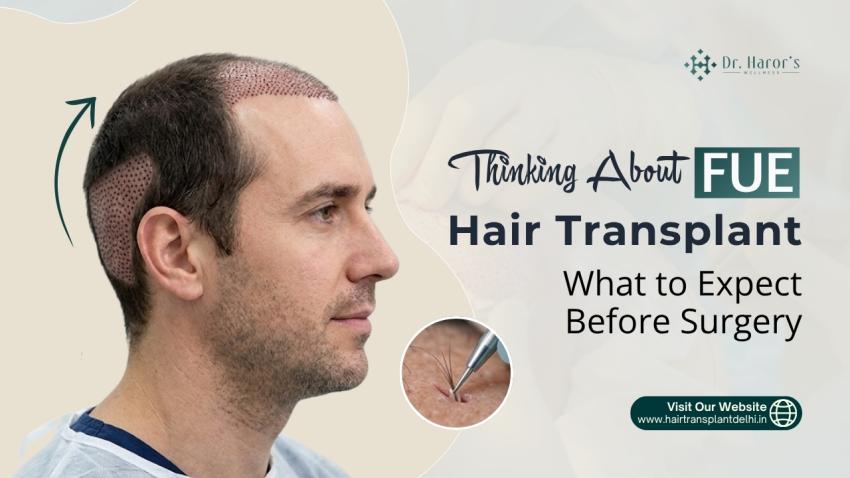
Watching your hair thin out—whether it’s a retreating hairline, widening parting, or a spot opening up at the crown—rarely happens overnight. Yet, when you finally realize just how much ground you've lost, it can take a real toll on your self-image.
Years ago, fixing significant hair loss almost always meant strip surgery (FUT), which involved cutting a sliver of scalp from the back of the head, leaving a noticeable linear scar and requiring a tough, painful recovery. Modern hair restoration has changed dramatically since then.
Today, Follicular Unit Extraction (FUE) has become the preferred option for anyone looking for a clean, minimally invasive procedure with little down-time and no major scars. But if you’re booking a procedure for the first time, walking in without knowing what to expect is a recipe for anxiety.
Here is an honest, straightforward walkthrough of what an FUE hair transplant in Delhi actually involves, what happens behind the scenes, and what you need to know before sitting in the surgical chair.
What Is an FUE Hair Transplant?
At its core, an FUE hair transplant is a micro-surgical procedure where a doctor relocates individual hair follicles from an area of your head with abundant hair (the donor zone, usually the back and sides) into the areas where hair has thinned or disappeared.
Unlike older strip techniques that slice away skin, FUE uses a specialized micro-punch tool (typically under 1mm in diameter). This extracts follicular units—natural clusters of 1 to 4 hairs—one by one.
Because the incisions are so tiny:
You avoid long linear cuts.
The tiny puncture sites heal into faint pinprick dots easily hidden beneath short hair.
The healing process is significantly faster and far less painful.
Why People Opt for FUE Over Traditional Methods
If you are weighing your choices for an FUE hair transplant in Delhi, several distinct advantages explain why it remains the go-to technique:
Soft, Undetectable Hairlines: Because follicles are implanted individually, a skilled surgeon can control the exact depth, angle, and direction of each hair. Done properly, new growth mimics the flow of your existing hair.
Virtually Scar-Free Healing: Without scalpels or stitches, there is no giveaway scar across the back of your head. You can keep your hair cut relatively short without revealing your procedure.
Excellent Graft Survival: When performed in a well-equipped clinic with temperature-controlled holding solutions, graft survival rates regularly sit between 90% and 95%.
Rapid Bounce-Back: Most patients are back on their feet within 24 to 48 hours, and visible scabbing generally clears up within a week to ten days.
How Does the Surgery Actually Unfold?
An FUE session typically takes anywhere from 4 to 8 hours depending on how many grafts you need. The surgery breaks down into three key phases:
Mapping and Hairline Design
Before anything medical begins, you and your surgeon sit down to map the recipient zone. A good doctor designs a hairline that respects your age, facial structure, and anticipated future hair loss—not just what looks sharp this year.
Harvesting the Grafts
After numbing the donor area with local anesthesia, the surgeon gently loosens individual follicular units using micro-punches. The extracted grafts are immediately sorted and bathed in a chilled nutrient solution to keep them healthy while out of the body.
Implantation
Tiny recipient sites are created in the thinning areas. The surgeon then places single-hair grafts along the soft frontal edge and clusters of two or three hairs deeper in for natural density.
4 Realities to Wrap Your Head Around Before Surgery
A successful transplant relies just as much on managing expectations as it does on the surgeon's hands. Keep these practical points in mind:
Patience Is Non-Negotiable: Hair does not sprout right away. It takes 3 to 4 months for follicles to wake up and begin sprouting, with the final, mature density showing up around the 10-to-12-month mark.
The "Ugly Duckling" Shedding Phase: Around week three or four, most transplanted hairs will fall out. Don't panic. This temporary shed (called shock loss) is completely normal; the hair shaft drops, but the follicle beneath remains alive and anchored.
Your Donor Bank Is Finite: You only have a limited amount of permanent hair on the back of your head. A conscientious surgeon protects this reserve rather than over-harvesting it in a single go.
Post-Op Care Matters as Much as Surgery: The first week dictates graft survival. You’ll need to follow strict instructions about how you wash your scalp, sleep slightly elevated, and avoid sweating or heavy gym sessions.
Are You a Good Match for FUE?
Not every pattern of hair loss calls for immediate surgery. You are typically a strong candidate for an FUE hair transplant in Delhi if:
You have a stable hair-loss pattern rather than sudden, unexplained shedding.
You possess adequate hair density and strong follicle caliber in your donor zone.
You are in good general health without uncontrolled systemic conditions that could slow healing.
Your expectations are grounded—understanding that surgery restores visual fullness and frames the face, but cannot replicate the biological hair density of a teenager.
Final Thoughts
Taking the leap into hair restoration can feel overwhelming, but clarity about the process changes everything. Once you know what happens during extraction, how recovery unfolds, and how hair grows back, the procedure feels far less daunting.
If you’re considering an FUE hair transplant and want an honest clinical assessment of your donor area, consider consulting Dr. Haror’s Wellness. Their surgical team brings years of focused experience in hairline design and high-density graft placement, ensuring results that seamlessly complement your natural features.
Ready to find out how many grafts your hairline actually needs? Book your session now to get started.
#fuehairtransplantindelhi #besthairtransplantsurgeonindelhi #besthairclinicindelhi #hairlosstreatmentindelhi #besthairfallreatmentindelhi #drnavnitharor #drharorswellness #hairdoctorindelhi #besthairtreatmentindelhi #besthairlosstreatmentindelhi #beforeafterresults #hairrestorationtreatmentindelhi #besthairdoctorindelhi #besthairfalltreatmentclinicindelhi #hairtreatmentclinicindelhi #bestdermatologistindelhincr #besthairtransplantdoctorindelhi #hairtransplantcostindelhi