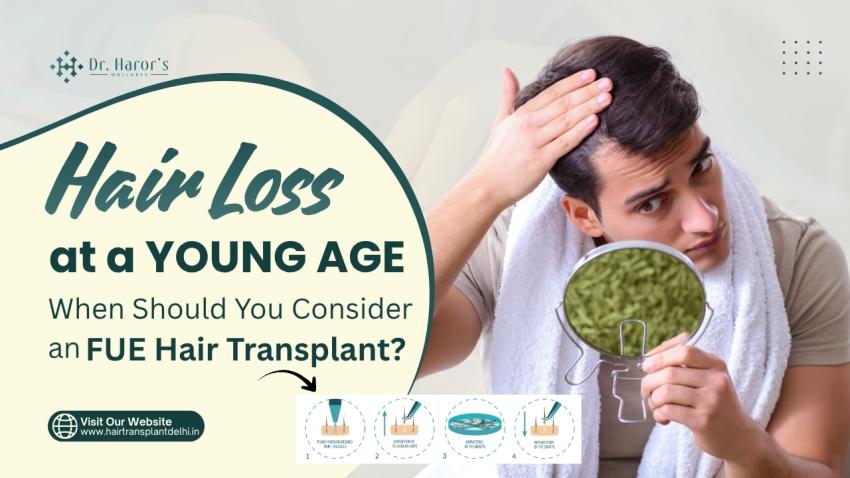
Noticing more hair on your pillow or in the shower drain before you've even hit 30 can be unsettling. Hair loss has always carried an "older person's problem" label, so when it shows up early, most people aren't sure what to do next — or whether they even qualify for a procedure yet. If you've been researching an FUE Hair Transplant in Delhi and keep running into the same question — am I too young, or maybe too old — this guide should clear things up.
Why Age Actually Matters in FUE Hair Transplant Planning
Hair loss isn't a fixed condition. It's a pattern that keeps evolving as you age, which is exactly why age plays such a big role in transplant planning. The earlier you are in that pattern, the harder it is to predict how it will look five or ten years from now.
Go in for a transplant too early, before your hair loss has settled into a clear pattern, and there's a real chance you'll need a second or even third procedure later to keep up with new balding areas. That's not a reason to panic — it's just a reason to plan properly with a surgeon who understands how hair loss actually progresses over time.
Getting an FUE Hair Transplant in Your 20s: Worth It or Too Soon?
Hair thinning in your early 20s is often more complicated than it looks. It can be triggered by hormonal shifts, poor diet, pollution, stress, or even certain medications — and not all of it is permanent. Some of it is simply your body's normal shedding cycle, which can easily be mistaken for the beginning of pattern baldness.
Because of this, most experienced surgeons won't rush a 20-something straight into a transplant. Instead, they'll usually recommend addressing the basics first — better sleep, a diet that actually supports hair growth, and lower stress levels — before deciding whether surgery is even necessary.
The bigger issue is that a hair growth cycle in your 20s is still active and unpredictable. Even a technically perfect transplant can end up looking uneven a few years down the line if the surrounding, untreated hair keeps thinning. The balding pattern simply hasn't finished forming yet, so operating on a moving target rarely gives lasting results.
Your 30s: Often the Sweet Spot for FUE Hair Transplant
Ask most hair restoration specialists, and they'll point to the 30s as the ideal window for an FUE Hair Transplant. By this stage, hair loss has usually stabilized enough to work with — the pattern is visible, predictable, and far easier to plan around.
There's a practical side to this too. In your 30s, the donor area at the back and sides of the scalp is typically still strong and dense, and the skin retains enough resilience to heal well and hold the transplanted grafts. That combination is a big part of why this age range comes up so often as the "ideal" one, for both men and women.
What Actually Decides If You're Ready
Age gives a rough starting point, but it's not the whole story. A qualified surgeon will look at several other factors before recommending a procedure:
How advanced and how stable your hair loss currently is
The quality and quantity of hair available in your donor area
Visible scalp changes and hairline patterns
Underlying causes contributing to your hair loss
Two people at the same age can be at completely different stages, which is why a proper in-person evaluation matters far more than a birthday number.
The Real Question Isn't Your Age — It's Your Readiness
At the end of the day, this isn't really about pinpointing the "correct" age for an FUE Hair Transplant. It's about whether your hair loss pattern has matured enough, and whether your scalp and donor area are ready to deliver a result that lasts. The only way to know for sure is a proper consultation with someone who can actually assess your scalp, not just guess based on your age.
If you're exploring your options for FUE Hair Transplant in Delhi, Dr. Haror's Wellness is a good place to start that conversation. Their team of qualified surgeons takes a patient-first approach, walking you through a personalized plan built around your specific hair loss stage, goals, and expectations — not a one-size-fits-all timeline.
Frequently Asked Questions
Is there a minimum age for an FUE hair transplant?
There's no strict legal minimum, but most surgeons prefer to wait until a patient's hair loss pattern has stabilized, which is usually in the late 20s to early 30s, rather than operating while the pattern is still forming.
Can I get a hair transplant in my 20s if I'm already losing hair?
It's possible, but most specialists will first check whether lifestyle factors are contributing to the shedding and may recommend addressing those before considering surgery, since early transplants can require touch-ups later.
Why are the 30s considered the best age for FUE?
By this age, hair loss has typically settled into a recognizable pattern, and the donor area is usually still dense and strong, giving surgeons a clearer, more stable base to plan the transplant around.
Is it too late to get a hair transplant in your 40s or 50s?
Not necessarily. What matters more than age at this stage is the quality and quantity of donor hair available, along with overall scalp health.
How do I know if I'm ready for an FUE hair transplant?
The best way is a one-on-one consultation with a hair transplant specialist who can evaluate your hair loss severity, donor supply, and underlying causes before recommending a plan.
#fuehairtransplant #fuehairtransplantindelhi #besthairtransplantsurgeonindelhi #besthairclinicindelhi #hairlosstreatmentindelhi #besthairfallreatmentindelhi #drnavnitharor #drharorswellness #hairdoctorindelhi #besthairtreatmentindelhi #besthairlosstreatmentindelhi #beforeafterresults #hairrestorationtreatmentindelhi #besthairdoctorindelhi #besthairfalltreatmentclinicindelhi #hairtreatmentclinicindelhi #bestdermatologistindelhincr #besthairtransplantdoctorindelhi #hairtransplantcostindelhi