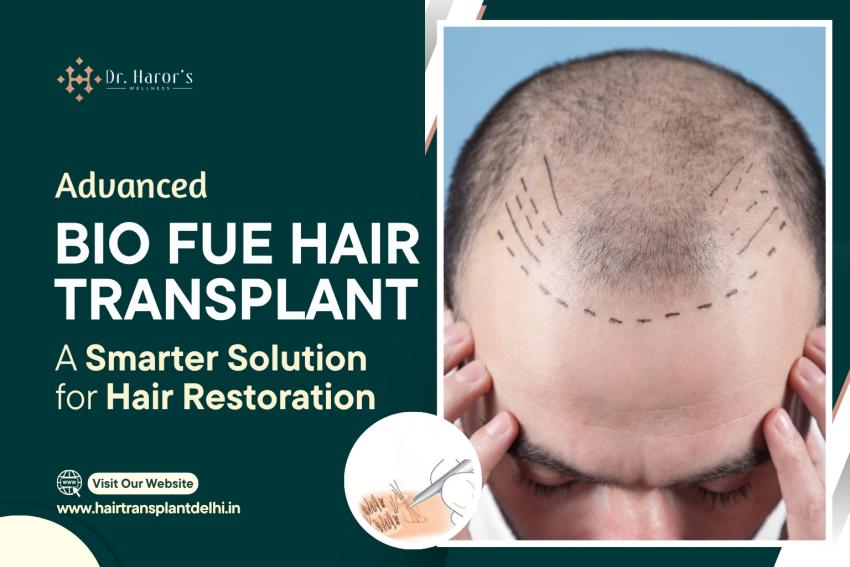
Losing hair isn't just a cosmetic issue — for most people, it chips away at confidence a little more every day. If you've spent time researching ways to get thicker, more natural-looking hair back, chances are you've come across a method that's gaining serious traction right now: bio FUE hair transplant. It's built on the same trusted FUE technique but adds a biological boost that many surgeons believe leads to better healing and stronger results.
In this post, we'll break down what a Bio FUE hair transplant in India actually involves, how the procedure works step by step, the benefits it offers over standard techniques, and who tends to get the best results from it.
What Exactly Is a Bio FUE Hair Transplant?
Think of it as FUE (Follicular Unit Extraction) with an upgrade. A bio FUE hair transplant takes the standard extraction-and-implantation process and pairs it with regenerative add-ons like PRP (Platelet-Rich Plasma) or GFC (Growth Factor Concentrate).
Both of these are derived from the patient's own blood. A small sample is drawn, spun in a centrifuge to separate out the concentrated growth factors, and then applied to the scalp during the procedure. The idea is simple — give the newly transplanted follicles a richer environment to settle into, which can support healing and encourage healthier regrowth.
Why People Are Choosing Bio FUE Over Traditional Methods
There's a reason this approach has become the go-to choice for many patients:
A hairline that actually looks like yours. Surgeons place each graft at a precise angle and direction so it blends in with your existing hair growth pattern instead of looking "planted."
No linear scar. Traditional FUT surgery involves removing a strip of scalp tissue, which leaves a visible line of scarring. Bio FUE extracts individual follicular units one at a time, so the donor area heals with only tiny, barely noticeable marks.
Better support for recovery. The growth-factor treatment applied during the procedure is thought to aid tissue healing and support how well the grafts settle in — something standard FUE doesn't offer on its own.
A plan built around you. No two heads of hair are the same. Your treatment is mapped out based on how advanced your hair loss is, how much donor hair you have available, the condition of your scalp, and the density you're hoping to achieve.
How Does the Procedure Actually Work?
Here's a rough walkthrough of what happens during a typical session:
Consultation and assessment – Your surgeon examines your hair loss pattern, checks the donor area for density, evaluates your scalp, and estimates how your balding might progress over time. This shapes the entire treatment strategy.
Designing the hairline – Rather than using a generic template, the surgeon designs a hairline suited to your facial features, age, and the extent of your current hair loss.
Extracting the grafts – Individual follicular units are carefully harvested from the donor area using FUE, which keeps scarring to a minimum and results looking natural.
Adding the biological boost – This is where bio FUE sets itself apart. PRP or GFC is applied to the scalp to support graft survival and aid in wound healing.
Placing the grafts – Each extracted follicle is implanted into the thinning or balding area, with close attention paid to angle, direction, and density so the final result blends seamlessly.
Final Thoughts
A bio FUE hair transplant is designed to give you results that look like your own hair simply grew back — not like you had "work done." That said, how natural the outcome looks ultimately comes down to the skill and experience of the surgeon placing the grafts.
If faster scalp recovery and better blending with your surrounding hair are priorities for you, a bio-FUE hair transplant in India is worth discussing with a qualified specialist. Every scalp is different, so a proper consultation is the best way to figure out which technique will actually get you the results you want.
At Dr. Haror's Wellness, our surgeons take the time to assess your hair loss pattern individually and recommend the technique best suited to help you reach your hair restoration goals.