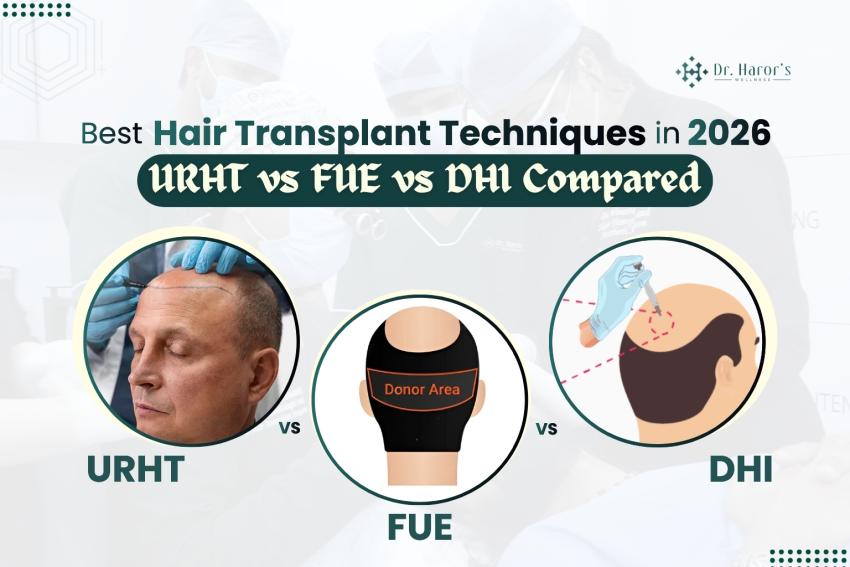
Trying to figure out which hair transplant technique is right for you? You've probably run into three names over and over again — URHT hair transplant, FUE, and DHI. All three are used by reputable clinics around the world, and all three have solid track records. So why does picking one feel so confusing?
Here's the honest answer: no article can replace a proper consultation with a qualified hair transplant surgeon. Your hair loss pattern, donor supply, scalp condition, and medical history all play into which method suits you. But you can walk into that consultation informed — and that's what this guide is for.
Let's break down what actually separates these three techniques: how much density they can deliver, how natural the results look, how much scarring you're left with, how long recovery takes, and how well the grafts survive the move.
What Is URHT Hair Transplant?
URHT stands for Ultra Receptive Hair Transplant. Think of it as FUE's more meticulous cousin — the entire technique is built around one goal: keeping as many extracted grafts alive as possible.
Instead of extracting a batch of follicles and implanting them afterward, a URHT hair transplant involves pulling each follicular unit with a micro-punch and placing it almost immediately, at a specific angle, depth, and direction. Some clinics call this the "zero-touch" method, because minimizing handling time is the whole point. Less handling means less drying out, less trauma to the root, and — in theory — sturdier regrowth down the line.
What Is FUE Hair Transplant?
FUE, or Follicular Unit Extraction, is the technique most people have already heard of. Individual follicular units are removed one at a time, held in a preserving solution, then implanted into the recipient area at the right angle and depth to look natural.
It's been around long enough, and been refined enough, that it's now the go-to option for a wide range of hair loss patterns — not just one specific case.
What Is DHI Hair Transplant?
DHI (Direct Hair Implantation) takes the FUE process and swaps out the implantation step. Instead of manually placing grafts into pre-made incisions, the surgeon uses a specialized implanter pen — often called a Choi pen — to extract and insert grafts directly.
This hands the surgeon a lot more control over exactly where, at what angle, and in what direction each graft goes in. That precision is why DHI tends to come up for tricky areas like the crown, where hair naturally grows in a spiral, uneven pattern.
URHT vs FUE vs DHI: Side-by-Side Comparison
Feature
URHT Hair Transplant
FUE Hair Transplant
DHI Hair Transplant
Technique
Refined graft extraction and implantation aimed at maximum survival
Grafts extracted one by one, stored, then implanted into mapped sites
FUE-based, but implanted using a specialized pen
Main Focus
Natural density and careful graft handling
Efficient extraction with minimal visible scarring
Exact control over graft angle and placement
Extraction
Refined, individual follicular extraction
Individual units removed with a small punch
Individual, similar to FUE
Implantation
Varies by clinic's specific protocol
Grafts placed into prepared recipient sites
Direct insertion via implanter pen
Best For
Patients wanting highly refined, natural results
Larger restoration areas or varying stages of hair loss
Cases needing precise density and placement control
Scarring
Tiny extraction marks, no linear scar
Small scattered marks that fade over time
Small marks, no linear FUT-style scar
Key Advantage
Precision, natural hairline design, efficient graft use
Versatile and proven across most hair-loss patterns
Fine control over hair direction and density
Watch Out For
Protocols and standards vary between clinics
Outcome depends heavily on donor management and surgeon skill
Demands real surgical skill; not needed for every case
So Which Technique Should You Actually Choose?
There's no one-size-fits-all winner here — that's really the whole point of this comparison.
FUE is usually the safest starting point if you want dense, natural results without a long downtime, and your hair loss follows a fairly typical pattern.
URHT hair transplant makes sense if you're specifically prioritizing graft survival and a refined, natural hairline — though it's worth asking any clinic exactly what their URHT protocol involves, since it isn't standardized the way FUE is.
DHI tends to be the better call when precision matters most, especially for crown restoration, where the growth pattern is spiral and uneven rather than straightforward.
At the end of the day, the right choice comes down to your donor area, your hair loss stage, your scalp, and your goals — which is exactly what a proper consultation is for.
Ready to Find Out What Works for You?
If you're still weighing your options, book a consultation with Dr. Haror's Wellness. Their team takes a patient-first approach, tailoring every plan to your specific hair loss pattern and goals — with strict attention to safety and hygiene at every step, so you get natural, lasting results without cutting corners.