Hair loss rarely shows up overnight. It creeps in — a slightly higher hairline here, a bit of thinning at the temples there — and before you know it, you're staring at the mirror wondering when exactly this started. Left alone, this slow progression can turn into full pattern baldness.
That's why anyone exploring hair loss treatment in Delhi usually starts with one simple step: getting properly staged. A qualified hair transplant surgeon uses the Norwood scale to figure out exactly how far the hair loss has progressed, and that single assessment shapes almost every decision that follows — medication, regenerative therapy, or a transplant.
This guide walks through what treatment actually looks like at each Norwood stage, along with realistic graft numbers so you know roughly what to expect.
What Is the Norwood Scale, and Why Does It Matter So Much?
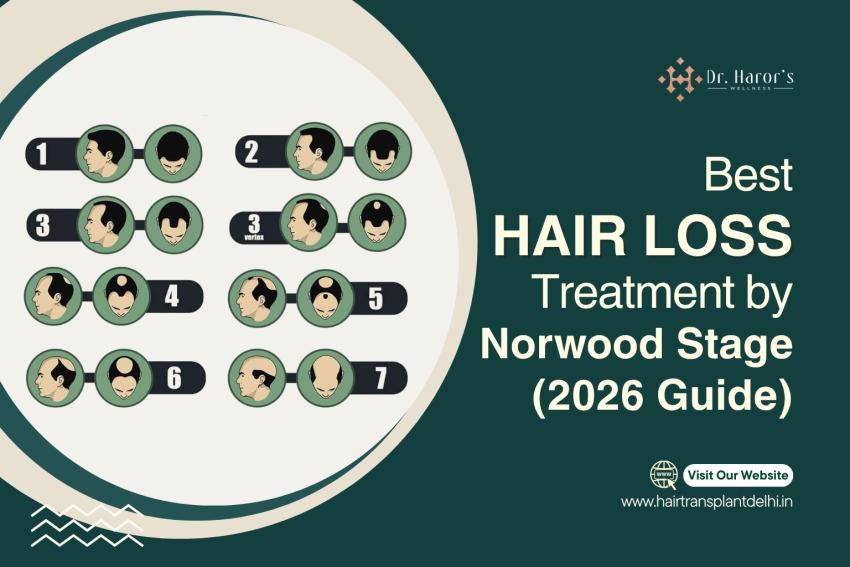
The Norwood scale is a seven-point classification used to track male pattern hair loss, starting at Norwood 1 (barely noticeable) and running through to Norwood 7 (near-complete baldness at the crown). It's become the backbone of hair loss treatment in Delhi simply because the right approach at stage 2 would be completely wrong for someone at stage 6.
A man at Norwood 2, for instance, might only need PRP or GFC sessions. Someone at Norwood 6 is looking at an entirely different conversation — one that almost always involves surgery.
Treatment by Norwood Stage
Norwood 1–2: Catch It Early
At this point, the signs are subtle — a touch of temple recession, some early thinning, maybe a hairline that's crept back just slightly. Nothing dramatic yet.
What usually helps:
Low-level laser therapy
Targeted PRP and GFC sessions in the affected areas
The whole point at Norwood 1–2 is prevention, not restoration. Surgery isn't on the table here, and most surgeons won't recommend it — there simply isn't enough hair loss to justify it.
Norwood Stage 3: When It Becomes Noticeable
By stage 3, the hairline has usually deepened into a clearer M, V, or U pattern, and crown thinning starts becoming visible to others, not just to you.
What usually helps: Regenerative therapy is still worth trying to protect the hair that remains. But if the hairline has receded significantly and there's a healthy donor area to work with, this is often the point where surgeons start discussing a hair transplant to rebuild the frontal hairline and improve facial framing.
Norwood Stage 4: Advanced Hairline or Crown Loss
Stage 4 is where the loss becomes harder to ignore — a clearly receding hairline paired with visible crown thinning or bald patches.
What usually helps: Most hair transplant surgeons recommend a transplant at this point, typically FUE (Follicular Unit Extraction) or DHI (Direct Hair Implantation), to rebuild both the hairline and the crown. The exact graft count depends on how the baldness is distributed, how much coverage you want, and how strong your donor area is.
Norwood Stage 5: Extensive Hair Loss
Here, the frontal and crown balding areas start closing in on each other, and the strip of hair separating them thins out considerably, cutting down on natural coverage.
What usually helps: A transplant, done with a lot more precision this time. The goal is to make sure the newly placed grafts blend into the surrounding hair rather than sitting there looking obviously "added."
Norwood Stage 6: Severe Baldness
At stage 6, the frontal, mid-scalp, and crown regions have largely merged into one bald area, with hair remaining mostly along the sides and back.
What usually helps: A hair transplant remains the go-to option, but it demands a much more careful evaluation of donor density, scalp condition, and the sheer size of the area that needs covering.
Norwood Stage 7: The Most Advanced Stage
This is as severe as male pattern baldness gets — just a narrow band of hair left around the sides and back, with the crown completely bald.
What usually helps: A standard transplant often can't supply enough grafts here, since the donor area itself is limited. Surgeons sometimes turn to body hair transplantation instead, pulling follicles from the beard, chest, or legs and combining them with scalp donor hair to achieve reasonable coverage.
How Many Grafts Does Each Stage Actually Need?
This is probably the single most common question surgeons hear during hair loss treatment in Delhi consultations, mostly because graft count is what drives the final cost. Here's a rough breakdown:
Norwood Stage
Estimated Grafts
What's Typically Going On
Stage 1
0–1,000
Very mild loss, usually manageable with PRP/GFC alone
Stage 2
1,000–1,500
Early hairline recession, grafts used mainly for touch-ups
Stage 3
~2,000
Clear hairline recession needing a transplant for real coverage
Stage 3 (Vertex)
2,000–2,500
Recession plus early vertex thinning
Stage 4
3,000–3,500
Larger bald patches requiring more substantial restoration
Stage 5
3,500–4,500
Thinning bridge between frontal and crown balding zones
Stage 6
4,500–6,000
Requires a strong donor area to rebuild a natural hairline
Stage 7
7,000+
Sparse donor hair, often needs body hair transplantation
What Else Affects Your Graft Count?
Your Norwood stage gives a starting estimate, but it's rarely the whole picture. A few other things move the number up or down:
Size of the balding area — bigger areas simply need more grafts for even density.
Donor hair density — a thicker, healthier donor zone at the back and sides means more grafts can safely be harvested.
Hair texture — curly hair tends to cover more visually per graft than straight hair does, so the numbers can differ between two people at the same stage.
Desired density — if you're chasing a thick, high-density look, you're likely looking at 50–60+ grafts per square centimeter, which adds up fast.
Why More Grafts Isn't Always the Better Choice
There's a common assumption that piling on more grafts guarantees a fuller, more natural result. In practice, over-harvesting the donor area can leave the sides looking noticeably thinner, and it eats into the reserve you might need for a future procedure. A good surgeon aims for the number that achieves the look you want — not the maximum the donor area can technically supply.
How Surgeons Actually Estimate Your Graft Needs
Most experienced surgeons follow a fairly consistent process:
Stage the hair loss accurately using the Norwood scale.
Assess donor hair health and density (typically 60–100 follicular units per cm²).
Measure the exact size of the balding area.
Design a hairline that suits your age, face shape, and goals.
Propose a graft range that balances donor supply with your desired outcome.
Final Thoughts
Norwood staging, donor supply, baldness pattern, and personal expectations — all of these factor into a hair transplant plan, and no online guide can substitute for an in-person evaluation. Graft counts here are a starting point, not a promise.
If you're still weighing your options for hair loss treatment in Delhi, it's worth booking a consultation with Dr. Haror's Wellness. Their surgeons have a strong track record with transplant procedures across every Norwood stage, and every session is carried out in a sterile, carefully controlled environment so you get results without cutting corners on safety.