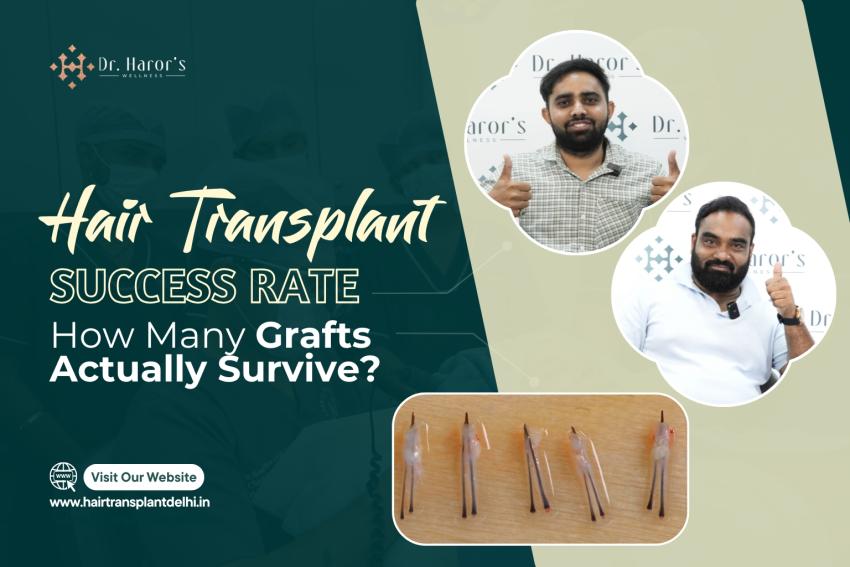
If you're thinking about getting a hair transplant, chances are you've already typed some version of this into Google: "What is the actual hair transplant success rate?" It's the first question almost every patient asks, and for good reason — you're not just paying for a procedure, you're investing in a result you'll be looking at in the mirror every day.
Here's the honest answer: there's no single fixed number. The hair transplant success rate depends on a mix of things — the technique used, how skilled the surgeon is, the quality of your donor hair, and how well you follow post-op care. But there are solid, well-documented ranges you can rely on when setting realistic expectations, and that's exactly what this guide breaks down.
What Does "Hair Transplant Success Rate" Actually Mean?
In plain terms, the hair transplant success rate is the percentage of transplanted grafts that survive, reconnect to a blood supply, and go on to grow healthy hair.
Not every graft that's implanted will take root — that's normal and expected. What matters is the proportion that does. With modern methods like FUE (Follicular Unit Extraction) and DHI (Direct Hair Implantation), skilled surgeons routinely report a hair transplant success rate of 90–95%, and sometimes higher.
What Actually Affects the Hair Transplant Success Rate?
A handful of factors determine whether you land at the low end of that 90–95% range or the high end.
1. The Surgeon's Skill and Experience
This is arguably the single biggest variable. Grafts are living tissue, and they're vulnerable the moment they're removed from the scalp. A surgeon who extracts, handles, and implants them quickly and carefully — without excessive handling or drying out — preserves far more of them than one who rushes or lacks technique. Experience really does show up in the numbers here.
2. The Technique Used
Not all hair transplant methods are created equal:
FUT (Follicular Unit Transplantation): The older, strip-based method. A strip of scalp tissue is removed, and follicles are separated from it under a microscope. It works, but grafts spend more time outside the body, which can lower survival rates compared to newer techniques.
FUE (Follicular Unit Extraction): Individual follicles are extracted one at a time using fine micro-punch tools, minimizing the time grafts spend outside the body and generally improving survival.
DHI (Direct Hair Implantation): A more refined version of FUE where follicles are implanted immediately using a specialized pen-like tool, cutting down "outside the body" time even further and allowing more precise placement.
Generally speaking, DHI and modern FUE techniques tend to produce a higher hair transplant success rate than traditional FUT.
3. Blood Supply to the Recipient Area
Once a graft is placed, it needs to form a new blood supply to survive long-term. This is where the days and weeks after surgery matter just as much as the surgery itself. Good outcomes usually come down to:
Taking prescribed medications as directed
Following the clinic's guidance on when and how to wash your hair for the first time
Attending follow-up appointments so any issues get caught early
4. Your Overall Health
Your body's ability to heal plays a real role too. Things that can lower graft survival include:
Smoking
Uncontrolled diabetes
Poor nutrition
Chronic stress
Autoimmune conditions
Certain medications
If any of these apply to you, it's worth discussing them openly with your surgeon before the procedure — most can be managed or accounted for with the right planning.
Quick Answers (FAQ)
What is a good hair transplant success rate?
Anything in the 90–95% range is considered a strong, realistic outcome with modern techniques like FUE or DHI, performed by an experienced surgeon.
Do all transplanted grafts survive?
No — losing a small percentage of grafts is completely normal, even in successful procedures. What matters is staying within the expected survival range.
Can I improve my own hair transplant success rate?
Yes. Choosing an experienced surgeon, picking the right technique for your case, and strictly following post-op instructions are the three biggest levers you actually control.
How long does it take to see if a graft "took"?
Most patients see initial shedding (normal) within the first few weeks, with new growth typically becoming visible around months 3–4, and fuller results by month 8–12.
Conclusion
The hair transplant success rate is genuinely encouraging when the procedure is done right — 90% or higher is achievable with modern techniques, an experienced surgical team, and good aftercare on your end. A small amount of graft loss is normal and expected, so don't let it worry you if you're told to expect it. What matters most is choosing a clinic that combines skilled hands, proven technique, and a clean, safety-first environment.
If you're exploring your options, Dr. Haror's Wellness is worth a look — their team specializes in advanced hair transplant techniques designed to maximize graft survival, all performed in a sterile, safety-focused setting aimed at delivering natural, long-lasting results.