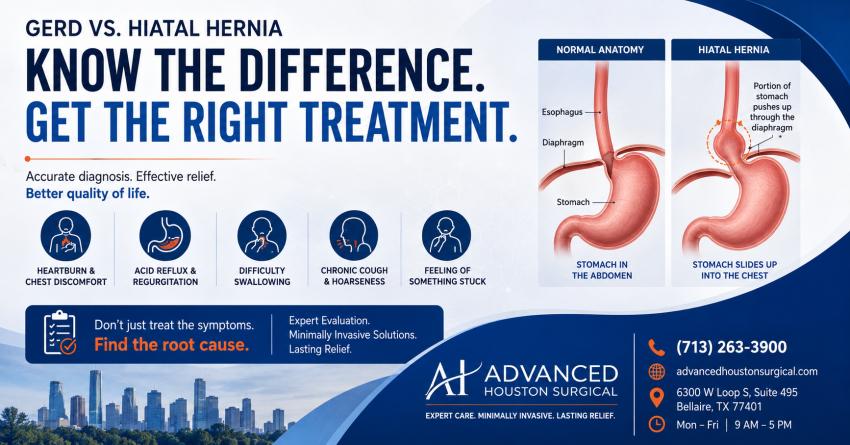
If you have been dealing with chronic heartburn, chest discomfort, or that burning feeling after meals, you have probably heard both terms thrown around — GERD and hiatal hernia. Many people assume they are the same thing. They are not. And getting the distinction wrong can mean years of treating the wrong problem.
This guide breaks it down in plain terms, so you can walk into your next doctor's appointment with the right questions.
What Is GERD?
GERD stands for gastroesophageal reflux disease. It happens when stomach acid flows back up into the esophagus repeatedly over time. Almost everyone experiences acid reflux occasionally — after a heavy meal or a late-night snack. GERD is different. It is persistent, and it causes real damage.
Common symptoms include:
- Burning in the chest or throat, especially after eating
- Regurgitation of food or sour liquid
- Difficulty swallowing
- Chronic cough or hoarseness
- The feeling that something is stuck in your throat
GERD is largely a functional problem. The valve between your esophagus and stomach, called the lower esophageal sphincter, stops working the way it should. Instead of staying closed after food passes through, it relaxes at the wrong time and lets acid come back up.
What Is a Hiatal Hernia?
A hiatal hernia is a structural problem. It happens when part of the stomach pushes up through the diaphragm into the chest cavity. The diaphragm has a small opening called the hiatus, which is where the esophagus passes through. When that opening becomes too wide or weakened, the stomach can slip through it.
Here is where it gets confusing: a hiatal hernia often causes acid reflux. So people end up with GERD symptoms because of a hernia they did not even know they had.
There are two main types. A sliding hiatal hernia is the most common, where the stomach and lower esophagus slide in and out of the chest. A paraesophageal hernia is more serious, where part of the stomach moves next to the esophagus and stays there, which can lead to complications like strangulation of the stomach tissue.
So Which One Do You Have?
This is where most patients get stuck. The symptoms overlap significantly. Heartburn, chest pain, difficulty swallowing, and belching are common to both. You cannot tell the difference just by how you feel.
Diagnosis typically involves one or more of the following:
Upper endoscopy — A camera is passed down the throat to look at the esophagus and stomach lining. This can confirm acid damage from GERD and also spot a hernia.
Barium swallow X-ray — You swallow a contrast liquid and X-rays are taken to see how your digestive tract looks. Hiatal hernias often show up clearly on this test.
Esophageal manometry — This test measures the pressure in your esophagus and checks how well the lower sphincter is functioning.
pH monitoring — A small device tracks acid levels in your esophagus over 24 hours to confirm whether reflux is actually occurring.
Without these tests, even experienced doctors cannot reliably tell the two apart from symptoms alone.
When Does GERD Need Surgery?
Most GERD patients start with lifestyle changes and medications like proton pump inhibitors. These work for a lot of people. But they do not fix the underlying problem. They just reduce the acid that comes back up.
Surgery becomes the right conversation when:
- Medications are not providing enough relief
- You are dependent on daily medication and do not want to stay on it long term
- You are developing complications like esophagitis or Barrett's esophagus
- Your quality of life is consistently affected despite treatment
The most common surgical option for GERD is Laparoscopic Nissen Fundoplication. The surgeon wraps the upper part of the stomach around the lower esophagus to reinforce the valve. It is done through small incisions, recovery is relatively quick, and the results for properly selected patients are very good.
When Does a Hiatal Hernia Need Surgery?
Small hiatal hernias with minimal symptoms often do not need surgery. Medications and dietary changes can manage the reflux they cause. But surgery becomes necessary when:
- The hernia is large and causing significant symptoms
- There is chest pain, shortness of breath, or trouble swallowing
- The hernia is a paraesophageal type, which carries risk of serious complications
- Medications are not working because the structural problem is not being addressed
Laparoscopic Hiatal Hernia Repair involves moving the stomach back into the abdomen and tightening the diaphragm opening. For paraesophageal hernias, the surgery is more involved, but still done minimally invasively in most cases.
It is also worth knowing that when a patient has both GERD and a hiatal hernia, surgeons often address both in the same procedure.
The Mistake Patients Make Most Often
They treat the symptoms for years without ever getting a proper structural evaluation. They take acid-reducing medications, adjust their diet, sleep at an angle, and still feel terrible. The reason is often that a hernia is sitting there, untreated, because no one ordered the right imaging.
If you have been managing reflux symptoms for more than six months without significant improvement, or if your symptoms are getting worse despite medication, it is worth asking your doctor specifically about a hiatal hernia evaluation.
Questions to Ask Your Surgeon
Before deciding on any procedure, here are questions worth bringing to your consultation:
- Do I have a hiatal hernia, and if so, what type?
- Is my GERD caused by a structural issue or a functional one?
- Would surgery fix the root cause, or just the symptoms?
- What are the risks of waiting versus operating now?
- Will you address both the hernia and the reflux in one surgery?
A good surgeon will walk you through all of this and help you understand exactly what is happening in your body before recommending any next step.
Getting the Right Evaluation in Houston
At Advanced Houston Surgical, Dr. Rizwan Chaudhry evaluates patients with chronic GERD and suspected hiatal hernias using a thorough diagnostic process before any surgical recommendation is made. His training at the Mayo Clinic and Cleveland Clinic, combined with his focus on minimally invasive techniques, means patients get an accurate diagnosis and a clear path forward.
If you have been living with persistent reflux or have been told you might have a hiatal hernia, a proper evaluation can make a significant difference.
Call (713) 263-3900 or visit advancedhoustonsurgical.com to schedule a consultation.