Why FEMA Mistakes Can Hurt Your Startup Growth
Many startups in cities like Bengaluru, Mumbai, Hyderabad, and Delhi raise funds from foreign investors. It feels like a big win. But the moment money hits your bank account, FEMA Compliance begins.
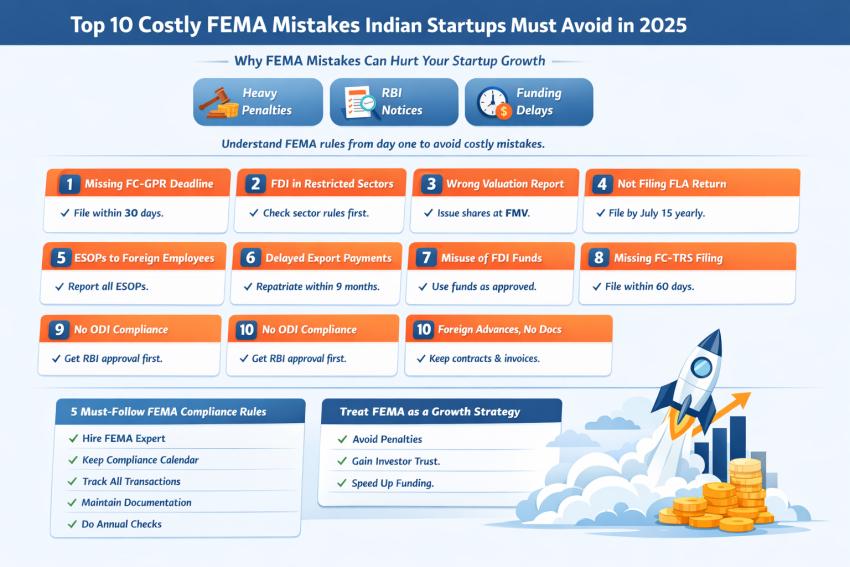
If you miss key rules, you may face:
- Heavy penalties
- RBI notices
- Delays in future funding
Even small mistakes can cost lakhs or crores. That’s why founders must understand FEMA basics from day one.
Mistake #1: Missing the 30-Day FC-GPR Filing Deadline
After issuing shares to a foreign investor, you must file FC-GPR (Foreign Currency — Gross Provisional Return) within 30 days.
Why this happens
Many founders think the process ends once funds are received.
What it costs
Late filing can lead to penalties from ₹50,000 to ₹10 lakh or more.
How to fix it
- Inform your CA or consultant before funds arrive
- Prepare documents in advance
- Track the 30-day deadline carefully
Mistake #2: Accepting FDI in Restricted Sectors
Not all sectors allow foreign investment freely.
Common risk areas
- Gaming and betting platforms
- Real estate-linked models
- Financial structures like chit funds
What it costs
- Full refund of investment
- Penalty up to 3 times the amount
How to avoid
- Check FDI rules before raising funds
- Take a legal opinion early
Mistake #3: Wrong or Missing Valuation Report
You must issue shares at fair market value (FMV).
Common mistakes
- No valuation report
- Outdated valuation
- Issuing shares below FMV
Impact
You may face penalties equal to the pricing difference.
Fix
- Get a valuation from a qualified CA or merchant banker
- Use proper methods like DCF
Mistake #4: Not Filing FLA Return
FLA Return must be filed every year by July 15.
Who must file
Any company with foreign investment or overseas assets.
Penalty
₹7,500 per day of delay.
Solution
- Set yearly reminders
- Assign responsibility to the finance team
Mistake #5: ESOPs to Foreign Employees Without Compliance
Giving ESOPs to foreign employees is treated as foreign investment.
Problem
HR teams often miss FEMA rules.
Impact
- Unreported FDI
- Penalties up to 3x value
Fix
- Involve the finance team in ESOP planning
- Report all such transactions
Mistake #6: Delay in Export Payment Realisation
Export income must come back to India within 9 months.
Who is affected
- IT companies
- SaaS startups
- Export businesses
Penalty
Can go up to the full unpaid amount.
Fix
- Track receivables weekly
- Follow up with clients regularly
Mistake #7: Wrong Use of FDI Funds
FDI money must be used only for approved business activities.
Common misuse
- Repaying promoter loans
- Investing in mutual funds
- Paying dividends early
Penalty
Up to 3 times the amount of misuse.
Fix
- Use funds strictly as per the BUSINESS PLAN
- Maintain proper records
Mistake #8: Missing FC-TRS Filing
When shares are transferred between residents and non-residents, FC-TRS must be filed.
Common cases
- Secondary share sale
- ESOP buybacks
Penalty
₹50,000 to ₹5 lakh.
Fix
- Track all share transfers
- File within 60 days
Mistake #9: Setting Up a Foreign Entity Without ODI Compliance
Many startups open companies in Singapore, the UAE, or the US.
Mistake
Not filing ODI or getting RBI approval.
Impact
- The entity becomes non-compliant
- Funding delays
Fix
- Complete ODI filing before investment
- Maintain RBI approvals
Mistake #10: Taking Foreign Advance Without Documents
Advance payments from foreign clients need proper documentation.
Common issue
- Missing invoices
- No contracts
- Poor banking records
Impact
Can be treated as a FEMA violation
Fix
- Keep contracts and invoices ready
- Maintain bank proof for all transactions
5 Must-Follow FEMA Compliance Rules for Startups
To stay safe, every startup should follow these basics:
✔ Hire a FEMA expert early
✔ Maintain a compliance calendar
✔ Track all cross-border transactions
✔ Keep proper documentation
✔ Do yearly compliance checks
Conclusion: Treat FEMA as a Growth Strategy
FEMA compliance is not just a legal rule. It protects your startup’s future.
If you follow the right steps:
- You avoid penalties
- You gain investor trust
- You close funding faster
Ignoring FEMA can block your growth. Managing it well can help you scale globally.
https://www.chhotacfo.com/blog/top-10-fema-mistakes-indian-startups-2025/