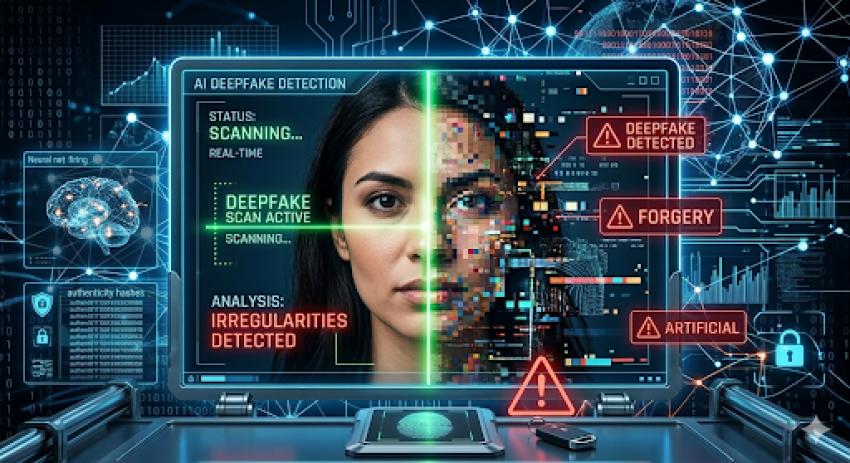
The digital world has undergone extraordinary changes brought about by artificial intelligence. AI technologies are changing industries and communication patterns, starting with enhancing automation and making more sophisticated data analysis possible. But in line with these innovations, there are also other risks that have cropped in. The emergence of deepfakes, which are very realistic images, videos, or audio recordings created with the help of artificial intelligence is one of the most disturbing trends.
Deepfakes have become increasingly sophisticated, making it difficult for people to distinguish between authentic and manipulated content. As a result, deepfake detection has become an essential part of cybersecurity and digital media protection. Detection tools and technologies are now being developed to analyze digital content and identify signs of manipulation.
This paper discusses the significance of deepfake detectors, their functionality, and their increased use in safeguarding digital media and cybersecurity systems.
Getting to Know Deepfakes and Their Effect
Deepfake Technology are synthetic media that have been developed through machine learning technology, especially with deep learning algorithms. These systems process vast quantities of images, videos or voice recordings in order to figure out patterns that are linked to the appearance or voice of a particular person. After training, the AI model can produce new content that seems to involve that person yet the content is completely artificial.
The reason why Deepfake Detection is Relevant to Cybersecurity
The risks associated with cybersecurity are ever changing since the attackers have devised new methods of overcoming the security systems. Deepfakes are a novel type of threat that is based on deception as opposed to conventional hacking techniques.
A significant area of concern is that in social engineering attacks, the use of deepfake videos or audio recordings is used. In such instances, the attackers pose as executives, employees or people that are trusted to influence other people to transfer money or disclose sensitive information. An image of a fictitious video call or voice message can seem as a real one to fool victims.
What Is a Deepfake Detection Tool?
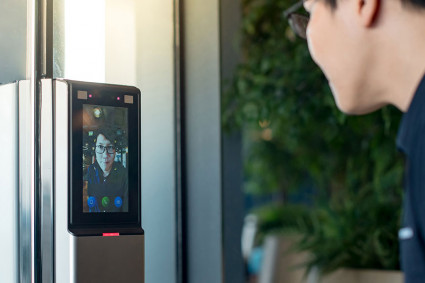
A deepfake detector is an application that analyses images, videos or audio files and decides whether they have been manipulated or created with the help of artificial intelligence. These tools are based on machine learning models that are highly trained to notice the slightest differences in genuine and fake media. Unlike simple editing detection software, modern deepfake detection software can analyze a wide range of features within digital content. This includes facial recognition, lighting patterns, voice characteristics, and pixel level details. By examining these elements, detection systems can identify inconsistencies that may indicate manipulation.
Detecting online deepfakes is also getting popular. These web based applications would enable users to post media files and examine on these files the existence of deepfake attributes. These tools might be especially helpful to journalists, investigators, and researchers who have to check the authenticity of digital information.
Deepfake Detection as the Digital Media Protection
Effort to determine the authenticity of digital content is gaining prominence in most sectors. Deepfake detection technology today finds applications in different fields to ensure that information integrity is preserved and that there is trust in online communication.
In journalism, one would find that reporters and editors should ensure that videos and images utilized in the coverage of the news are genuine. Online deepfake detectors can assist media organizations to analyze suspicious posts prior to publishing them, and this can help minimize the likelihood of informing misinformation.
Detection technology is also based on social media platforms to detect the manipulated content. Having billions of users, who post media each day, automatic detection services assist in identifying suspicious videos or pictures which can be against the policies of this platform.
Digital media can be a very important piece of evidence in a legal and forensic investigation. Deepfake detector software can help investigators to establish that a video or audio recording has been altered. This is especially vital where it comes to matters of fraud, cybercrime, or harassment.
Deepfake detection technology is also being investigated by educational institutions and research organizations to research the proliferation of misinformation and invent new verification methods.
Deepfake Detection in the Future
As the deepfake technology advances, scholars are working on new lines to enhance detection strategies. The merging of artificial intelligence with online authentication is one of the promising ones.
Indicatively, other scientists are creating mechanisms that incorporate digital signatures or watermarks in genuine media during their production. Later these markers would be checked to ensure that the content is not modified.
Another field that is being experimented in digital media verification is blockchain technology. The media files may then be easily verified as authentic by keeping a record of their source and update history in an uncorrupted ledger.
The aspect of artificial intelligence will also contribute significantly to the detection systems in future. Machine learning models which are more sophisticated can detect more and more subtle patterns in digital content, better detecting advanced deepfakes.
There will be a need to have collaboration between technology firms, researchers, governments and media houses in order to come up with effective measures in addressing the synthetic media threats.
Conclusion
Deepfakes have also become a new challenge to the digital world as it has become easier and simpler to produce highly convincing manipulated media. Such artificial videos, images, and audio files have the potential to disseminate false information, tarnish the reputations and pose security threats.
The tools to detect Deepfakes offer a valuable defense mechanism to such threats. These systems can detect the manipulation of digital content and preserve the integrity of online information by examining digital content to determine its integrity.
Cybersecurity personnel and journalists as well as investigators and social media providers are among many sectors that have embraced deepfake detection technology in verifying digital media. Despite these challenges, there is increased accuracy and effectiveness of the detection systems that is being enhanced by another wave of research and innovation.