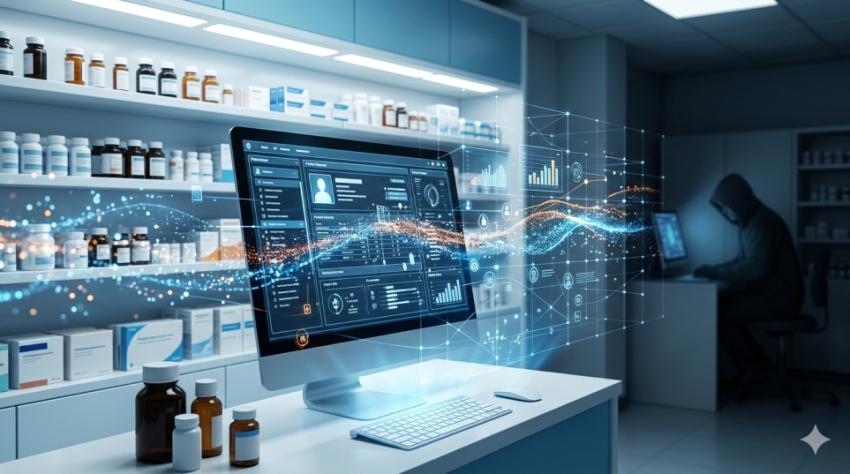
Many people think of hospitals or doctor’s offices when they think of healthcare data. But a data-rich healthcare system that is also often ignored is the pharmacy network. Behind every prescription filled is an extensive network of systems that capture, store, and share patient information.
Pharmacies, specifically those that serve long-term care facilities, do much more than just fill prescriptions. They also maintain patient histories, treatment plans, insurance information, and billing information for their clients in multiple interconnected technology-based environments. These environments hold large amounts of centralized data that provide valuable support to healthcare delivery, but are also sensitive to security breaches.
The consequences of security breaches in pharmacy networks can be significant since these systems often contain so many different types of data. The IPPC data breach is a perfect example of how pharmacy networks can be a high point of risk for data breaches due to the way that these systems capture so much different information.
Because they include information on prescriptions, dosages, treatment timelines, and provider interactions, one of the main characteristics of pharmacy data systems is their depth of detail. When personal identifiers and financial data are added to pharmacy data, an individual’s health and identity can be fully characterized.
Pharmacies have an essential function in long-term care. For example, patients who reside in a long-term care setting typically receive treatment for extended periods of time, which means their patient information will be continuously created and stored, thus increasing both the level of value of the data and the level of potential risk associated with unauthorized access.
The recent IPPC data breach demonstrates how quickly data can be accessed following the successful compromise of an information system. Even a very short period of unauthorized access may enable an attacker to copy or view large volumes of data/information. Because these systems are designed specifically to be efficient and to provide fast access to information/data, they also enable both healthcare providers and threat actors to rapidly move information/data.
What makes pharmacy-related data breaches particularly alarming is the natural co-mingling of both medical and financial data. The information that can be obtained from a pharmacy's system may include prescription drug histories, health insurance account numbers, and payment histories; thus providing sufficient foundation for various types of fraud (such as identity theft and healthcare fraud). As a result, the layered nature of this data creates long-term consequences for the individuals affected by a pharmacy-related data breach.
Securing pharmacy networks is a multifaceted endeavor for organizations. A multifaceted approach includes monitoring access to sensitive systems, encrypting data, and ensuring that third-party integrations adhere to strict security standards. Regular audits and timely identification of unusual behaviours are also necessary to limit possible exposure.
Individual users should be aware of the fact that their healthcare data does not stop with their primary provider, enabling them to make better decisions about how to protect themselves. By reviewing their medical and insurance statements regularly, remaining vigilant for clues that someone may have committed identity theft, and following common precautions after an incident of theft, patients can reduce their risk.
Pharmacy networks have an ongoing role in the patient care landscape; therefore, as the healthcare system continues to change, pharmacy networks will continue to play a crucial role in patient care. While the data breach at the IPPC is no longer fresh in anyone's mind, it remains a reminder that amongst the most sensitive kinds of data are the very kinds of information that patients do not think about when they come into contact with healthcare providers - making the need for data security as crucial now as it has ever been.
Securing pharmacy networks is a multifaceted endeavor for organizations. A multifaceted approach includes monitoring access to sensitive systems, encrypting data, and ensuring that third-party integrations adhere to strict security standards. Regular audits and timely identification of unusual behaviours are also necessary to limit possible exposure.
Individual users should be aware of the fact that their healthcare data does not stop with their primary provider, enabling them to make better decisions about how to protect themselves. By reviewing their medical and insurance statements regularly, remaining vigilant for clues that someone may have committed identity theft, and following common precautions after an incident of theft, patients can reduce their risk.
Pharmacy networks have an ongoing role in the patient care landscape; therefore, as the healthcare system continues to change, pharmacy networks will continue to play a crucial role in patient care. While the data breach at the IPPC is no longer fresh in anyone's mind, it remains a reminder that amongst the most sensitive kinds of data are the very kinds of information that patients do not think about when they come into contact with healthcare providers - making the need for data security as crucial now as it has ever been.