Introduction
India’s renewable energy sector has moved from ambition to execution in a relatively short time. Policy support has played a decisive role in this transformation. From early incentives to large scale regulatory frameworks, government action continues to guide investment, innovation, and adoption. As India aims to meet its climate commitments and energy security goals, policy direction remains the backbone of sectoral growth.
This article explores how policy measures are influencing renewable energy expansion across India, while examining the legal and regulatory environment shaping this progress.
Policy Driven Growth in Renewable Energy
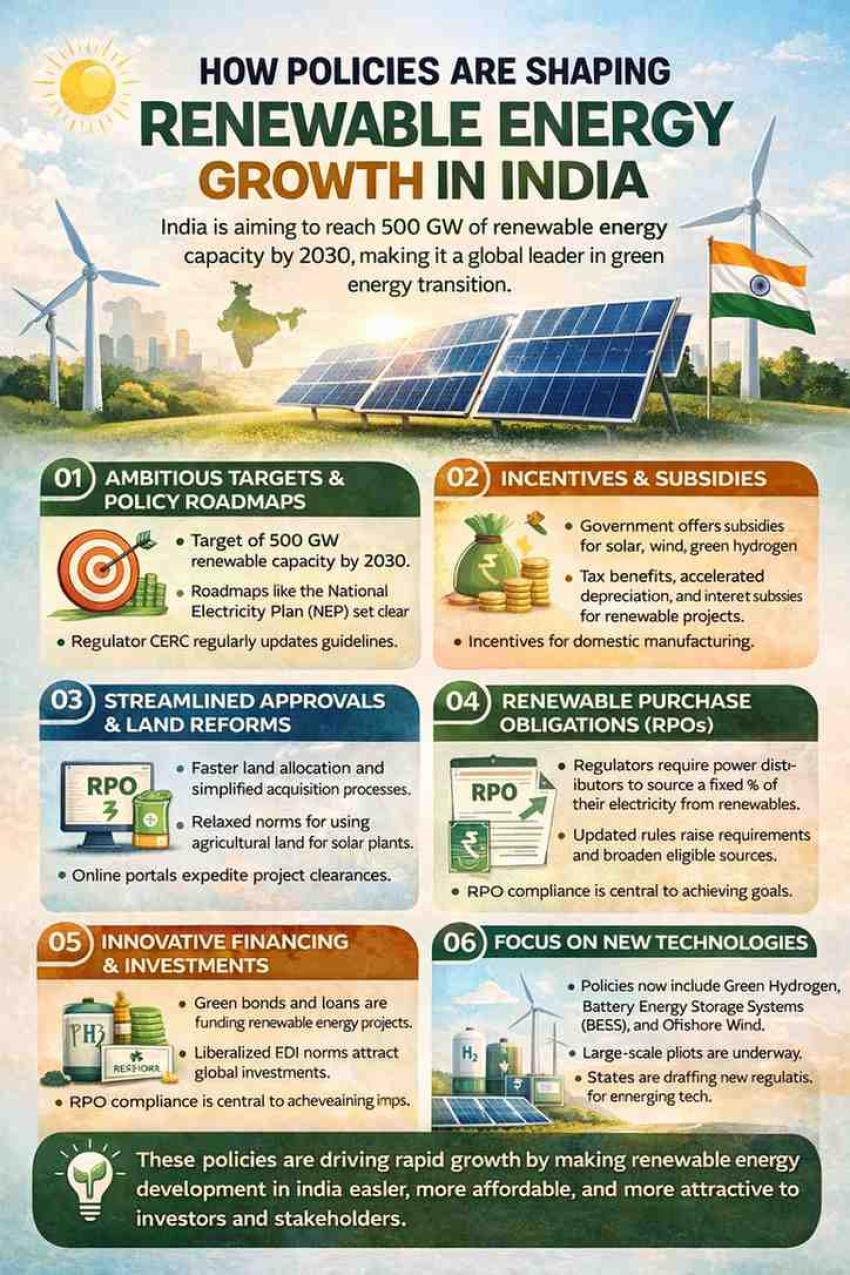
India’s renewable energy journey has been strongly influenced by targeted policy interventions. The government has introduced schemes, fiscal incentives, and regulatory reforms to encourage both domestic and foreign investment.
Key initiatives such as the National Solar Mission and wind energy policies have created a favourable ecosystem. These frameworks provide clarity for developers and reduce risks associated with long term investments. Clear policy direction has also improved investor confidence, leading to increased participation from private players.
Moreover, renewable purchase obligations have compelled distribution companies and large consumers to procure a certain percentage of power from renewable sources. This has created a steady demand pipeline, which in turn drives project development.
Regulatory Framework and Legal Certainty
A stable regulatory framework is essential for sustained growth. India has made significant progress in developing laws and regulations governing renewable energy projects.
Electricity laws, tariff policies, and grid regulations ensure smoother integration of renewable energy into the national grid. Regulatory commissions at central and state levels play a crucial role in tariff determination, dispute resolution, and compliance monitoring.
Legal certainty helps reduce project delays and financial risks. Developers rely on well defined frameworks for land acquisition, environmental approvals, and power purchase agreements. However, evolving policies also require businesses to stay updated with legal developments.
Companies often seek expert guidance from a renewable energy law firm and lawyers India to navigate complex regulatory requirements and ensure compliance with changing norms.
Incentives and Financial Support Mechanisms
Financial incentives remain a key driver of renewable energy adoption in India. The government offers various subsidies, tax benefits, and viability gap funding to support project development.
Accelerated depreciation and tax holidays have historically attracted investors. More recently, production linked incentives have encouraged domestic manufacturing of solar modules and other equipment.
Green bonds and infrastructure investment trusts have also gained traction as alternative financing tools. These mechanisms provide access to capital while reducing the cost of funding for developers.
Such policy backed financial support has made renewable energy projects more competitive compared to conventional energy sources.
Focus on Domestic Manufacturing
Policy efforts are increasingly focused on reducing dependence on imports. The government has introduced measures to boost local manufacturing of solar panels, batteries, and other components.
Import duties on certain equipment aim to promote domestic production. At the same time, incentive schemes support the establishment of manufacturing units within India.
This shift not only strengthens the supply chain but also creates employment opportunities. It aligns with the broader objective of achieving self reliance in critical sectors
Grid Integration and Infrastructure Development
One of the major challenges in renewable energy growth is grid integration. Renewable sources such as solar and wind are intermittent in nature, which requires robust grid infrastructure.
Government policies have prioritised investment in transmission networks and energy storage solutions. Initiatives such as green energy corridors aim to facilitate the efficient evacuation of renewable power.
Smart grid technologies and battery storage systems are also being encouraged through policy support. These developments enhance grid stability and enable higher penetration of renewable energy.
State Level Policies and Their Impact
While central policies provide direction, state governments play an equally important role in implementation. Each state has its own renewable energy policies, which influence project development at the local level.
Variations in land acquisition processes, tariff structures, and approval timelines can impact project feasibility. Some states offer additional incentives, making them more attractive for investment.
However, inconsistencies across states can create challenges for developers operating in multiple regions. Harmonisation of policies remains an area where further progress is needed.
Businesses often collaborate with the best corporate law firm and lawyers in India to address multi state regulatory complexities and streamline their operations.
Environmental and Sustainability Considerations
Policies in the renewable energy sector are closely linked with environmental objectives. India’s commitment to reducing carbon emissions has driven the adoption of cleaner energy sources.
Environmental impact assessments and sustainability guidelines ensure that projects are developed responsibly. Policies also promote the use of eco friendly technologies and practices.
In addition, the government is encouraging innovations such as green hydrogen and offshore wind energy. These emerging areas are expected to play a significant role in the future energy mix.
Challenges in Policy Implementation
Despite strong policy support, certain challenges persist. Delays in approvals, land acquisition issues, and financial stress in distribution companies can hinder project execution.
Policy uncertainty at times, especially with retrospective changes, can affect investor confidence. Consistency and transparency in policy implementation are crucial for long term growth.
Another challenge lies in balancing rapid expansion with environmental and social considerations. Policymakers must ensure that development does not come at the cost of ecological balance.
Future Outlook
The future of renewable energy in India looks promising, driven by continued policy support and technological advancements. The government has set ambitious targets for renewable capacity, signalling strong commitment to clean energy.
Policies are expected to evolve further to address emerging challenges and opportunities. Areas such as energy storage, electric mobility, and decentralised energy systems will likely receive increased attention.
Collaboration between government, industry, and legal experts will be essential in shaping a resilient and sustainable energy ecosystem.
Conclusion
Policies have been instrumental in shaping the trajectory of renewable energy growth in India. From financial incentives to regulatory frameworks, each element plays a vital role in driving the sector forward.
A stable and transparent policy environment encourages investment, fosters innovation, and ensures sustainable development. While challenges remain, continued policy refinement and effective implementation can unlock the full potential of renewable energy in India.
As the sector evolves, businesses must stay informed and adaptable. Legal and regulatory expertise will remain crucial in navigating this dynamic landscape and ensuring compliance with ever changing policies.