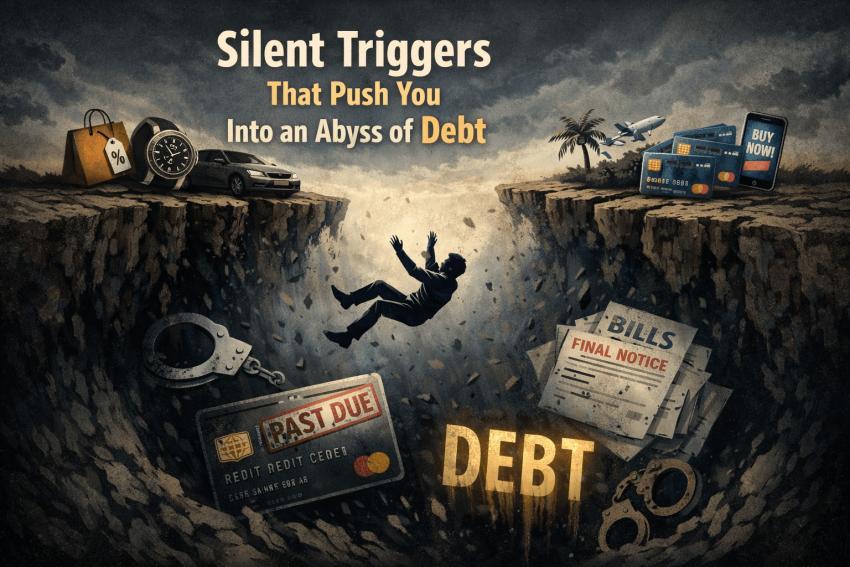
Overspending, a lack of budgeting, and not keeping tabs on expenses are some of the causes of racking up debt, but there are some silent triggers or habits that you never think could push you to the verge of debt. Burying your head in the sand will never help you deal with insurmountable debt. While it is vital to come up with a functional strategy, it is also crucial that you identify debt triggers.
Silent triggers that lead you to a constant debt spiral
There are some hidden triggers that might cause a debt pile-up.
1. Boredom
There is no doubt that your spending behaviour is driven by emotional and psychological aspects. For instance, if you are feeling bored or lonely, you might be tempted to shop online or go to a brick-and-mortar store. This is a common scenario to uplift your mood, but unfortunately, this is a practice of a short-term gain for a long-term loss.
If you are getting bored to death, you should consider other ways to uplift your mood. Maybe you hang out with friends or invite them over.
2. Impulse spending
Most of the people tend to spend money impulsively when they are stressed or depressed. Spending becomes a way to escape anxiety and stress, but unfortunately, it traps you into an ongoing spending cycle. Every time you are stressed, you tend to spend money to divert your mind. Soon, you find that you have overspent your money, and now you do not have enough money to spend on essential expenses.
You will have to break the cycle of stress-induced spending if you want to keep a tight rein on spending. This is crucial to avoid borrowing for recurring expenses, which causes a debt spiral.
3. Keep up with the Joneses
Those who spend too much time on social media exploring other people's lives often feel the pressure of living up to their standards. When people see others being on international trips every so often, they get so inspired by their lifestyle. They hope to live up to their standards and therefore do not mind spending beyond their means. In order to increase their living standards, they do not even hesitate to borrow money from direct lenders.
Unfortunately, this behaviour costs them a lot of money. Even if you borrow money from affordable lenders, interest payments quickly add up. If you want to be in control of your money, you should always avoid keeping up with the Joneses.
4. Neglecting credit score monitoring
You must have a good credit score if you want to qualify for low interest rates. A subprime credit report will cause high interest rates. Of course, the total cost of the debt will be quite high. Though there are the best direct lender for bad credit, their interest rates will still be high. Make sure that you keep an eye on your credit score.
5. Fear of missing out
When you come across great deals which last for a limited time period, you become tempted to buy it even though you do not need it. Just because a deal is helping you save money, there is no point in buying something you do not need.
You do not save money by doing so, but you rather block your money. Buying unnecessary or unwanted things only because they are cheap will reduce money for other essential purchases. As a result, you will be forced to borrow money. You will most likely end up with debt.
6. Trivial purchases
Most of the people spend on coffee, meals, snacks, and subscriptions. Just paying £5 for coffee every day does not sound too much. Similarly, takeaway and meals do not feel too expensive, but when you add up the total cost, it becomes thousands of pounds.
You might not realise, but these expenses quickly add up. It means you will not be left with enough money to pay for your essential expenses. As a result, you will be forced to take out a loan.
7. Using credit cards for daily expenses
Credit cards should be used for small purchases. This will help you build your credit rating. Since credit card bills are discharged in full on the due date, it is recommended that you make small purchases so you do not struggle with payments. Further, it also helps you keep the credit card limit less than 30%.
However, if you use your credit card for almost all purchases, you will end up maxing it out. This will destroy your credit score. In addition, you will struggle to pay off the balance in full. As a result, you will end up with credit card debt.
8. A lack of an emergency fund
It is vital to save money for emergencies. When you are caught unawares by financial emergencies, you must have some savings to fall back on. A lack of an emergency cushion means you will not be able to pay for emergencies from your pocket. As a result, you will have to borrow money. Unfortunately, borrowing is expensive. You will struggle with payments. Eventually, you will fall into debt.
9. Not addressing the issues before it is too late
Money talks are painful. Most of the people avoid them as they find them embarrassing. Sometimes, it is hard for people to turn over a new leaf. Well, if you are struggling with debt, you should identify the cause. Maybe you overspend, or maybe your wages cannot cope with all of your essential expenses. Maybe your budgeting is poor, or you fail to keep tabs on your expenses.
You should address these concerns immediately. Sometimes, people fall into debt as they are not managing their finances properly. Make sure that you and your partner are in agreement when it comes to achieving financial goals. If there are any money-related issues, ensure that you deal with them without further ado.
The bottom line
There are silent triggers that can lead you to a debt spiral. Some are psychological while others are behavioural. It is recommended that you identify these triggers so as to avoid yourself falling into debt.