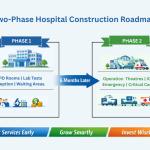
Phase 1 focuses on establishing essential services that require relatively lower investment but ensure continuous patient flow and trust-building. Facilities such as diagnostic lab tests, reception, pharmacy, and waiting areas are developed first. This enables the hospital to begin operations sooner, serve patients immediately, and build community credibility. Early functioning also helps management understand patient demand, operational challenges, and resource needs through real-time experience.
After gaining stability and revenue in the initial months, Phase 2 focuses on high-value, technology-driven, and critical care departments such as Operation Theatres, ICUs, Emergency Care, and Critical Care Units. These advanced facilities demand heavy capital investment, strict medical standards, and skilled professionals. By this stage, the hospital has not only earned trust but also achieved a steady financial base, making expansion more secure and sustainable.
This two-phase approach significantly reduces financial pressure, improves cash flow, lowers business risk, and accelerates hospital launch timelines. Instead of waiting years to open fully, healthcare services begin early, benefiting both the hospital and the community.
In today’s healthcare infrastructure landscape, two-phase hospital construction is more than a strategy—it’s a smart growth model. It supports strategic investment planning, steady revenue generation, sustainable expansion, and stronger healthcare delivery.
If planned correctly, this approach allows hospitals to start services early, grow smartly, and invest wisely—creating long-term success for healthcare providers and better care access for society.
Constructing a multi-speciality hospital is a massive financial and operational responsibility. Instead of completing the entire project at once, many healthcare developers today are choosing a two-phase hospital construction strategy to balance budget, speed, and long-term sustainability. This approach allows hospitals to start services early, generate revenue, and then expand confidently into advanced medical infrastructure.
Phase 1 focuses on building the essential but lower-investment departments such as OPD consultation rooms, diagnostic laboratories, reception, pharmacy, and waiting areas. These facilities ensure continuous patient flow and help the hospital begin operations much sooner. Early launch not only supports community healthcare needs but also helps the hospital gain trust, understand real-time patient demand, streamline operations, and strengthen financial stability.
Once patient flow, brand trust, and revenue systems are established, Phase 2 focuses on high-value, technology-driven facilities like Operation Theatres, Intensive Care Units (ICUs), Emergency Care, and Critical Care Units. These require major capital investment, advanced equipment, skilled manpower, and strict compliance standards. By this stage, the hospital is financially stronger, operationally experienced, and better prepared for large-scale expansion.
1. Decentralized Healthcare Units
Instead of concentrating large hospitals in single locations, mid-sized OPD centers, diagnostic hubs, and emergency care units should be built closer to communities. Here, medical clinic builders play a crucial role in setting up modular clinics and satellite centers that reduce travel time and distribute patient load.
2. Integrated Medical Zones
Cities need smart healthcare clusters combining hospitals, labs, pharmacies, and rehabilitation centers. These integrated zones improve coordination, reduce cost, and speed up treatment. Experienced hospital builders are now designing such clusters using modular layouts, enabling faster expansion and smoother construction of hospital facilities.
3. Technology-Enabled Infrastructure
Future-ready hospitals must integrate telemedicine rooms, IoT patient monitoring, modular ICUs, and digital diagnostic systems to support high patient traffic. This kind of planning is easier to implement in new hospital building designs, where modular architecture supports quick installation of tech-enabled spaces.