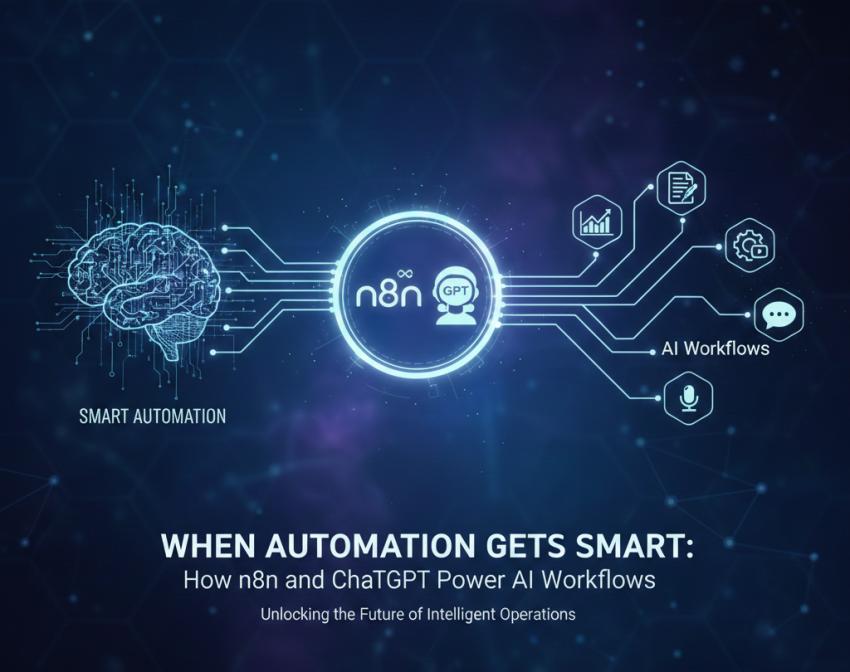
Fast-growing organizations all run into the same fundamental problems: too many manual processes and disconnected tools that start holding them back. Teams spend hours shuttling data between systems, answering the same questions over and over again, and overseeing processes that ought to be able to run themselves. The answer isn’t simply automation; it’s intelligent automation that adjusts, learn, and grows with the pace of business.
This is where n8n and ChatGPT meet to do something truly great: workflows that not only perform tasks, but contextually reason, decide, and generate uncannily human responses. For organizations that are ready to step away from robotic process automation, this combo unleashes speed, agility, and operational efficiency across the enterprise.
What Makes n8n Different
n8n is a free and open-source platform, which means anyone can use it to manage their work and life. Whereas closed systems trap users into predefined actions, with n8n, businesses are free to shape their workflows in the way that works best for them—outsourcing or licensing models be damned.
The platform integrates hundreds of tools, databases, APIs, and services with a visual interface that lets both technical and non-technical team members jump in and build workflows. It can handle everything from simple data transfers to complex, multi-step processes powered by AI agents—complete with conditional logic, error handling, and real-time triggers.
n8n is special because of its open nature and customizability. Teams have the choice to self-host the platform, manage their data, and develop custom nodes if they need deeper integrations. Factor also has this degree of control, which is great for any business that places a high priority on security and compliance (and budget-friendly long-term expandability).
How ChatGPT Transforms Workflows
ChatGPT opens up the world of natural language understanding to automation. It can digest unstructured inputs, produce contextual responses, condense information, extract meaning, and communicate in a way that feels personal and appropriate. Incorporated into workflows, ChatGPT makes static processes dynamic and reactive to change.
This is where the true value of ChatGPT emerges: as a reasoning layer within larger workflows, when it’s no longer just a chatbot. It doesn’t supersede human judgment; it simply improves our decision-making by sorting through data more quickly and surfacing the most relevant information.
Building Intelligent Workflows with n8n and ChatGPT
Combining n8n's automation capabilities with ChatGPT's language intelligence creates workflows that adapt in real time.
Step 1: Define the Workflow’s Purpose
Start by identifying where the most value comes from in the business with intelligent automation. They are mainly used for everyday tasks such as customer support, content creation, data analysis, lead generation, and process documentation. Well-defined goals prevent complexity & keep workflows aligned with core objectives.
Step 2: Plan How Everything Flows
Now it's time to map out exactly how your workflow will run.n8n's visual canvas makes this pretty straightforward. You can drag and drop different actions to create your flow. If you need the workflow to do different things based on the situation—like handling VIP customers differently than regular ones—you can split it into branches. Got a list of leads to process? Set it to loop through each one automatically.
Sometimes you'll want a real person to step in and make a call. Maybe before sending out a big batch of emails or approving a refund. You can add these checkpoints wherever they make sense.
Step 3: Integrate ChatGPT for Contextual Intelligence
You can also use n8n's HTTP Request or OpenAI nodes to connect ChatGPT at certain stages of the workflow. Provide context you have about the customer—past interactions, product information—, so responses feel more informed and targeted. Write structure prompts thoughtfully to keep on-brand and business-relevant quality outputs.
Step 4: Connect Data Sources and Destinations
n8n moves information between your different tools automatically. It can grab data from your CRM, databases, spreadsheets, or other software, send it to ChatGPT to analyze or create content, then deliver the results to Slack, email, project management apps, or back to where it came from. Everything happens on its own—no need to manually copy and paste between systems.
Step 5: Test, Validate, and Refine
Run your workflow with different types of information to see what works and what doesn't. Check if the responses sound right and make sense for your needs. Adjust your instructions, logic, and connections based on what you learn. Keep tweaking things as your business needs change.
Real-World Applications Across Industries
Customer Support Automation
Incoming support tickets initiate workflows that route questions by urgency, pull pertinent account details, and craft responses with ChatGPT—sending them through for review by an agent or dispatching directly. This restricts response times, which is also the exception to keep consistency and allow support teams to focus on complex cases.
Content Production at Scale
Marketing pros incorporate n8n to fetch data from analytics platforms, draft content briefs, build blog outlines, write social posts, and schedule distribution—all via a single workflow. ChatGPT takes care of the first draft; human editors do polish and strategize.
Lead Qualification and Outreach
Sales processes are automatically prioritized listeners through engagement logic, automate personal outreach messages and actions within CRMs to drive sales conversations. ChatGPT makes every message feel custom, elevating your reply rates without raising a finger.
Internal Knowledge Management
Workers pose queries over Slack or internal tools, emboldening workflows that comb through documentation, synthesize using ChatGPT, and spit out compressed answers in seconds. This saves time looking for data and eases the onboarding of new team members.
Why This Combination Works for Growing Companies
Speed Without Sacrificing Quality
Automation handles routine tasks immediately, while ChatGPT makes sure the quality stays good. Your team can accomplish more without cutting corners or letting the customer experience suffer.
Scalability Built In
As you scale, processes take on extra work without headcount. New processes, integrations, and features are added without disruption to existing systems.
Cost Efficiency Over Time
And while ChatGPT integration services do cost more upfront, the time and money saved by eliminating manual labor, speeding up execution times, and minimizing errors make for a clear return on investment. Move the day-to-day users away from the ongoing expense of countless SaaS tools by combining duplicate tasks and functionality into centralized workflows.
Flexibility for Unique Needs
Every business operates differently. n8n’s open structure and ChatGPT’s flexible thinking enable teams to design workflows matching their own distinct workflow, culture, and client expectations—sans template.
Considerations Before Building AI Workflows
Data Privacy and Security
Make sure that the workflows are treating sensitive data the way they should. Running n8n on your own server means you have complete control over your data; however, API integrations should conform to encryption and compliance guidelines. Periodically audit data storage policies and access permissions.
Prompt Engineering and Output Quality
ChatGPT is a reliance model, and so its prompts require a clear, well-structured format. Spend time perfecting how you pass context, frame instructions, and validate outputs. Bad prompts result in noise that is inconsistent, which undermines automation.
Human Oversight for Critical Decisions
You shouldn’t automate everything. Create approval stages in workflows, where business judgment, legal review, or customer sensitivity needs manual input. Autonomy is there to strengthen decisions, not provide an excuse for holding no one accountable.
Ongoing Maintenance and Updates
Workflows need regular review to stay aligned with changing business needs, new integrations, and platform updates. Set aside occasional audits, performance monitoring & team training to ensure that systems run smoothly.
The Future of Intelligent Automation
The move to AI-based workflows is about more than increased efficiency; it’s building digital spaces that are able to think for themselves, learn, and grow as the business does. As both n8n and ChatGPT develop further, that distinction between manual operations and intelligent systems will only grow with it. The companies that invest now in developing those capabilities stand to gain long-term advantages in speed, agility, and innovation.
For companies investing in vibe coding development, EVv charging app development, or AI copilot development, intelligent workflows form the backbone of being able to prototype quickly, integrate easily, and deploy at scale. These systems are not just supportive of growth — they are enabling of it.
With more businesses transitioning to automation-first models, the cost of custom software development in 2026 is an investment in smart systems over dumb instruments. “Once it’s clear how valuable your professional work can be, the question is not whether to automate,” said Ilya Sutskever, an A.I. researcher and an investor in OpenAI who wasn’t involved in its announcement.
Intelligent automation isn’t some far-off dream — it’s happening now, and the organizations that set themselves on an aggressive course will determine what “operational excellence” means in the year to come.