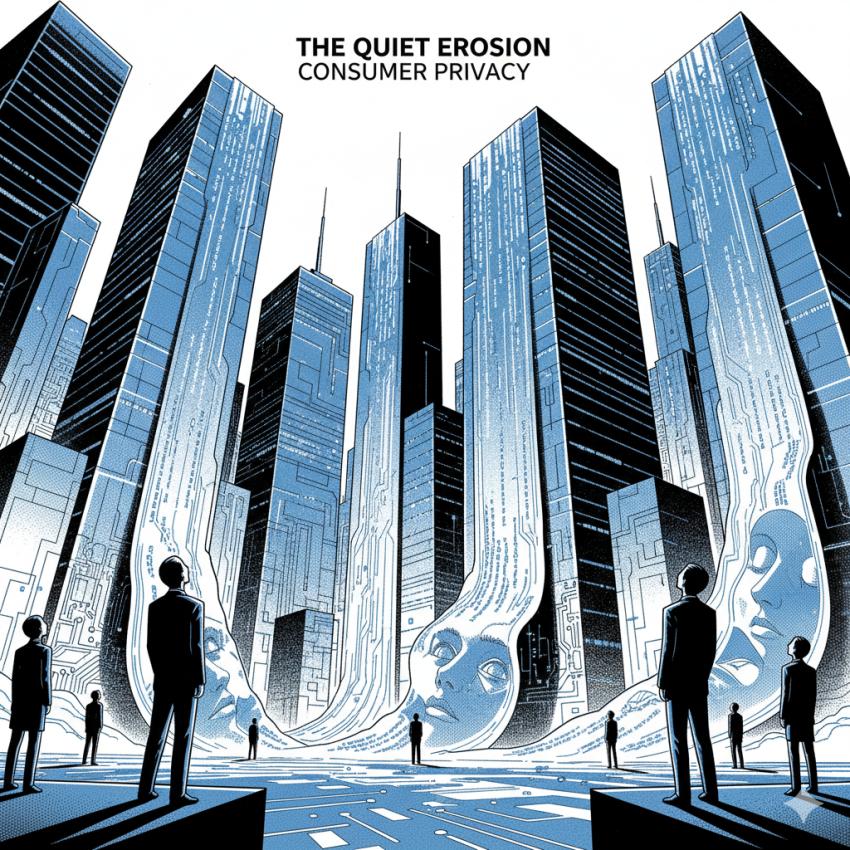
For many years, financial companies assured consumers that their data sits behind the most secure systems in the world. “Your information is safe with us,” was practically a mantra in the industry spoken in bank apps, credit-card portals, investment dashboards, and mortgage platforms. But an unquiet change is happening, and insiders fear that consumer privacy in financial services is entering a precarious new chapter. Recent incidents — including The Miller Financial Group Data Breach, which exposed highly sensitive personal information — signal that even mid-sized financial firms are struggling to maintain the protections they once promised.
This erosion is not occurring as a result of some sudden, shocking cyberattack, as we see reported in the news, but instead is occurring through the gradual build-up of backdoor data sharing, surveillance partnerships, and opaque AI systems analyzing personal behavior without oversight. Breaches like the Miller incident simply reveal the kinds of weaknesses that were already quietly spreading throughout the sector.
What’s worst? Most experts are not saying anything.
A New Economy of Financial Surveillance
The contemporary financial industry does not offer data protection; it sells it. Banks, credit unions, fintech apps, and third-party marketplaces now exist in a tightly knit data-exchange economy – one in which the finance life of the consumer is routinely packaged, traded, analyzed, and resold.
What was once simple banking metadata – deposits, withdrawals, spending categories – is the basis of a complex behavioral profile:
- Shopping intent
- Subscription behaviors
- Income volatility
- Risk tolerance
- Financial stress signals
- Possibility of default
- Probability of switching banks
Such details used to be highly private, and now they flow through algorithms and brokers like a commodity.
While regulatory frameworks such as GLBA and state privacy laws exist, the flow of data in real life has not yet matched such compliance structures, and institutions almost never explain the extent to which they trade or derive information from consumer behaviors.
The Hidden Danger: "Shadow Vendors"
More and more financial firms are relying on an increasing array of outside technology vendors— fraud detection tools, KYC/AML databases, account aggregation companies, cloud analytics, marketing platforms, authentication vendors, and digital onboarding tools.
Many of these vendors have access to raw or semi-raw consumer financial data.
Yet few consumers have heard of them.
These shadow vendors represent a structural vulnerability:
The weakest link in the privacy chain is no longer the bank, but rather the dozens of smaller partners orbiting the bank.
Regulators know this— but they seldom say so out loud. Experts in the industry know it— but many are careful about how they express it. Breach notifications often downplay these events by simply stating, "an unauthorized actor gained access to a third-party system".
Very rarely does the public know the true extent.
AI Speeds Up The Collapse
The financial services are moving with a staggering velocity to embrace AI technology, which is now used for:
• Scoring creditworthiness
• Predicting fraud
• Assessing transaction risk
• Suggesting financial products
• Identifying suspicious or questionable behaviors
• Modeling consumer intent
It requires enormous amounts of sensitive training data, as well as more inference power than traditional analyses of finance. These systems know much more than just what you bought today or the day your paycheck was deposited. They can infer struggles, transitions, and vulnerabilities in your life.
AI does not just process your financial life — it understands it, and often better than you do.
Nonetheless, the industry is still minimal on AI transparency, and oversight infrastructures are years delayed.
Consumers Are Quietly Losing Control
The most concerning trend is subtle: consumers no longer have meaningful control over how their financial data is collected, or how that data is used. Opt-out mechanisms are buried, incomplete, or confusing. Privacy notice policies are dozens of pages long and exist to check the legal box rather than educate consumers.
Worse, financial decisions that impact people's lives - the approval of loans, pricing for insurance, fraud flags, suspicious activity reports - increasingly rely on data the consumer never knowingly shared.
When the public learns about privacy failures, it's usually in the form of a breach or enforcement action. Privacy folks know the real crisis here is not episodic, it's structural.
What People Aren't Saying Out Loud
In private, financial insiders will worriedly admit:
- There is too much dependency on data - it is not going to unwind.
- AI-driven profiling will outpace regulations for at least a decade.
- Vendor ecosystems are too large to properly secure.
- Consumers have little visibility into (or leverage against) these systems.
- Even compliant organizations can inadvertently disclose sensitive data through analytics partners.
In private, a handful of analysts refer to the financial services sector as "one major incident away" from a similar reckoning as Cambridge Analytica tied to personal finance.
The Unavoidable Consequences
The financial services industry is very close to a tipping point. As surveillance technologies converge on consumer finance, the boundary between "security," "analytics," and "behavioral prediction" has become more indistinct.
Public trust will not collapse all at once. It will erode slowly, then it will be instant.
When that moment arrives, the entire financial services industry will have to answer a difficult question:
How much of consumers’ private financial lives did they expose — by design instead of negligence?
Until there are appropriate regulators that act, until institutions start rebuilding transparency, and until consumers start asking for transparency, the inevitable collapse of consumer privacy in financial services will hum along quietly.
And most commentators will continue to avoid the issue.